
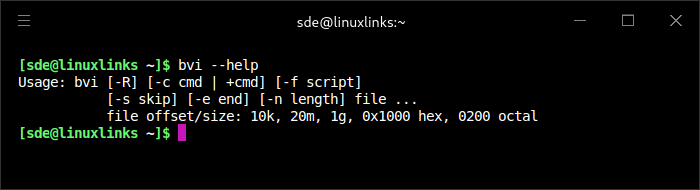
bvi, or Binary VIsual editor, is a screen-oriented editor for binary files whose command set is based on vi. Its display separates byte offsets, hexadecimal values and their ASCII representation, with a status line showing information about the current position.
The vi heritage extends beyond cursor movement. bvi offers command, insert and replace operations together with ex-style colon commands adapted for binary rather than line-oriented data.
Because inserting or deleting bytes can change offsets throughout a binary file, those operations are deliberately disabled by default and must be enabled when they are appropriate for the data being edited.
This is free and open source software.
Key Features
- Provides familiar vi-style keyboard navigation and editing commands.
- Displays byte offsets, hexadecimal values and ASCII representations together.
- Shows the current byte in octal, hexadecimal, decimal and ASCII forms.
- Replaces individual bytes or enters a continuous replace mode.
- Can append bytes to the end of a file.
- Supports insertion and deletion after explicitly enabling byte-moving operations.
- Searches forwards and backwards for ASCII strings.
- Provides dedicated hexadecimal searches for arbitrary byte sequences.
- Supports regular expressions in both text and binary searches.
- Performs ASCII and binary substitutions over selected address ranges.
- Supports decimal and hexadecimal byte addresses in colon commands.
- Provides logical operations including AND, OR, XOR, shifts and rotations.
- Lets users customise the number of displayed columns and starting address offset.
- Can open only a selected portion of a file using start, end or length controls.
- Offers an explicit read-only mode.
- Can execute a sequence of ex-style commands from a script.
- Includes bmore, a read-only binary-file pager with ASCII and binary searching.
Website: bvi.sourceforge.net
Support:
Developer: Gerhard Bürgmann
License: GNU General Public License v2.0
bvi is written in C. Learn C with our recommended free books and free tutorials.
Related Software
| Console-Based Hex Editors | |
|---|---|
| hexyl | Colored command-line hex viewer |
| hyx | Minimalistic hex editor |
| hexedit | View and edit hexadecimal files |
| hexer | Multi-buffer editor for binary files |
| dz6 | Terminal hex editor with Vim-inspired key bindings |
| hx | Hex editor using plain C and POSIX libs |
| poke | Extensible editor for inspecting and modifying structured binary data |
| Hextazy | Colorful hexadecimal editor |
| HexPatch | Interactive TUI for viewing, editing and patching binary files |
| hexhog | Configurable hex viewer and editor |
| DHEX | ncurses-based hex editor with diff mode |
| fileobj | ncurses based hex editor |
| vbl | Terminal-based hexadecimal viewer and editor for binary files |
| HexMe | Written in C++ that uses the Curses library |
| hexcurse-ng | Written in C |
| ddhx | Simple multi-platform modal text UI hex editor |
| bvi | Based on the vi text editor |
| XVI | Hex editor using ncurses |
| Hexit | Minimalistic hex editor |
Read our verdict in the software roundup.
 Explore our carefully curated directory of recommended free and open source software, covering every major software category. Explore our carefully curated directory of recommended free and open source software, covering every major software category.The directory forms part of our extensive collection of articles for Linux enthusiasts. It includes hundreds of detailed reviews, together with free and open source alternatives to proprietary software from companies such as Google, Microsoft, Apple, Adobe, IBM, Cisco, Oracle, and Autodesk. LinuxLinks also covers interesting projects worth exploring, Linux-compatible hardware, free programming books and tutorials, and much more. Know a useful free and open source Linux application that we haven’t covered? Tell us about it using our submission form. |
Please read our Comment Policy before commenting.