

LinuxLinks, like most modern websites, is dynamic in that content is stored in a database and converted into presentation-ready HTML when readers access the site.
While we employ built-in server caching which creates static versions of the site, we don’t generate a full, static HTML website based on raw data and a set of templates. However, sometimes a full, static HTML website is desirable. Because HTML pages are all prebuilt, they load extremely quickly in web browsers.
There are lots of other advantages of running a full, static HTML website.
Here are some of the main advantages:
- Less software is needed to produce a static site. A small software stack can improve security. Static sites do not contain dynamic content, and are therefore immune to most common attacks;
- Obsolescence. Running a dynamic site relies on a content management system that constantly needs to be updated. The foundations of a dynamic site changes over time;
- Cost – every time a visitor accesses a page, a set of database queries are made with dynamic sites. While caching reduces these queries, there are always pages that aren’t in the cache or need to be refreshed. With a static site, the load on the server is considerably reduced;
- Previewable – as static sites are developed locally, you can play around with the site to your heart’s content without affecting the live site;
- A static site means that data is easier to export than if it’s contained within a database;
- Versionable – ideal to be used with version control system, such as Git.
A static site works very well in certain use cases. For example, it’s great for documentation. And static sites can be just as engaging as dynamic sites. The only real difference is that all the HTML is generated before being uploaded.
To provide an insight into the quality of software that is available, we have compiled a list of 11 best Perl static site generators. All of these tools are released under a freely distributable license. Here’s our verdict.
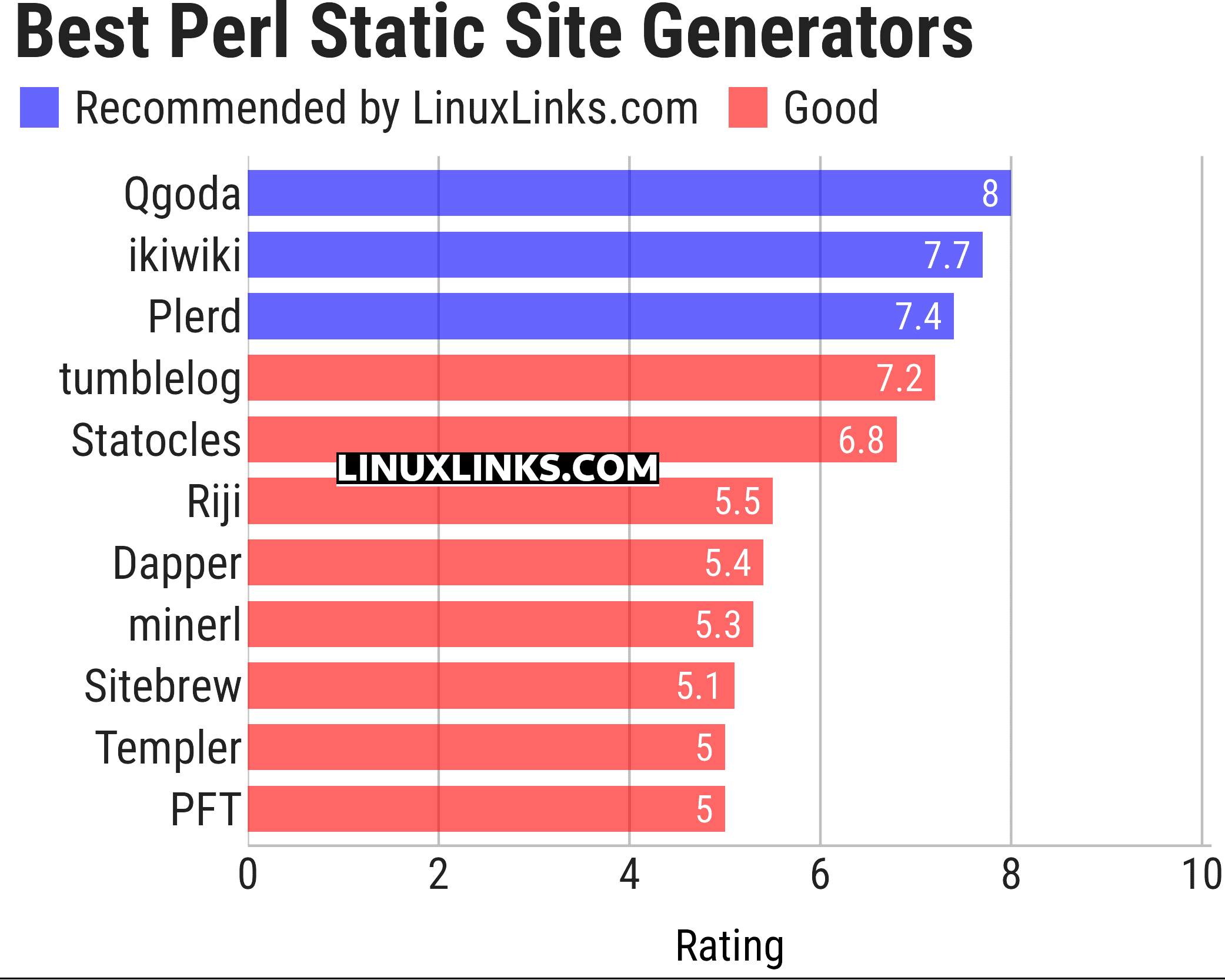
Let’s explore the 11 static site generators at hand. For each application we have compiled its own portal page, a full description with an in-depth analysis of its features, together with links to relevant resources.
| Perl Static Site Generators | |
|---|---|
| Qgoda | Extensible static site generator with arbitrary taxonomies and cross-links |
| ikiwiki | Flexible static site generator with some dynamic features |
| Plerd | Ultralight blogging platform for Markdown |
| tumblelog | static microblog and microsite generator with Perl and Python versions |
| Statocles | Building static web pages from a set of plain YAML and Markdown files |
| Riji | Git based simple static site generator |
| Dapper | Simple but powerful static website generator |
| minerl | Blog-aware static site generator |
| Sitebrew | Converts Markdown content into HTML while preserving a directory structure |
| Templer | Modular extensible static-site-generator |
| PFT | Uses the library PFT to obtain an abstraction over the file system access |
This article has been updated to reflect the changes outlined in our recent announcement.
 Explore our carefully curated directory of recommended free and open source software, covering every major software category. Explore our carefully curated directory of recommended free and open source software, covering every major software category.The directory forms part of our extensive collection of articles for Linux enthusiasts. It includes hundreds of detailed reviews, together with free and open source alternatives to proprietary software from companies such as Google, Microsoft, Apple, Adobe, IBM, Cisco, Oracle, and Autodesk. LinuxLinks also covers interesting projects worth exploring, Linux-compatible hardware, free programming books and tutorials, and much more. Know a useful free and open source Linux application that we haven’t covered? Tell us about it using our submission form. |
Please read our Comment Policy before commenting.
Notably missing [Orion SSG]
We don’t intend to list every single one, just the best.
Agreed, it’s a niche custom build toolchain rather than a polished SSG. Not something that would interest ordinary users looking for a SSG.
Why not? Are Apache developers ordinary users? Thousands of users.
Haha, yeah right. 5 GitHub starts for a project which saw its first release back in 2022.
The number of GitHub stars is not a relevant factor from LL’s perspective.
Our FAQ explains how we determine what’s included.
Best in which way? Orion is better than Hugo. Nothing in the Perl space comes close.
Utter tripe.