

A honeypot is a deliberately exposed or simulated system designed to attract malicious activity so that it can be observed without putting genuine production services at unnecessary risk. By presenting attackers with convincing targets, honeypot software can record connection attempts, exploit behaviour, credential guessing, malware delivery, scanning activity, and other hostile interactions.
These tools are useful for system administrators, network defenders, security researchers, incident response teams, and anyone interested in understanding how attackers probe and abuse internet-facing services. They can complement firewalls, intrusion detection systems, and log monitoring by providing a controlled environment in which suspicious behaviour is easier to isolate and study.
The software featured here covers several different approaches. Some applications emulate multiple network protocols and services, making them suitable for broad monitoring across an infrastructure. Others focus on capturing malware and exploit attempts, recording usernames and passwords submitted by attackers, detecting abuse of SIP and VoIP services, or monitoring hostile activity directed at web applications.
All of the programs selected are free and open source, allowing administrators to inspect the code, adapt deployments to their own environments, and integrate captured data with wider security monitoring workflows.
Here’s our verdict captured in a legendary LinuxLinks-style ratings chart.
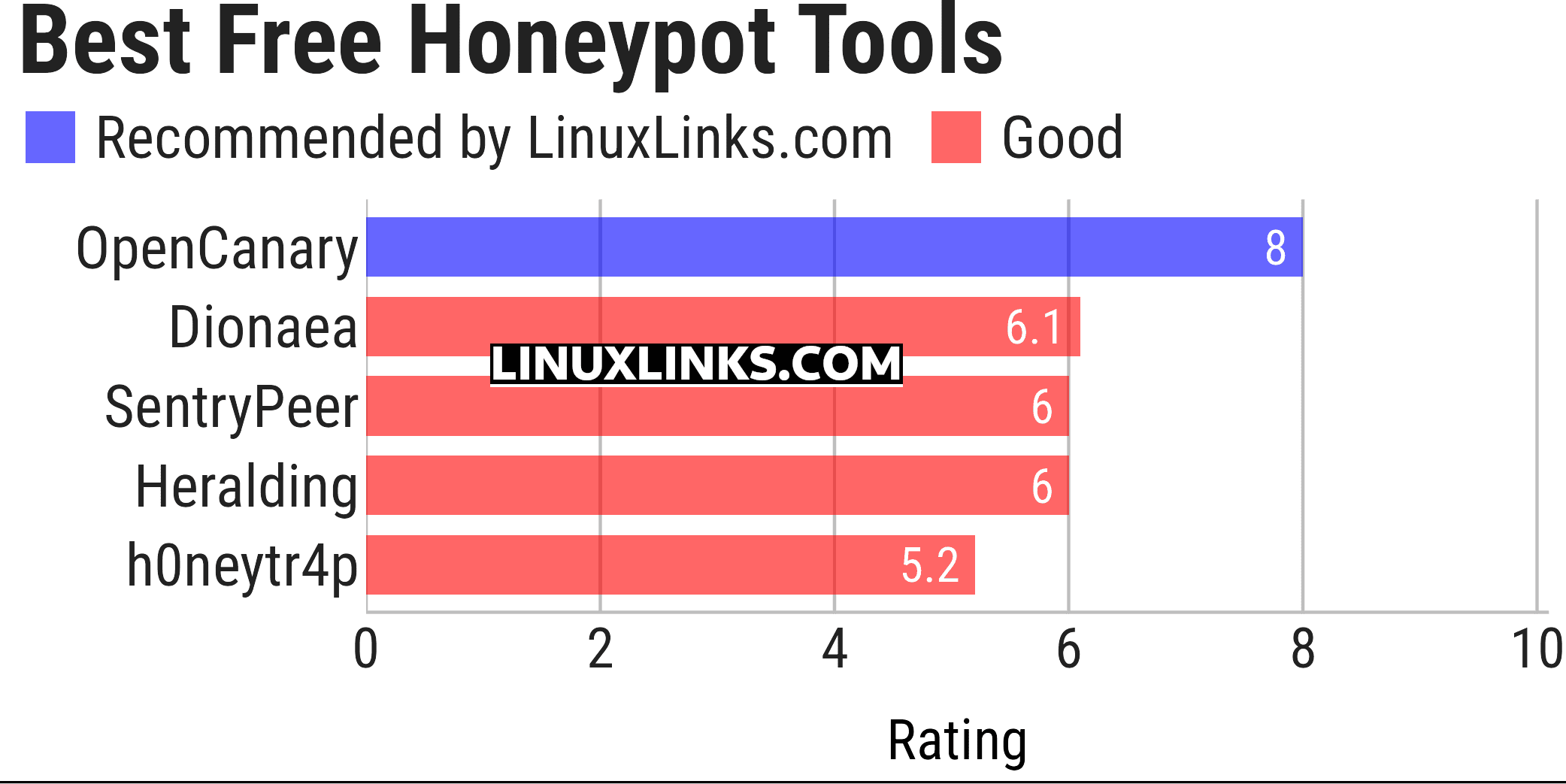
Click the links below to learn more about each tool.
| Honeypot Tools | |
|---|---|
| OpenCanary | Multi-protocol network decoy for detecting attacks |
| Dionaea | Traps exploits and captures malware samples |
| SentryPeer | Spots malicious SIP traffic and attempts to abuse VoIP systems |
| Heralding | Records usernames and passwords submitted by attackers |
| h0neytr4p | Web-focused trap for inspecting hostile HTTP requests and probing |
 Explore our carefully curated directory of recommended free and open source software, covering every major software category. The directory forms part of our extensive collection of articles for Linux enthusiasts. It includes hundreds of detailed reviews, together with free and open source alternatives to proprietary software from companies such as Google, Microsoft, Apple, Adobe, IBM, Cisco, Oracle, and Autodesk. LinuxLinks also covers interesting projects worth exploring, Linux-compatible hardware, free programming books and tutorials, and much more. Know a useful free and open source Linux application that we haven’t covered? Tell us about it using our submission form. |
Please read our Comment Policy before commenting.