

For years, if you said “infrastructure standardization” to anyone running a large enterprise data center, they’d nod and think of one thing: VMware. It was just what you did. You bought the licenses, you built your team’s skills around vSphere, and you didn’t ask too many questions.
That’s changed, and it’s changed fast. The recent overhaul of VMware licensing, moving everyone toward mandatory bundled subscription models, has thrown a wrench into how enterprises calculate their total cost of ownership.
IT leaders are spending months just trying to figure out what their renewal or IT modernization would actually cost them this time around. And a lot of them didn’t like the answer.
Here’s the thing, though. This isn’t really about VMware being “bad” now.
It’s about enterprises realizing that locking your entire data center to one vendor’s roadmap, and one vendor’s pricing decisions, isn’t the safe bet it used to be.
Right now, a rigid standardization on a single software-defined data center stack is no longer what IT experts call strategy. It’s more like a liability now.
Operational resilience doesn’t come from flexibility. It’s something that the standardized and outdated licensing plans of any vendor cannot support.
The Costs and Risks of Forced Standardization after VMware licensing Changes
Let’s talk about what’s actually going on under the hood.
The Subscription Squeeze
When the procurement team shops around for vendors, a bundled licensing sounds easy and efficient on paper. It meets the enterprise cost requirements, and there are enough capabilities to try and use.
But you can see it this way: vSAN features, cloud orchestration tools, add-ons- everything is baked into every environment irrespective of your needs. Your team has the need for a fraction of the abilities that the package delivers.
What does this mean? On a year-on-year basis, this means less ROI, and more money spent on unnecessary stack, and people needed to manage them.
Vendor Lock-in is a Real Business Risk, not just an IT Headache
When your entire infrastructure sits on one vendor’s stack, you’re exposed every time that vendor changes pricing, restructures its business, or shifts support priorities. That’s not a hypothetical anymore. It’s happened, and plenty of enterprises got caught flat-footed.
The shift toward fit-for-purpose thinking
What’s visible more now is enterprises moving away from “standardize on one vendor” toward “standardize on what actually works for each workload.” A dev/test environment doesn’t need the same infrastructure tier as a mission-critical financial system.
Mapping infrastructure to actual performance and budget needs, instead of a one-size-fits-all license, just makes more sense.
What are the best enterprise-grade VMware alternatives for private cloud virtualization?
Sangfor HCI, along with other hardened KVM-based hyperconverged infrastructure platforms, has matured into one of the strong VMware alternatives.
Sangfor HCI delivers live migration, high availability, and distributed resource scheduling without the tiered VMware licensing headaches that come with legacy virtualization vendors.
Addressing the Questions IT Teams Are Actually Asking
If you’re the one being asked to figure this out, you probably have some very practical questions. So let’s get into them directly.
How can enterprises migrate away from VMware without disrupting live operations?
The trick is using virtual-to-virtual migration tools that are built directly into the target hypervisor, not bolted on as an afterthought. Good enterprise platforms let IT teams move live workloads in phases, running data validation and checksum comparisons along the way, so there’s no need for a big-bang cutover or painful downtime windows.
Do I need to rebuild my whole environment to move off VMware?
No. You don’t need to tear everything down and start from scratch. A phased migration, workload by workload, with proper validation at each step, is how most enterprises actually do this in the real world.
That second question comes up constantly, and I get why. Nobody wants to be the person who caused an outage during a “cost-saving” migration.
But the tooling has genuinely gotten better over the past couple of years, and phased migrations are now a well-worn path rather than a leap of faith.
Sangfor HCI: A Rational Path Forward
So where does this leave enterprises that are done with rigid, single-vendor standardization but still need something enterprise-grade?
This is where Sangfor HCI fits in, as one of the more credible names among VMware Competitors that enterprises are shortlisting right now.
It’s a full-stack platform that brings compute, software-defined storage (aSAN), networking, and built-in security tools, including virtual firewalls and anti-ransomware capabilities, together under a single console.
Instead of stitching together separate products and licenses, you’re managing one integrated stack.
It’s not just marketing talk either. Sangfor was named a G2 Leader for Cloud Computing and HCI Solutions in Winter 2026.
It also holds active user reviews on both Gartner Peer Insights and G2, where real customers talk about deployment ease, cost predictability, and support quality. For risk-averse enterprise leaders, that kind of third-party validation matters a lot more than a vendor’s own sales deck.
Real Proof of Success with Sangfor HCI
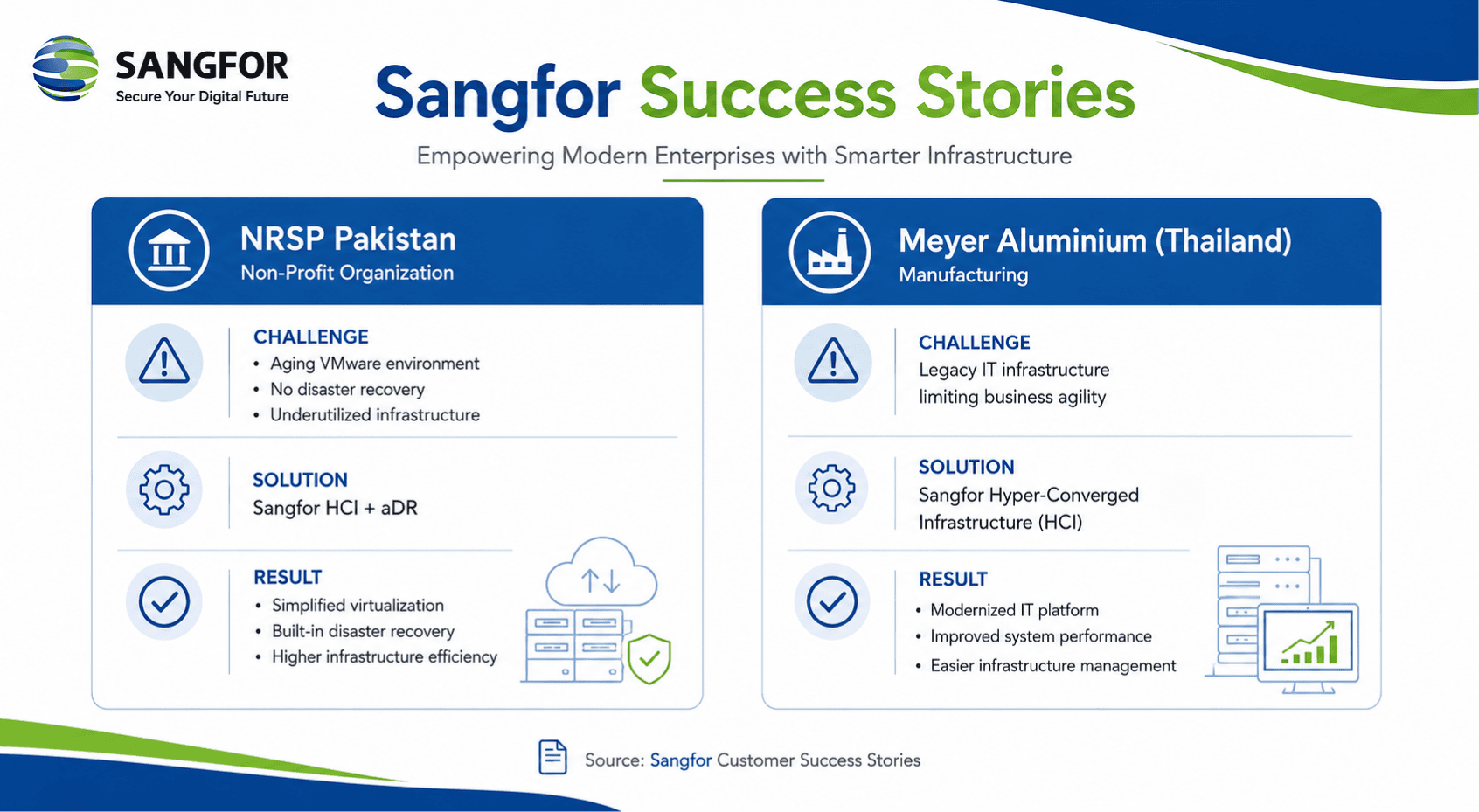
The real proof, though, is in how it plays out on the ground. Two organizations, leaders in their respective industries, shared their success with Sangfor HCI:
NRSP
Take NRSP, a large not-for-profit organization in Pakistan running a mix of bare-metal servers and non-clustered VMware ESXi hosts. Centralized management was nonexistent; there was no real disaster recovery plan, and resource utilization was a mess.
NRSP actually ran a proof of concept comparing VMware, Oracle Virtualization, and Sangfor HCI side by side. Sangfor came out ahead, not because it was the cheapest, but because the platform was more intuitive, more scalable, and the local support team was responsive.
After deployment across their primary and DR sites, NRSP got centralized management, better system availability, and a lot less operational complexity to deal with day-to-day.
Meyer Aluminium
Then there’s Meyer Aluminum, a manufacturing company in Thailand. Their infrastructure had been running on physical servers with bolted-on virtualization and backup tools, which worked fine until hardware refresh cycles turned into a recurring migration headache.
They moved to a two-node Sangfor HCI setup and paired it with Sangfor’s next-gen firewall and endpoint protection. The result was a simplified, more secure environment, and one less thing for their lean IT team to babysit constantly.
Two very different industries, two very different starting points, but the same underlying pattern: complexity going down, control going up.
For Operational Efficiency
Evaluating alternatives to VMware isn’t just a line item on a cost-cutting exercise anymore. It’s become part of how serious enterprises think about risk management and long-term infrastructure modernization. Vendor concentration is a risk category now, right up there with security posture and compliance.
True standardization was never supposed to mean handing your entire IT roadmap over to one vendor’s pricing decisions. It should mean standardizing on operational efficiency, on performance, and on security, wherever that comes from.
If you’re at the point where your team is asking hard questions about your next renewal, it might be worth running a phased, low-risk proof of concept with Sangfor HCI to see how it performs against your actual workloads, not a hypothetical one. You can request a demo here and see what it looks like for your environment specifically.
Please read our Comment Policy before commenting.