

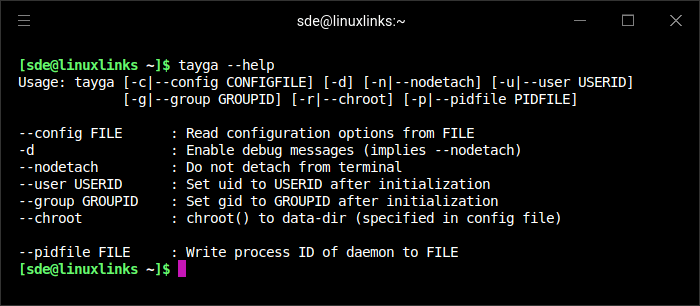
TAYGA is a stateless NAT64 (Network Address Translation 64) implementation designed to provide IPv6 connectivity to IPv4-only hosts and services. It operates as a user space daemon that performs address translation between IPv6 and IPv4 networks, allowing IPv6-only systems to communicate with legacy IPv4 infrastructure. TAYGA is commonly used in IPv6 transition deployments and works by translating packets between the two protocols using the NAT64 technique defined in relevant IETF standards.
This is free and open source software.
Key Features
- Implements stateless NAT64 translation to enable communication between IPv6-only and IPv4-only networks.
- Runs as a lightweight user space daemon designed for Linux systems.
- Uses a virtual network interface (TUN device) to exchange packets with the kernel networking stack.
- Supports mapping of IPv4 addresses into an IPv6 prefix for transparent translation.
- Suitable for IPv6 transition deployments and experimental IPv6 networking environments.
- Low resource usage with a straightforward configuration model.
- Compatible with common Linux networking tools and routing configurations.
- Implements NAT64 behaviour defined by IETF standards.
Website: github.com/apalrd/tayga
Support:
Developer: TAYGA developers
License: GNU General Public License v2.0
TAYGA is written in C and Python. Learn C with our recommended free books and free tutorials. Learn Python with our recommended free books and free tutorials.
 LinuxLinks helps you discover the best free and open source software for Linux. Explore our extensive collection of recommended applications, including alternatives to popular proprietary software. We also publish software reviews, Linux tutorials, hardware reviews, free programming books and articles covering the wider open source community. Browse our Linux resources to discover more. Know a useful free and open source Linux application we haven't covered? Suggest a program for inclusion. Has your software been featured on LinuxLinks? Display one of our Featured on LinuxLinks badges on your website or GitHub README. |
Please read our Comment Policy before commenting.