

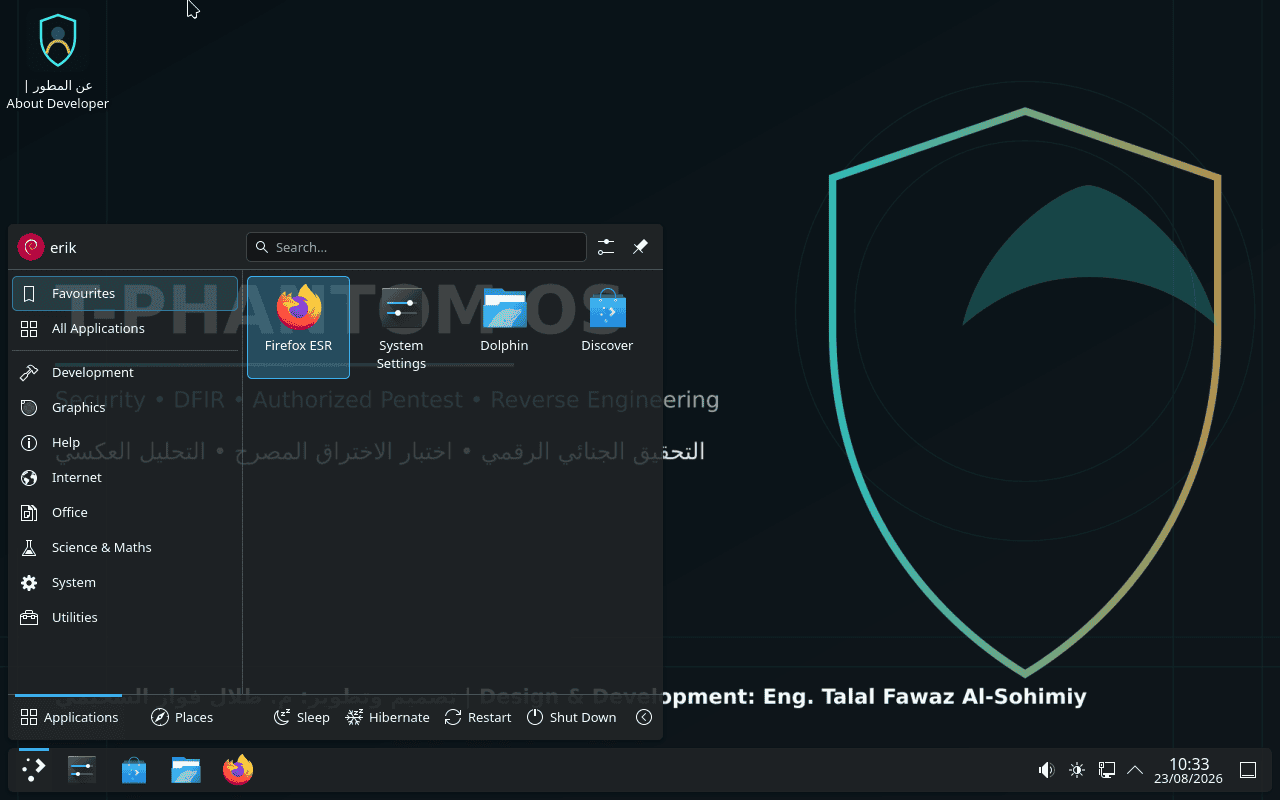
T-PHANTOM OS is a security-focused Linux distribution designed for digital forensics, incident response, authorized penetration testing, reverse engineering, network analysis and privacy-oriented work. It’s based on Debian.
It provides a KDE Plasma desktop with Arabic and English support and aims to present security applications as a coherent workstation rather than simply bundling as many tools as possible. The distribution is intended for security professionals, researchers, students, training labs and CTF environments.
Key Features
- KDE Plasma desktop with a customised T-PHANTOM visual identity.
- Arabic and English are treated as first-class user environments.
- Designed for digital forensics and incident response workflows.
- Provides tools for disk, file-system, registry, timeline and artifact investigation.
- Targets authorised penetration testing and controlled security assessment.
- Supports binary analysis and reverse engineering workflows.
- Includes utilities for packet, protocol, DNS and other network analysis.
- Curated security application set organised around practical workflows rather than raw tool count.
- AppArmor availability is validated in the current release.
- nftables is available for firewalling and network security.
- Custom boot, installer, login and desktop branding.
- Requires at least 4GB RAM, with 8GB or more recommended for heavier analysis workloads.
| Working state: | Active |
| Desktop: | KDE Plasma |
| Init Software: | systemd |
| Package Management: | APT |
| Release Model: | Fixed |
| Platforms: | x86_64 |
| Home Page: | T-PHANTOM OS |
| Developer: | Talal Fawaz Al-Sohimiy |
| This article is part of our Big List of Active Linux Distributions and Open Source Operating Systems. |
What's a Linux distribution ("distro")? |
| A distro provides the user with a desktop environment, preloaded applications, and ways to update and maintain the system. Each distro makes different choices, deciding which open source projects to install and provides custom written programs. They can have different philosophies. Some distros are intended for desktop computers, some for servers without a graphical interface, and others for special uses. Because Linux is an open source operating system, combinations of software vary between Linux distros. |
Please read our Comment Policy before commenting.