

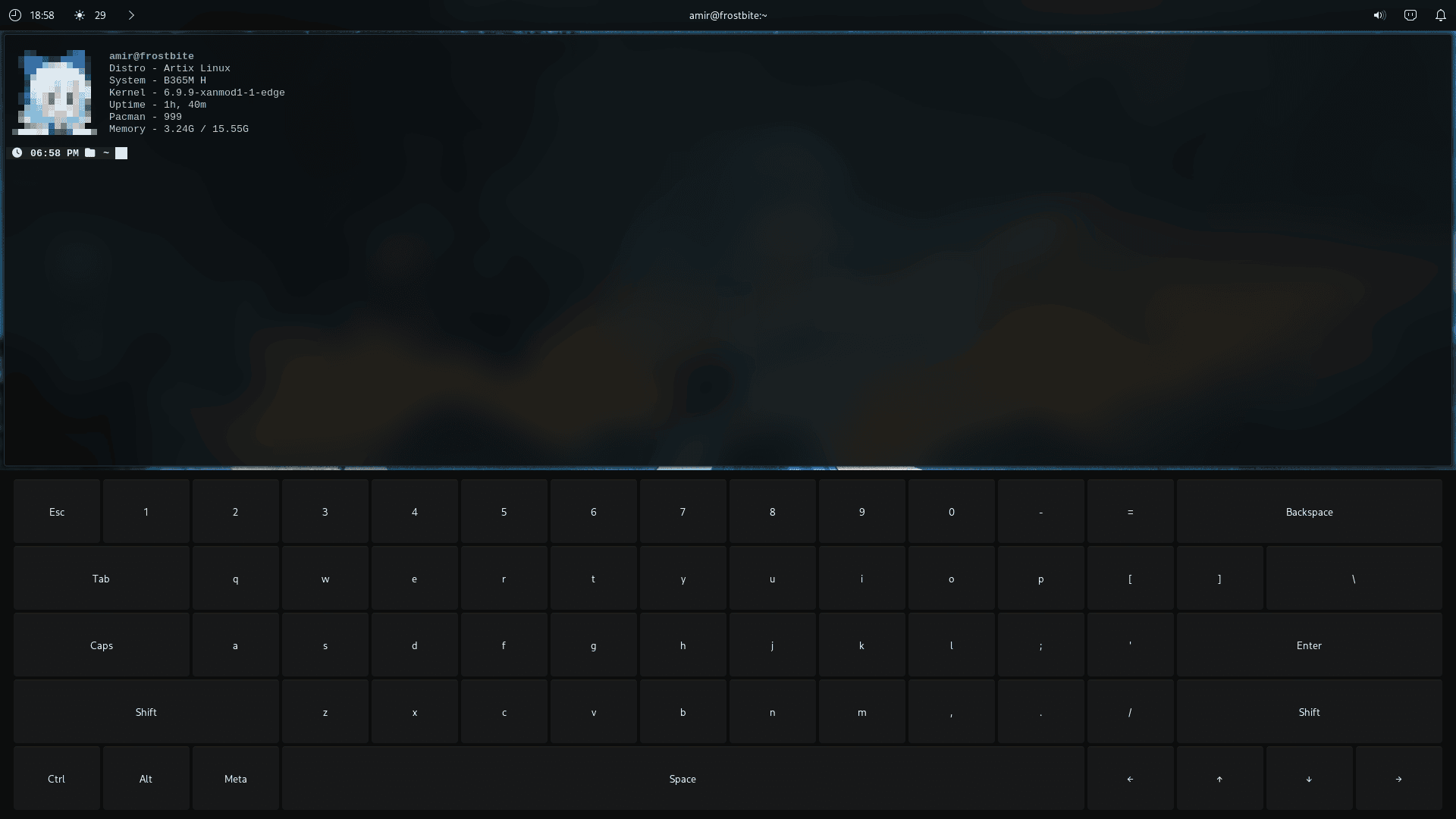
Sysboard is a simple virtual keyboard for Wayland written using gtkmm 4. It provides an on-screen keyboard with configurable layouts and appearance.
The application can be configured by editing its source before compilation, using a configuration file, or passing command-line arguments. It also supports signals for manually showing, hiding, or toggling the keyboard.
This is free and open source software.
Key Features
- On-screen virtual keyboard for Wayland.
- Written using gtkmm 4.
- Offers full, mobile, and mobile numeric layouts.
- Configure margin, height, and keyboard layout.
- Supports configuration files and command-line arguments.
- Can be configured at compile time.
- Show, hide, or toggle the keyboard using signals.
- Uses the GTK 4 theme by default.
- Supports custom CSS styling.
Website: github.com/System64fumo/sysboard
Support:
Developer: System64fumo
License: GNU General Public License v3.0
Sysboard is written in C++. Learn C++ with our recommended free books and free tutorials.
Related Software
| Virtual Keyboards | |
|---|---|
| Florence | Extensible scalable virtual keyboard |
| Maliit | Virtual keyboard implemented as a plug-in for Maliit Framework |
| squeekboard | Keyboard-shaped input method supporting Wayland |
| GOK | GNOME On Screen Keyboard |
| CoreKeyboard | Simple virtual keyboard with word suggestions |
| Onboard | Useful for tablet PC users and for mobility impaired users |
| xvkbd | Virtual (graphical) keyboard program |
| wvkbd | On-screen keyboard for wlroots |
| Wkeys | Wayland-focused keyboard offering compact controls for direct text entry |
| Plasma Keyboard | Adaptive Plasma input panel designed for touchscreens and tablets |
| QingBoard | Qt-based on-screen typing tool with configurable layouts and themes |
| MaiN_Keyboard | Flexible desktop input panel with layouts suited to accessibility needs |
| Sysboard | Minimal Wayland typing interface built for simple, lightweight operation |
| QVKbd | Virtual keyboard written in C++ and QML |
| qtvkbd | Fork of kvkbd with all KDE4 dependencies replaced with Qt components |
| eekboard | Easy to use virtual keyboard toolkit |
Read our verdict in the software roundup.
 Explore our carefully curated directory of recommended free and open source software, covering every major software category. Explore our carefully curated directory of recommended free and open source software, covering every major software category.The directory forms part of our extensive collection of articles for Linux enthusiasts. It includes hundreds of detailed reviews, together with free and open source alternatives to proprietary software from companies such as Google, Microsoft, Apple, Adobe, IBM, Cisco, Oracle, and Autodesk. LinuxLinks also covers interesting projects worth exploring, Linux-compatible hardware, free programming books and tutorials, and much more. Know a useful free and open source Linux application that we haven’t covered? Tell us about it using our submission form. |
Please read our Comment Policy before commenting.