
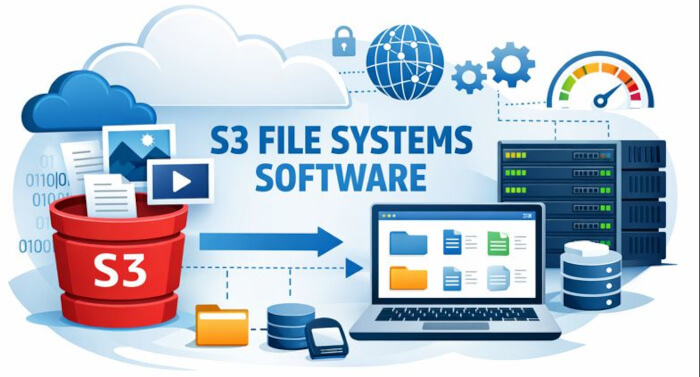
s5cmd is a command-line utility for working with Amazon S3 and other S3-compatible object storage services from a terminal.
It’s designed for high-throughput workflows, handling large numbers of objects with parallel execution across cloud storage and local filesystems. The software is suited to tasks such as transferring data, managing buckets and objects, and running batch commands efficiently in storage-heavy environments.
This is free and open source software.
Key Features
- Lists buckets and objects.
- Uploads, downloads, and deletes objects.
- Copies, moves, and renames objects.
- Creates and removes buckets.
- Supports wildcard matching for S3 operations.
- Runs batches of commands from a command file.
- Selects JSON records from objects using SQL expressions.
- Supports server-side encryption with AWS Key Management Service.
- Sets access control lists on uploaded, copied, and moved objects.
- Works with Google Cloud Storage and other S3 API compatible services.
Website: github.com/peak/s5cmd
Support:
Developer: Peak
License: MIT License
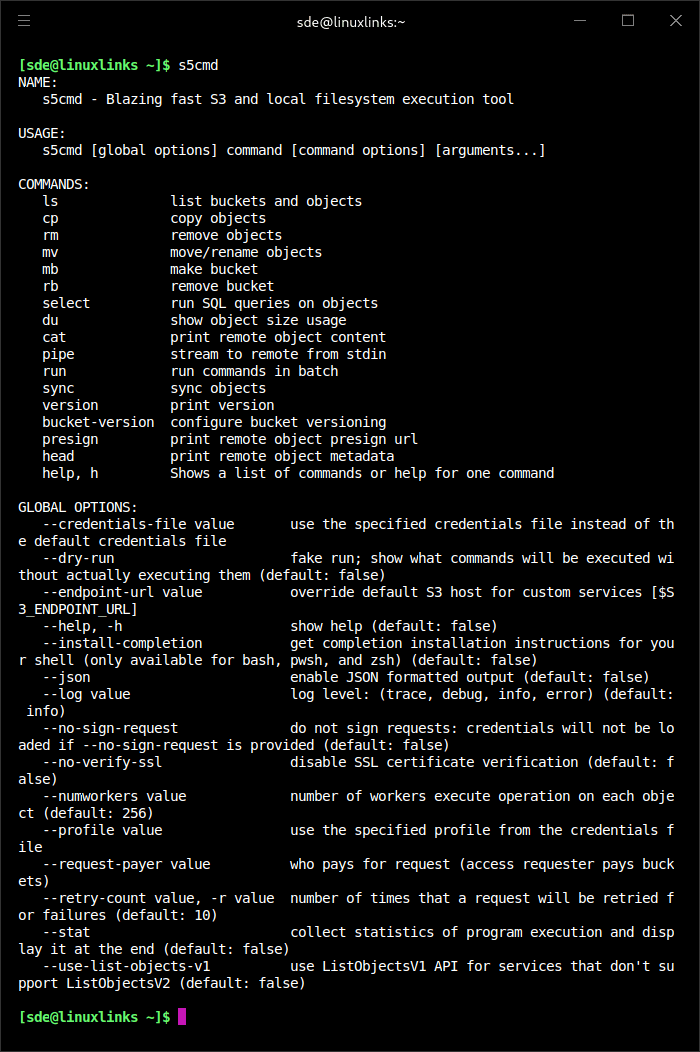
s5cmd is written in Go. Learn Go with our recommended free books and free tutorials.
Related Software
| S3 Terminal Tools | |
|---|---|
| s5cmd | S3 and local filesystem execution tool |
| claws | Terminal user interface for managing AWS resources |
| s3cmd | Manage objects in Amazon S3 storage |
| Rclone | Command line program to sync files and directories |
| STU | Browse buckets and objects directly from your terminal, preview files, and more |
| stree | Visualize the directory tree structure of an S3 bucket |
| MinIO Client | Work with object storage from a Unix-style shell |
| s3tui | Simple S3 CLI client for file transfers |
| S3ry | AWS S3 interactive terminal client |
Read our verdict in the software roundup.
 Explore our carefully curated directory of recommended free and open source software, covering every major software category. Explore our carefully curated directory of recommended free and open source software, covering every major software category.The directory forms part of our extensive collection of articles for Linux enthusiasts. It includes hundreds of detailed reviews, together with free and open source alternatives to proprietary software from companies such as Google, Microsoft, Apple, Adobe, IBM, Cisco, Oracle, and Autodesk. LinuxLinks also covers interesting projects worth exploring, Linux-compatible hardware, free programming books and tutorials, and much more. Know a useful free and open source Linux application that we haven’t covered? Tell us about it using our submission form. |
Please read our Comment Policy before commenting.