
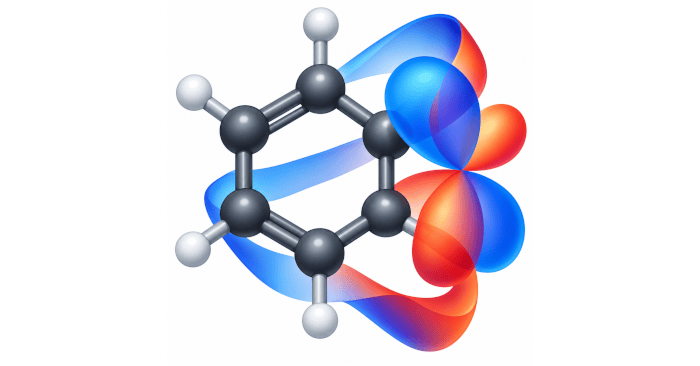
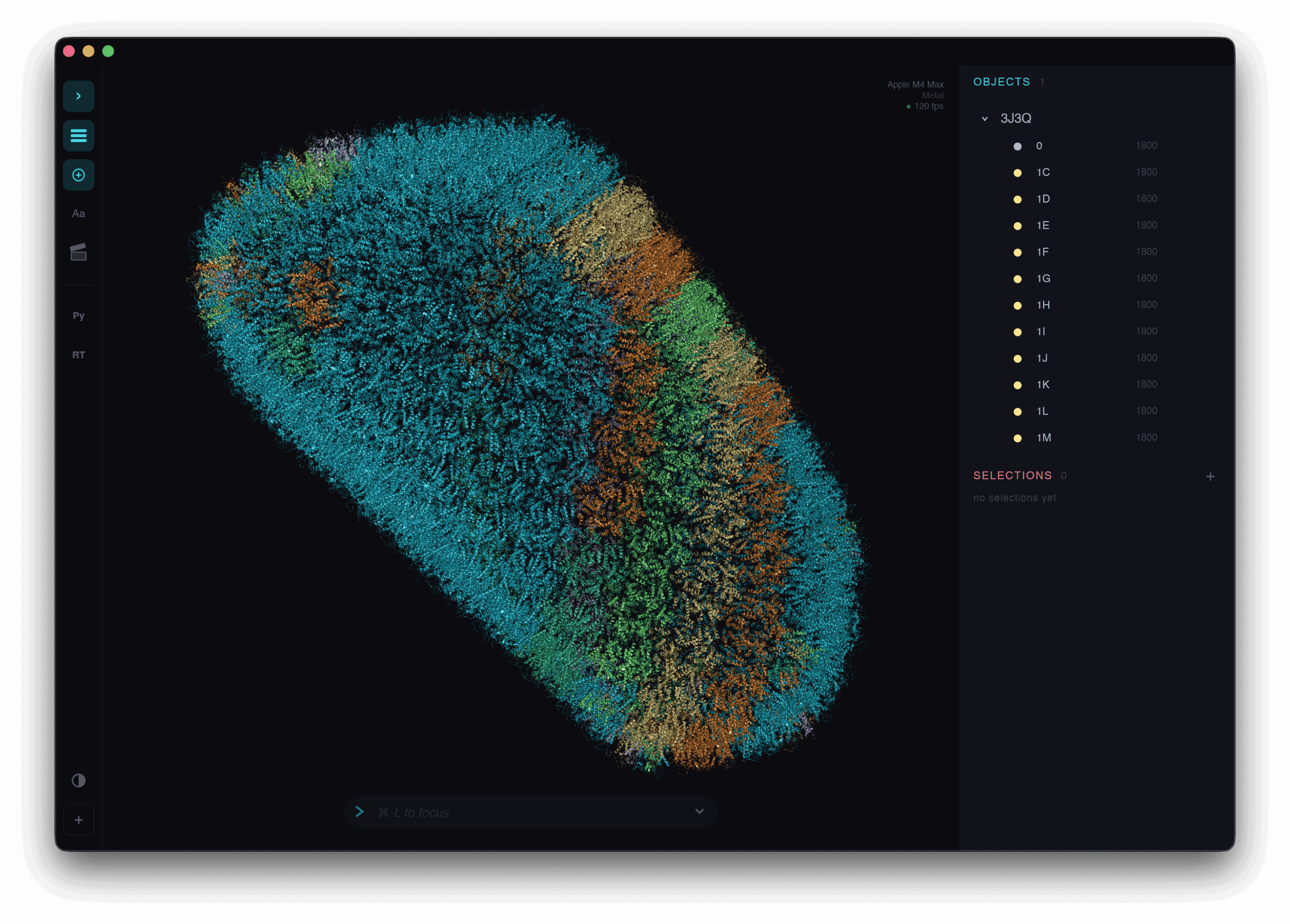
Patinae is a programmable molecular visualization toolkit with a native graphical application, Python interfaces and a browser-based viewer.
The project was formerly known as PyMOL-RS but has developed into an independent application with its own renderer, command runtime, plugin host, desktop interface and session format. It is built around a GPU-first rendering architecture using WebGPU through wgpu and is intended for interactive research, structural analysis, scripting and preparation of publication graphics.
Patinae supports common molecular and structural formats including PDB, mmCIF, BinaryCIF, MOL2, SDF/MOL, XYZ and GRO. It can also work with CCP4/MRC map data and trajectory formats such as XTC and TRR. Available representations include spheres, sticks, lines, cartoons, ribbons, molecular surfaces, meshes, dots and labels.
The application combines graphical interaction with a command-driven workflow. Users can select atoms, residues, chains, polymers, solvent and objects, perform measurements, control representations and colours, and automate repetitive operations. Structural analysis tools include Kabsch superposition, CE structural alignment, crystallographic symmetry expansion, secondary-structure assignment and electron-density map contouring.
This is free and open source software.
Key Features
- Provides a GPU-first molecular visualization environment using WebGPU.
- Offers native desktop, Python, Jupyter and web interfaces.
- Reads PDB, mmCIF, BinaryCIF, MOL2, SDF/MOL, XYZ and GRO structures.
- Supports CCP4/MRC maps and XTC and TRR trajectories.
- Provides spheres, sticks, cartoons, ribbons, surfaces, meshes, dots and labels.
- Includes Kabsch superposition and CE structural alignment.
- Supports crystallographic symmetry expansion and electron-density map contouring.
- Provides a native plugin architecture for extending commands and the graphical interface.
Website: github.com/zmactep/patinae
Support:
Developer: Pavel Yakovlev
License: BSD 3-Clause “New” or “Revised” License
Patinae is written in Rust. Learn Rust with our recommended free books and free tutorials.
 Explore our comprehensive directory of recommended free and open source software. Our carefully curated collection spans every major software category. Explore our comprehensive directory of recommended free and open source software. Our carefully curated collection spans every major software category.This directory is part of our ongoing series of informative articles for Linux enthusiasts. It features hundreds of detailed reviews, along with open source alternatives to proprietary solutions from major corporations such as Google, Microsoft, Apple, Adobe, IBM, Cisco, Oracle, and Autodesk. You’ll also find interesting projects to try, hardware coverage, free programming books and tutorials, and much more. Discovered a useful open source Linux program that we haven’t covered yet? Let us know by completing this form. |
Please read our Comment Policy before commenting.