

hashdir is a command-line utility for calculating checksums of files and complete directory trees. It is designed to make it easy to create a fingerprint of a collection of files, allowing users to determine whether the contents have changed.
Unlike tools that operate only on individual files, hashdir can calculate a checksum representing an entire directory. This makes it useful for checking archives, comparing transferred directories, and detecting changes to collections of data. It can also operate on individual files or multiple selected paths, giving users a consistent interface for different kinds of integrity checks.
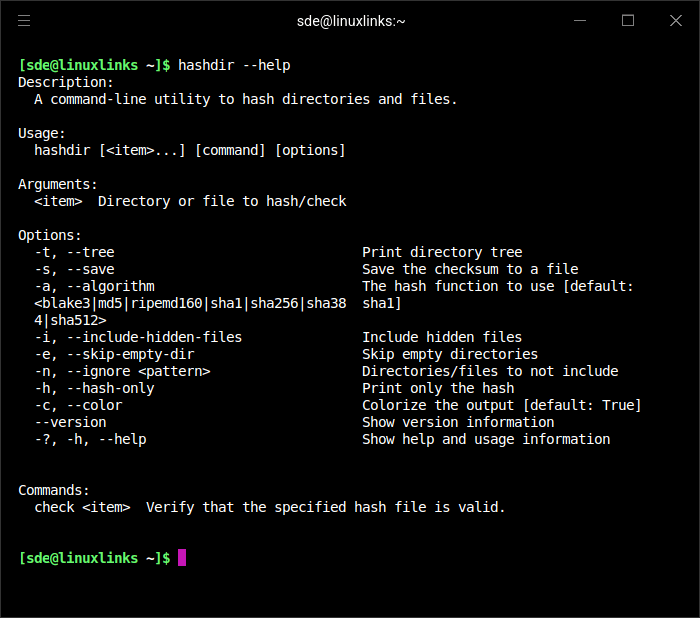
The software supports several cryptographic and non-cryptographic hash algorithms. Its default algorithm is designed for fast processing, while alternatives are available when stronger cryptographic properties or compatibility with existing checksum systems are required. Directory processing can be customised to include hidden files, exclude selected paths, or omit empty directories. A tree view provides a visual representation of the files included in a calculation.
This is free and open source software.
Key Features
- Calculates checksums for individual files and complete directory trees.
- Generates a single hash representing directory contents.
- Supports BLAKE3, CRC32, MD5, RIPEMD-160, SHA-1, SHA-2, and xxHash3.
- Configurable selection of the hashing algorithm.
- Verification of previously saved checksum records.
- Directory tree display for examining processed content.
- Optional inclusion of hidden files.
- Pattern-based exclusion of selected files and directories.
- Option to omit empty directories from processing.
- Hash-only output for integration with scripts.
- Colourised terminal output.
- Cross-platform support – runs on Linux, macOS, and Windows.
Website: github.com/ultimateanu/hashdir
Support:
Developer: Anu Bandi
License: MIT License
hashdir is written in F# and C#. Learn F# with our recommended free books and free tutorials. Learn C# with our recommended free books and free tutorials.
Related Software
| CLI Data Hashing Tools | |
|---|---|
| xxHash | Non-cryptographic hash algorithm |
| b3sum | Implementation of the BLAKE3 hash function |
| RHash | Calculate and verify magnet links and various message digests |
| md5sum | Compute and check MD5 message digest; part of GNU Coreutils |
| cfv | Test and create checksum files |
| Jacksum | Work with checksums, CRCs, and message digests |
| md5 | Generate / check MD5 message digest |
| digup | Update md5sum or shasum digest files |
| cksum | Compute and verify file checksums |
| Hashrat | Hash-generation utility |
| Directory Checksum | Recursively calculate checksums for directory contents |
| paq | Fast BLAKE3 hashing tool for files and directories |
| ddgst | Hashing and checksum utility |
| QCalcFileHash | Hash calculator |
| hashdir | Checksum directories and files |
| Hash Calculator | Calculates around 50 cryptographic hashes of strings and files |
| dano | Hashdeep/md5tree for media files |
| sha3sum | Keccak, SHA-3, SHAKE, and RawSHAKE checksum utilities |
| luha | Simple file checksum tool |
| filepack | File hashing and verification |
| bitrat | Fast file checksum tool supporting multiple hash algorithms |
| b2sum | Calculate BLAKE2 checksums |
| Additional tools: | |
| hashit | Generate file hashes quickly |
| hashdeep | Generate and verify file hashes |
| cksfv | Create and check sfv listings using CRC32 checksums |
| cksfv.rs | Reimplements the classic cksfv tool |
Read our verdict in the software roundup.
 LinuxLinks helps you discover the best free and open source software for Linux. Explore our extensive collection of recommended applications, including alternatives to popular proprietary software. We also publish software reviews, Linux tutorials, hardware reviews, free programming books and articles covering the wider open source community. Browse our Linux resources to discover more. Know a useful free and open source Linux application we haven't covered? Suggest a program for inclusion. Has your software been featured on LinuxLinks? Display one of our Featured on LinuxLinks badges on your website or GitHub README. |
Please read our Comment Policy before commenting.