

Geographic Resources Analysis Support System (GRASS) is an open source Geographic Information System (GIS) used for geospatial data management and analysis, image processing, graphics/maps production, spatial modeling, and visualization.
It consists of more than 400 modules for processing vector (2D/3D), raster and voxel data. Many interfaces to other programs in related domains like geostatistics, databases, mapserver and even other GIS software exist.
It can serve as a Desktop GIS and as the backbone of a complete GIS infrastructure.
It was created in the 1980s by the US Army Corps of Engineers, Construction Engineering Research Laboratory (USA/CERL) and has been enhanced by many others.
GRASS is currently used in scientific applications, commercial settings and by public officials all over the world.
Key Features
- wxPython graphical user interface (wxGUI):
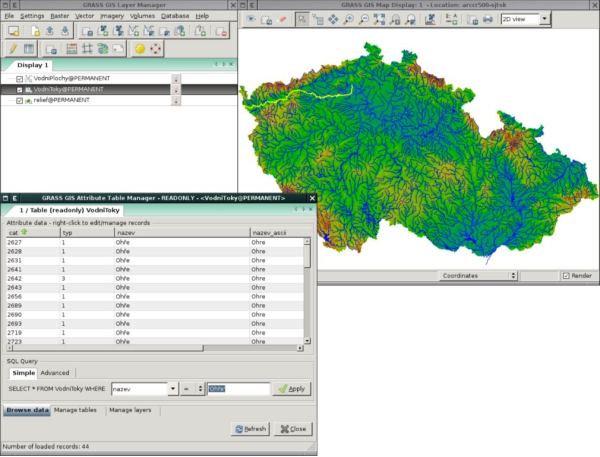
- Layer Manager – includes map layer management, integrated command-line prompt, and command output window tab.
- Map Display Window – integrates basic tools for zooming, panning, data querying, and map elements (north arrows, barscale, etc.).
- Module dialogs enable running GRASS modules.
- 2D raster analysis and 3D voxel management (volumes).
- 2D/3D Vector engine with SQL based DBMS support.
- Image processing modules.
- Vector network analysis, Linear Referencing System.
- Visualization of 2D, 3D maps and volumes.
- Interoperable with standard raster and vector formats.
- Modular architecture and scripting capabilities for batch processing.
- Supports various RDBMS (Relational database management system) and embedded databases. SQL (Structured Query Language) queries are directly passed to the underlying database system.
- Over 400 built-in analysis modules and 100 community supplied add-on modules and toolboxes can be downloaded for free.
- Python interface to the C library – create new modules in a simple way while at the same time creating powerful and fast modules.
- Can be used either as a stand-alone application or as backend for other software packages such as QGIS and R geostatistics.
Website: grass.osgeo.org
Support: Documentation, Quickstart, FAQ, Mailing Lists
Developer: Refractions Research
License: GNU Lesser General Public License
GRASS is written in C, C++, and Python. Learn C with our recommended free books and free tutorials. Learn C++ with our recommended free books and free tutorials. Learn Python with our recommended free books and free tutorials.
Related Software
| Earth Science Software | |
|---|---|
| GRASS | Geographic Resources Analysis Support System |
| Quantum GIS | User friendly Geographic Information System |
| Survex | Cave surveying and mapping software |
| SAGA | System for Automated Geoscientific Analyses |
| GPlates | Interactive visualization of plate-tectonics |
| GMT | Collection of tools that allow users to manipulate data sets |
| Therion | Cave surveying - 2D and 3D drawing software |
| GeoServer | Server written in Java that allows users to share and edit geospatial data |
| OpenJUMP | Geographic Information System written in Java |
| GrADS | Grid Analysis and Display System for earth science data |
| gvSIG Desktop | Powerful, user-friendly Geographic Information System |
| PostGIS | Database extender for PostgreSQL object-relational database |
| WhiteboxTools | Advanced geospatial data analysis platform |
| ObsPy | Framework to process, analyse, and visualise seismological data |
| ncview | Visual browser for NetCDF format files |
| MapServer | System for developing web-based GIS applications |
| OpenDrift | Framework for ocean trajectory modelling |
| MetPy | Read, visualize and perform calculations with weather data |
| uDig | Spatial data viewer/editor |
| OpenSees | Open System for Earthquake Engineering Simulation |
| Grock | Displays a geological map of the UK |
Read our verdict in the software roundup.
 Explore our comprehensive directory of recommended free and open source software. Our carefully curated collection spans every major software category. Explore our comprehensive directory of recommended free and open source software. Our carefully curated collection spans every major software category.This directory is part of our ongoing series of informative articles for Linux enthusiasts. It features hundreds of detailed reviews, along with open source alternatives to proprietary solutions from major corporations such as Google, Microsoft, Apple, Adobe, IBM, Cisco, Oracle, and Autodesk. You’ll also find interesting projects to try, hardware coverage, free programming books and tutorials, and much more. Discovered a useful open source Linux program that we haven’t covered yet? Let us know by completing this form. |
Please read our Comment Policy before commenting.