

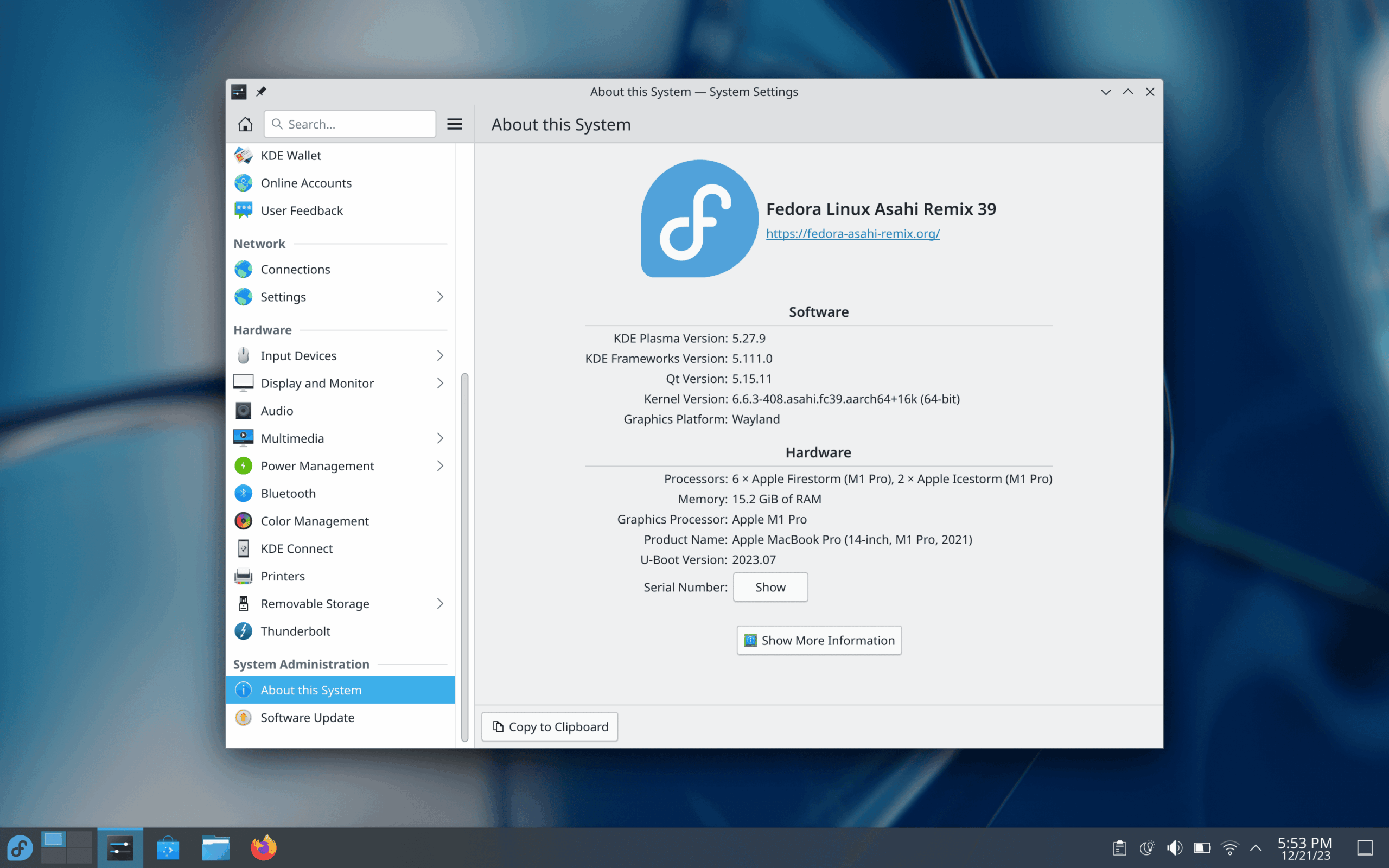
Fedora Asahi Remix is a Fedora-based Linux distribution designed specifically for Apple Silicon Macs.
It is the flagship distribution of the Asahi Linux project and is developed through close collaboration between Asahi Linux and the Fedora Project. The distribution integrates the hardware enablement needed to make Linux practical on supported Apple hardware, rather than expecting users to assemble the necessary kernel, graphics and platform components themselves.
KDE Plasma is the flagship desktop environment, although a GNOME edition is also available. Minimal and Server images cater for users who want to build their own environment or run a system without a conventional graphical desktop.
The distribution uses a Wayland-based desktop environment and benefits from extensive work on graphics, audio and other Apple-specific hardware.
Key Features
- Designed specifically for Apple Silicon Macs.
- KDE Plasma is the flagship desktop environment, with GNOME also available.
- Offers Minimal and Server images for custom and headless installations.
- Provides accelerated graphics through open source drivers developed for Apple Silicon.
- Supports OpenGL, OpenGL ES, OpenCL and Vulkan through the Mesa graphics stack.
- Includes integrated audio support using PipeWire and WirePlumber together with machine-specific DSP configuration.
- Uses Wayland by default, with XWayland available for legacy applications.
- Supports a broad range of M1 and M2 MacBook, Mac mini, Mac Studio, iMac and Mac Pro systems.
- Integrates Apple-specific hardware support with the Fedora package ecosystem.
| Working state: | Active |
| Desktop: | KDE Plasma, GNOME |
| Init Software: | systemd |
| Package Management: | DNF |
| Release Model: | Fixed |
| Platforms: | aarch64 |
| Home Page: | asahilinux.org/fedora |
| Developer: | Asahi Linux project and Fedora Project |
| This article is part of our Big List of Active Linux Distributions and Open Source Operating Systems. |
What's a Linux distribution ("distro")? |
| A distro provides the user with a desktop environment, preloaded applications, and ways to update and maintain the system. Each distro makes different choices, deciding which open source projects to install and provides custom written programs. They can have different philosophies. Some distros are intended for desktop computers, some for servers without a graphical interface, and others for special uses. Because Linux is an open source operating system, combinations of software vary between Linux distros. |
Please read our Comment Policy before commenting.