

Public Key Infrastructure (PKI) provides the framework used to create, manage and verify digital identities and cryptographic certificates. It allows systems to establish trust between users, servers, applications and software components using public-key cryptography.
Certificate Authority tools form part of this infrastructure. They can issue, sign, renew, revoke and validate digital certificates, helping organisations control which systems and identities are trusted. Related tools may also handle key management, certificate policies, signing workflows and verification of software or other digital assets.
PKI is widely used for securing websites and network services, authenticating users and devices, encrypting communications, signing software and protecting software supply chains. It is particularly important in environments where systems need a reliable way to prove identity or verify that data has not been altered.
These tools are used by system administrators, security engineers, DevOps teams, software developers, infrastructure operators and organisations running internal or public services. They range from utilities suited to individual projects to components used in large-scale automated security infrastructure.
Here’s our verdict captured in a legendary LinuxLinks-style ratings chart. Only free and open source software is eligible for inclusion.
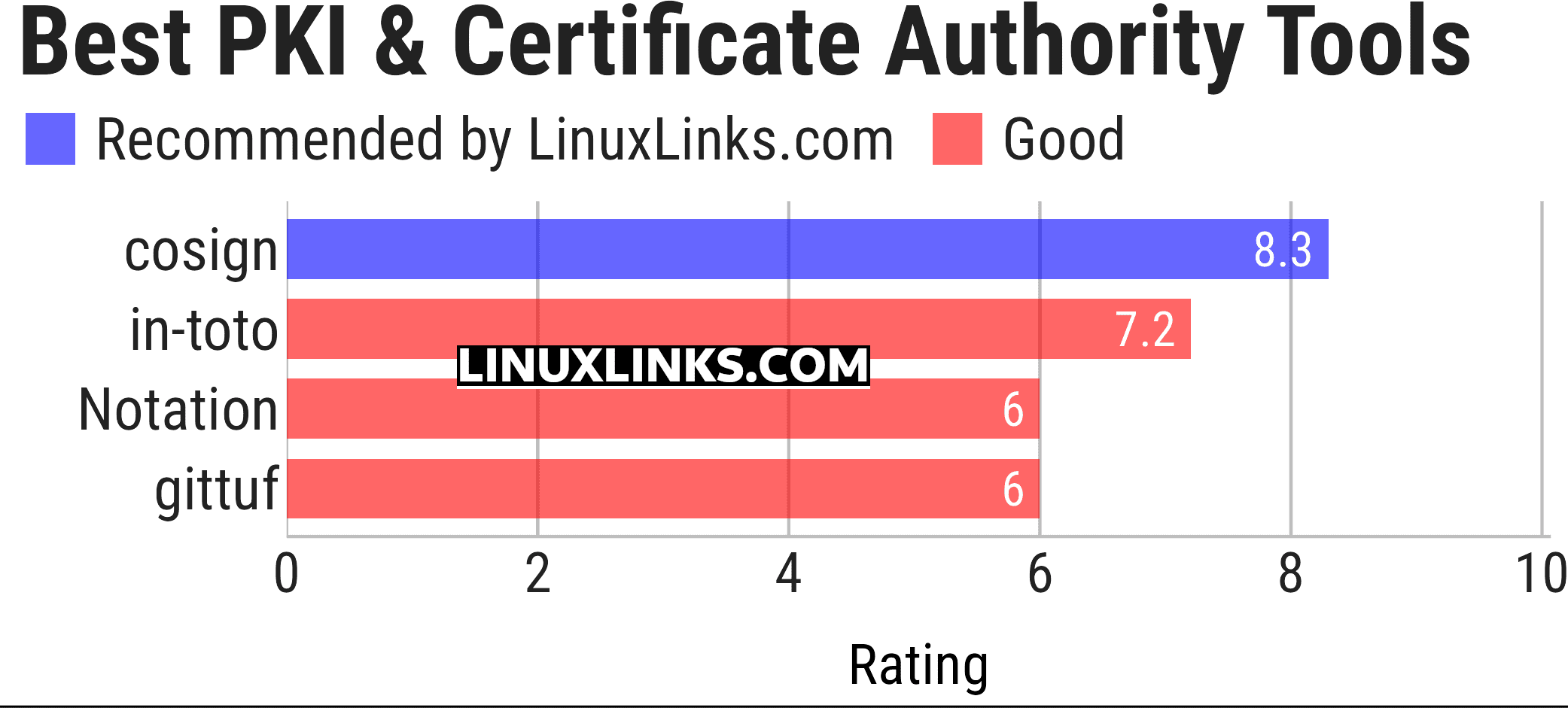
Click the links to learn more about each tool.
| PKI and Certificate Authority Tools | |
|---|---|
| cosign | Sign, verify and protect software artifacts using Sigstore |
| in-toto | Framework for securing the integrity of software supply chains |
| Notation | Sign and verify container images and other OCI artifacts |
| gittuf | Security layer for protecting Git repositories and development workflows |
 Explore our carefully curated directory of recommended free and open source software, covering every major software category. Explore our carefully curated directory of recommended free and open source software, covering every major software category.The directory forms part of our extensive collection of articles for Linux enthusiasts. It includes hundreds of detailed reviews, together with free and open source alternatives to proprietary software from companies such as Google, Microsoft, Apple, Adobe, IBM, Cisco, Oracle, and Autodesk. LinuxLinks also covers interesting projects worth exploring, Linux-compatible hardware, free programming books and tutorials, and much more. Know a useful free and open source Linux application that we haven’t covered? Tell us about it using our submission form. |
Please read our Comment Policy before commenting.