

The Berkeley Advanced Reconstruction Toolbox (BART) toolbox is an image-reconstruction framework for Computational Magnetic Resonance Imaging.
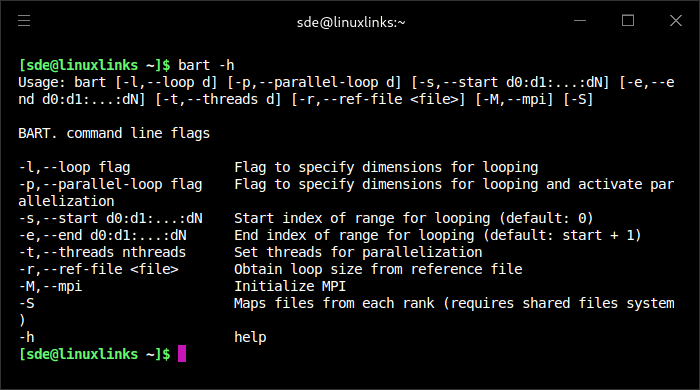
It consists of a programming library and a toolbox of command-line programs. The library provides common operations on multi-dimensional arrays, Fourier and wavelet transforms, as well as generic implementations of iterative optimization algorithms. The command-line tools provide direct access to basic operations on multi-dimensional arrays as well as efficient implementations of many calibration and reconstruction algorithms for parallel imaging and compressed sensing.
The software is intended for research use only and NOT FOR DIAGNOSTIC USE.
This is free and open source software.
Features include:
- Basic features:
- runs on Linux and Mac OS X
- multi-dimensional operations on arrays
- fast non-uniform Fourier Transform (nuFFT, convolution-based method, GPU gridding)
- multi-dimensional (divergence-free) wavelet transform
- parallel computation on multiple cores and with Graphical Processing Units (GPU)
- Iterative methods:
- Conjugate Gradients (CG)
- (Fast) Iterative Soft-Thresholding Algorithm (ISTA and FISTA)
- Normalized iterative hard thresholding (NIHT)
- Alternating Direction Method of Multipliers (ADMM)
- Iteratively Regularized Gauss-Newton Method (IRGNM)
- Primal-dual hybrid gradient algorithm
- Adam, stochastic gradient descent, adadelta, iPALM
- Calibration methods:
- direct calibration of coil sensitivities from k-space center
- Walsh’s method for calibration of coil sensitivities
- ESPIRiT
- (geometric) channel compression and whitening
- RING: estimation of gradient delays for radial MRI
- Reconstruction methods for MRI:
- iterative parallel imaging reconstruction: POCSENSE, SENSE
- compressed sensing and parallel imaging
- calibration-less parallel imaging: NLINV and ENLIVE (non-linear optimization) and SAKE
- (structured low-rank matrix completion)
- reconstruction with linear subspace constraints
- non-linear model-based reconstruction for T1, T2, T2*, flow, and water-fat mapping
- methods based on deep learning: variational networks and MoDL
- Regularization (in arbitrary dimensions):
- Tikhonov
- total (generalized) variation
- l1-wavelet
- (multi-scale) low-rank
- Tensorflow-based priors
Website: codeberg.org/mrirecon/bart
Support:
Developer: Martin Uecker (Graz University of Technology), Jon Tamir (UT Austin), and Michael Lustig (UC Berkeley)
License: BSD license
BART is written in C. Learn C with our recommended free books and free tutorials.
| Explore Linux | |
|---|---|
 | Best Free and Open Source Software - A huge collection of recommended free and open source software covering every major category. |
 | In-depth Linux Software Reviews - Detailed assessments of Linux software covering features, usability and overall quality. |
 | The Big List of Active Linux Distros - An extensive collection of actively developed Linux distributions. |
 | Open Source Alternatives - Alternatives to software and services from Google, Microsoft, Apple, Adobe, IBM, Autodesk, Oracle and others. |
 | Essential Linux System Tools - Indispensable utilities for monitoring, maintaining and managing Linux systems. |
 | Linux Productivity Tools - Useful utilities for improving productivity and streamlining everyday tasks. |
 | Alternatives to Popular CLI Tools - Modern alternatives to familiar command-line utilities supplied with Linux systems. |
 | Awesome Free Linux Game Tools - Tools, utilities and companion software that improve gaming on Linux. |
 | Machine Learning on Linux - Machine learning and deep learning software, self-hosted applications and practical tools. |
 | Saving Money with Linux - Practical ways to reduce electricity consumption and lower computing costs with Linux. |
 | Linux Candy - Fun, entertaining and sometimes delightfully quirky software from the lighter side of Linux. |
Please read our Comment Policy before commenting.