

Zoi is a universal package manager and environment setup tool, designed to simplify package management and environment configuration across multiple operating systems.
It’s part of the Zillowe Development Suite (ZDS) and aims to streamline your development workflow by managing tools and project environments with ease.
This is free and open source software.
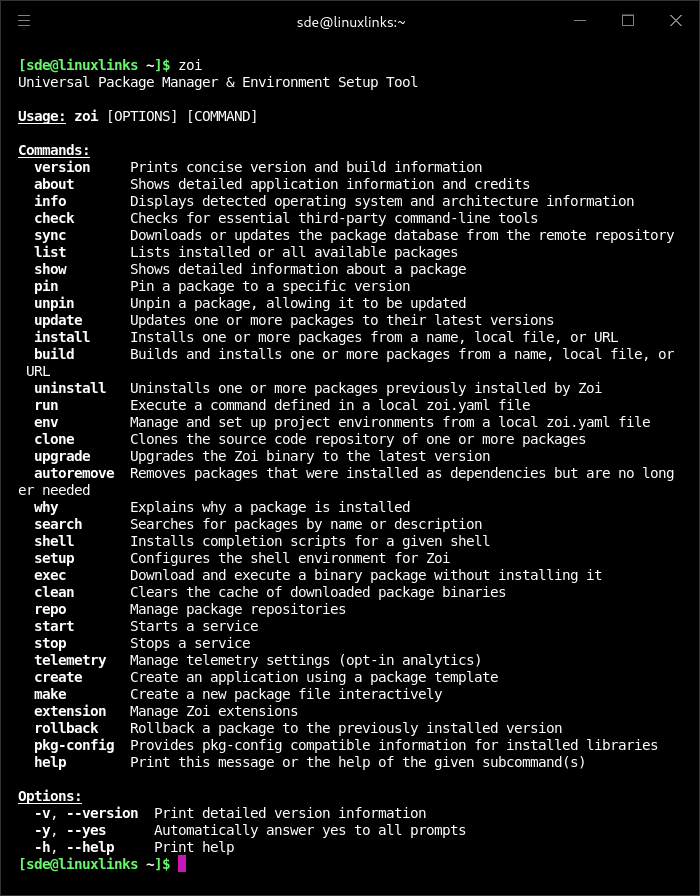
Features include:
- Universal Package Support: Install packages from various sources: binaries, compressed archives, build from source, or installer scripts.
- Extensive Dependency Management: Integrates with over 30+ package managers (apt, brew, cargo, npm, pip, scoop, etc.) to handle dependencies.
- Rich Dependencies: Packages can define runtime and build dependencies with required, optional, and selectable options groups.
- Project Environments: Easily define and manage project-specific environments and commands using zoi.yaml.
- Repository-Based: Manage packages from official or community repositories. Easily add your own.
- Intuitive CLI: A simple and powerful command-line interface with helpful aliases for a better developer experience.
- Package Types: Supports standard packages, meta-packages (collections), background services, configuration packages, extensions, libraries, and app templates.
- Secure Package Distribution: Support for checksums and GPG signatures to verify package integrity and authenticity.
- Tag-based Discovery: Search by and filter packages using tags for faster discovery.
- Use as a Library: Integrate Zoi’s package management features directly into your Rust applications. See the Library documentation for details.
- Package Recording & Re-installation: Automatically keeps a record of all installed packages, which can be used to easily reinstall them on a new machine.
- Cross-platform support – runs under Linux, macOS, and Windows.
Website: gitlab.com/zillowe/zillwen/zusty/zoi
Support: Documentation
Developer: Zusty – Zillowe Foundation
License: Apache 2.0 License
Zoi is written in Rust. Learn Rust with our recommended free books and free tutorials.
| Explore Linux | |
|---|---|
 | Best Free and Open Source Software - A huge collection of recommended free and open source software covering every major category. |
 | In-depth Linux Software Reviews - Detailed assessments of Linux software covering features, usability and overall quality. |
 | The Big List of Active Linux Distros - An extensive collection of actively developed Linux distributions. |
 | Open Source Alternatives - Alternatives to software and services from Google, Microsoft, Apple, Adobe, IBM, Autodesk, Oracle and others. |
 | Essential Linux System Tools - Indispensable utilities for monitoring, maintaining and managing Linux systems. |
 | Linux Productivity Tools - Useful utilities for improving productivity and streamlining everyday tasks. |
 | Alternatives to Popular CLI Tools - Modern alternatives to familiar command-line utilities supplied with Linux systems. |
 | Awesome Free Linux Game Tools - Tools, utilities and companion software that improve gaming on Linux. |
 | Machine Learning on Linux - Machine learning and deep learning software, self-hosted applications and practical tools. |
 | Saving Money with Linux - Practical ways to reduce electricity consumption and lower computing costs with Linux. |
 | Linux Candy - Fun, entertaining and sometimes delightfully quirky software from the lighter side of Linux. |
Please read our Comment Policy before commenting.
Hi, I’m the author of Zoi, thank you so much for sharing my project, v5 Beta is on the way and it has so many exciting features
Looks an impressive tool – a single tool that lets you manage packages whatever they are is really interesting and a very worthwhile project.
I’m a bit wary about using pip. Does Zoi stop pip from polluting the system, as I always read that it’s much safer to use a conda environment or something like pipx rather than use pip?
I don’t really use python, but Zoi is a binary and source package manager with a build system soon.
Do you have any suggestions for python integration?
Zoi has a rich dependency system that can install dependencies from other package managers like pip, pipx and conda but it doesn’t organise them, it just run the install command from that package manager.
You can take look at the docs for all the features.
Many Linux distributions don’t even allow you to use pip unless its used within something like Conda, a system package manager which addresses dependency conflicts native to the pip package manager (that installs any dependent Python package without checking for conflicts). Conda is available through Anaconda or Miniconda.
Conda is not the only option. I’ve sometimes used the venv module which also lets you create lightweight virtual environment each with their own independent set of Python packages.
pipx is also another option, but for some Python software it’s easier to use Conda.
BTW, for the reasons explained in the Comment FAQ, external links in the Comments section are not allowed, but I’ve added the Documentation link into the article.
Thank you, I really appreciate it.
Zoi’s purpose is to be a binary/source package manager with a build system (currently working on it) so its not tide to python ecosystem, but you can add dependencies from other package managers such as conda, pip, pipx and uv (handled by running the equivalent commands).
I’ll probably create a language-specific package later but for now just that.