

SkillFishOS is a Debian-based Linux distribution designed primarily for the AMD BC-250 compute board. It uses KDE Plasma and seeks to turn the inexpensive mining-oriented board into a ready-to-use desktop computer and gaming console.
The distribution includes a customised kernel, hardware-specific patches, clock and thermal profiles, and graphical tools for controlling the BC-250’s CPU, GPU, fan and Compute Units. It also ships with a gaming and emulation stack, a steampunk-themed desktop, automatic system snapshots, and a collection of native management applications. A generic edition is available for other x86-64 computers and virtual machines.
Key Features
- Provides a customised linux-tkg kernel with BC-250-specific patches.
- Offers optional control of the board’s disabled CPU cores and GPU Compute Units.
- Includes a graphical Tuner for clocks, voltages, fan speed and thermal profiles.
- Ships with Steam, Heroic, Proton, gamescope, GameMode and MangoHud.
- Provides EmuDeck and ES-DE for installing and managing emulators.
- Uses Btrfs with Snapper and grub-btrfs for automatic snapshots and bootable rollback.
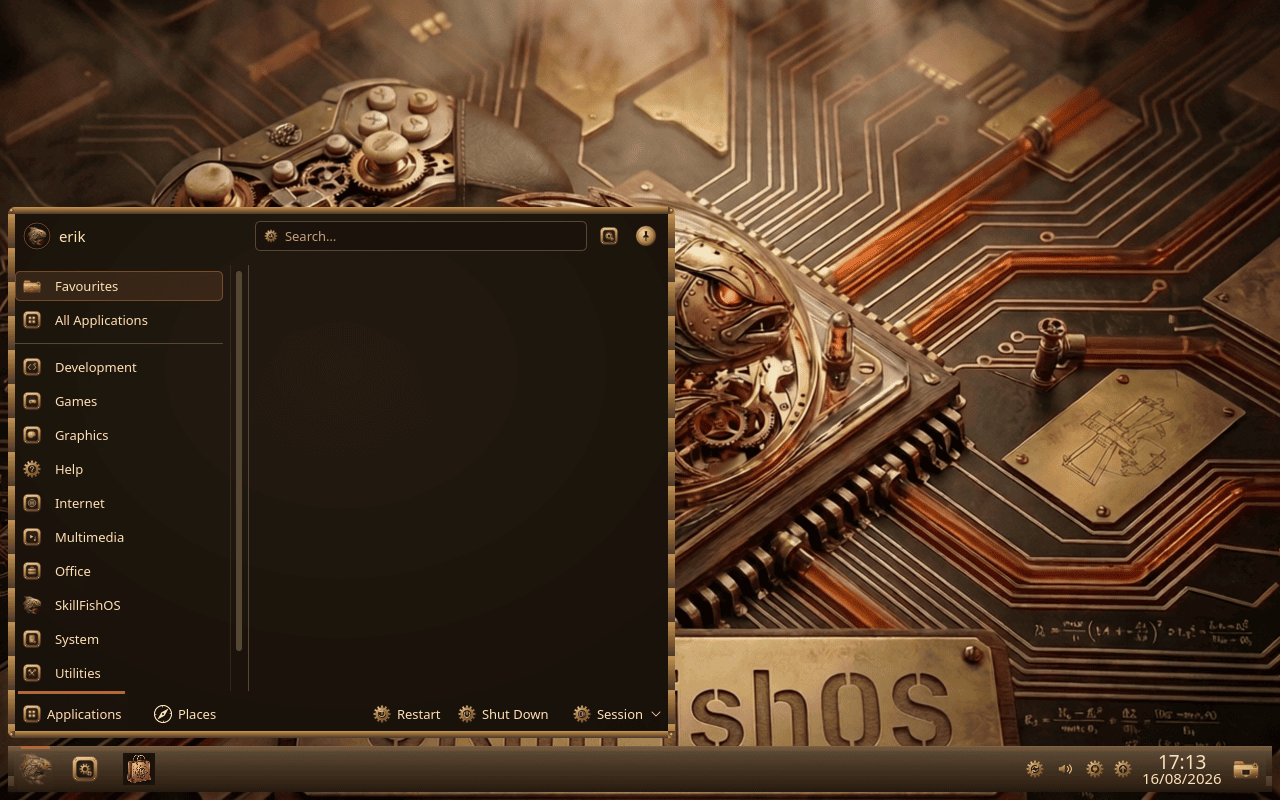
- Includes a steampunk theme spanning GRUB, Plymouth, SDDM and KDE Plasma.
- Provides a live system display showing processor load, clocks, temperatures, power consumption and fan speed.
- Includes native utilities for kernel management, system monitoring, mounting ISO images and installing software.
- Offers a web-based Remote Manager with telemetry, terminal access, software management and KVM functionality.
- Includes a local AI stack accelerated through Vulkan.
- Receives tested packages through the project’s signed APT repository.
- Uses the Calamares graphical system installer.
| Working state: | Active |
| Desktop: | KDE Plasma |
| Init Software: | systemd |
| Package Management: | APT |
| Release Model: | Fixed |
| Platforms: | x86_64 |
| Home Page: | skillfishos.com |
| Developer: | MTSistemi |
| This article is part of our Big List of Active Linux Distributions and Open Source Operating Systems. |
What's a Linux distribution ("distro")? |
| A distro provides the user with a desktop environment, preloaded applications, and ways to update and maintain the system. Each distro makes different choices, deciding which open source projects to install and provides custom written programs. They can have different philosophies. Some distros are intended for desktop computers, some for servers without a graphical interface, and others for special uses. Because Linux is an open source operating system, combinations of software vary between Linux distros. |
Please read our Comment Policy before commenting.