
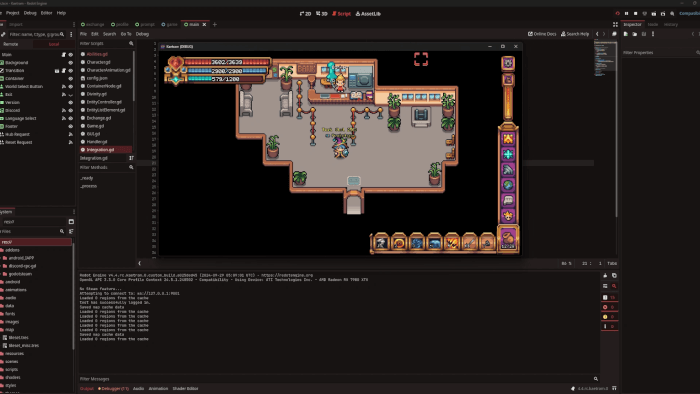
Redot Engine is a feature-packed, cross-platform game engine to create 2D and 3D games from a unified interface. It provides a comprehensive set of common tools, so that users can focus on making games without having to reinvent the wheel.
Games can be exported with one click to a number of platforms, including the major desktop platforms (Linux, macOS, Windows), mobile platforms (Android, iOS), as well as Web-based platforms and consoles.
Redot Engine is a completely free and open source fork of Godot.
Features include:
- 3 rendering methods:
- Forward+, running over Vulkan 1.0 (with optional Vulkan 1.1 and 1.2 features). The most advanced graphics backend, suited for desktop platforms only. Used by default on desktop platforms.
- Forward Mobile, running over Vulkan 1.0 (with optional Vulkan 1.1 and 1.2 features). Less features, but renders simple scenes faster. Suited for mobile and desktop platforms. Used by default on mobile platforms.
- Compatibility, running over OpenGL 3.3 / OpenGL ES 3.0 / WebGL 2.0. The least advanced graphics backend, suited for low-end desktop and mobile platforms. Used by default on the web platform.
- Good support for 2D graphics including:
- Sprite, polygon and line rendering.
- High-level tools to draw lines and polygons such as Polygon2D and Line2D, with support for texturing.
- AnimatedSprite2D as a helper for creating animated sprites.
- Parallax layers.
- Pseudo-3D support including preview in the editor.
- 2D lighting with normal maps and specular maps.
- Point (omni/spot) and directional 2D lights.
- Hard or soft shadows (adjustable on a per-light basis).
- Custom shaders can access a real-time SDF representation of the 2D scene based on LightOccluder2D nodes, which can be used for improved 2D lighting effects including 2D global illumination.
- Font rendering using bitmaps, rasterization using FreeType or multi-channel signed distance fields (MSDF).
- Bitmap fonts can be exported using tools like BMFont, or imported from images (for fixed-width fonts only).
- Dynamic fonts support monochrome fonts as well as colored fonts (e.g. for emoji). Supported formats are TTF, OTF, WOFF1 and WOFF2.
- Dynamic fonts support optional font outlines with adjustable width and color.
- Dynamic fonts support variable fonts and OpenType features including ligatures.
- Dynamic fonts support simulated bold and italic when the font file lacks those styles.
- Dynamic fonts support oversampling to keep fonts sharp at higher resolutions.
- Dynamic fonts support subpixel positioning to make fonts crisper at low sizes.
- Dynamic fonts support LCD subpixel optimizations to make fonts even crisper at low sizes.
- Signed distance field fonts can be scaled at any resolution without requiring re-rasterization. Multi-channel usage makes SDF fonts scale down to lower sizes better compared to monochrome SDF fonts.
- GPU-based particles with support for custom particle shaders.
- CPU-based particles.
- Optional 2D HDR rendering for better glow capabilities.
- Sprite, polygon and line rendering.
- 3D graphics:
- HDR rendering with sRGB.
- Perspective, orthographic and frustum-offset cameras.
- When using the Forward+ backend, a depth prepass is used to improve performance in complex scenes by reducing the cost of overdraw.
- Variable rate shading on supported GPUs in Forward+ and Forward Mobile.
Website: github.com/Redot-Engine/redot-engine
Support:
Developer: Redot Engine contributors
License: MIT License
Redot Engine is written in C++. Learn C++ with our recommended free books and free tutorials.
| Explore Linux | |
|---|---|
 | Best Free and Open Source Software - A huge collection of recommended free and open source software covering every major category. |
 | In-depth Linux Software Reviews - Detailed assessments of Linux software covering features, usability and overall quality. |
 | The Big List of Active Linux Distros - An extensive collection of actively developed Linux distributions. |
 | Open Source Alternatives - Alternatives to software and services from Google, Microsoft, Apple, Adobe, IBM, Autodesk, Oracle and others. |
 | Essential Linux System Tools - Indispensable utilities for monitoring, maintaining and managing Linux systems. |
 | Linux Productivity Tools - Useful utilities for improving productivity and streamlining everyday tasks. |
 | Alternatives to Popular CLI Tools - Modern alternatives to familiar command-line utilities supplied with Linux systems. |
 | Awesome Free Linux Game Tools - Tools, utilities and companion software that improve gaming on Linux. |
 | Machine Learning on Linux - Machine learning and deep learning software, self-hosted applications and practical tools. |
 | Saving Money with Linux - Practical ways to reduce electricity consumption and lower computing costs with Linux. |
 | Linux Candy - Fun, entertaining and sometimes delightfully quirky software from the lighter side of Linux. |
Please read our Comment Policy before commenting.