

Scilab is a numerical computational package developed by INRIA and École nationale des ponts et chaussées (ENPC), both organisations located in France.
It is a high level programming language in that most of its functionality is based around the ability to specify many computations with few lines of code. It does this primarily by abstracting primitive data types to functionally equivalent matrices.
Scilab has been designed to be an open system where the user can define new data types and operations on these data types by using overloading.
Scilab includes hundreds of mathematical functions. It has a high level programming language allowing access to advanced data structures, 2-D and 3-D graphical functions.
Scilab syntax is largely based on the MATLAB language.
The software has been in development since 1994.
Key Features
- 2-D and 3-D graphics, animation.
- Linear algebra, sparse matrices.
- Polynomials and rational functions.
- Interpolation, approximation.
- Simulation: ODE solver and DAE solver.
- Scicos: a hybrid dynamic systems modeler and simulator.
- Classic and robust control, LMI optimization.
- Differentiable and non-differentiable optimization.
- Signal processing.
- Metanet: graphs and networks.
- Parallel Scilab.
- Statistics.
- Interface with Computer Algebra: Maple package for Scilab code generation.
- Interface with Fortran, Tcl/Tk, C, C++, Java, LabVIEW.
- Xcos provides a new state of the art user interface for Scicos (INRIA) which allows to take all advantages of the powerful simulator.
- ATOMS is an embedded packaging system for Scilabmodules (toolboxes).
- LaTeX/MathMl.
- Unified and consistent API.
- SciNotes Text editor:
- Code navigator.
- On-the-fly typing completion.
- Multiple editor instances management.
- GUI customization.
- Last session restoration.
- Tabs drag & drop management.
- Advanced scripting capabilities.
- Cross-platform support – runs under Linux, macOS, and Windows.
Website: www.scilab.org
Support: Documentation, Tutorials, Wiki
Developer: Institut national de recherche en informatique et en automatique (INRIA)
License: CeCILL license
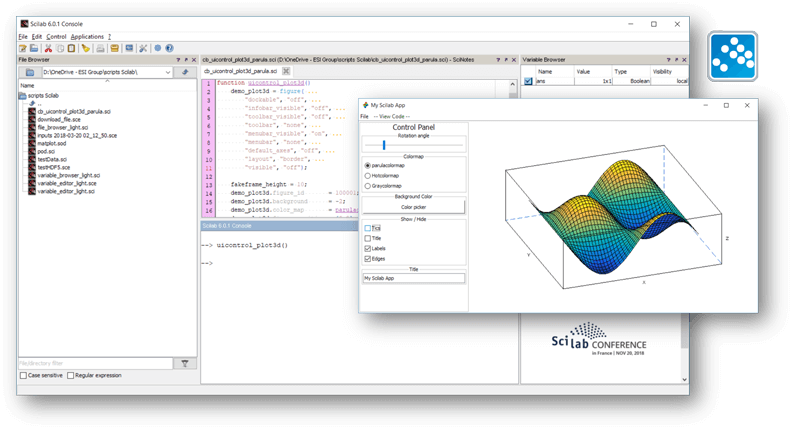
Scilab is written in C++, C, and Java. Learn C++ with our recommended free books and free tutorials. Learn C with our recommended free books and free tutorials. Learn Java with our recommended free books and free tutorials.
Related Software
| Computer Algebra Systems | |
|---|---|
| Scilab | Numerical computational package |
| Maxima | System for the manipulation of symbolic and numerical expressions |
| Octave | Powerful programming language with built-in plotting and visualization tools |
| SageMath | Open source alternative to Magma, Maple, Mathematica and Matlab |
| SymPy | Python library for symbolic mathematics |
| SINGULAR | Computer Algebra System for polynomial computations |
| Macaulay2 | Software system for research in algebraic geometry |
| Cadabra | Symbolic computer algebra system for field theory problems |
| PARI/GP | Widely used algebra system designed for fast computations in number theory |
| GAP | System for computational discrete algebra |
| FriCAS | Fork of Axiom |
| CoCoA | System for doing computations in commutative algebra |
| Mathics | General-purpose CAS with Mathematica-compatible syntax and functions |
| FORM | Symbolic Manipulation System |
| Nelson | Numerical computational language |
| wxMaxima | GUI for the sublime Maxima CAS |
| Xcas | Cross-platform mathematical environment |
| REDUCE | General-purpose computer algebra system for symbolic computation |
| Axiom | General purpose Computer Algebra system |
| Symja | Computer algebra system and symbolic mathematics library |
| CGSuite | For research in combinatorial game theory |
Read our verdict in the software roundup.
 Explore our comprehensive directory of recommended free and open source software. Our carefully curated collection spans every major software category. Explore our comprehensive directory of recommended free and open source software. Our carefully curated collection spans every major software category.This directory is part of our ongoing series of informative articles for Linux enthusiasts. It features hundreds of detailed reviews, along with open source alternatives to proprietary solutions from major corporations such as Google, Microsoft, Apple, Adobe, IBM, Cisco, Oracle, and Autodesk. You’ll also find interesting projects to try, hardware coverage, free programming books and tutorials, and much more. Discovered a useful open source Linux program that we haven’t covered yet? Let us know by completing this form. |
Please read our Comment Policy before commenting.