

Quantum chemistry uses the principles of quantum mechanics to understand the behaviour of atoms, molecules and materials. It helps researchers investigate chemical bonds, molecular structures, reaction mechanisms and the electronic properties of matter.
Computational quantum chemistry software makes it possible to perform these calculations without relying entirely on laboratory experiments. Researchers can predict molecular energies, optimise geometries, study chemical reactions and model the properties of materials.
Several computational approaches are used. Ab initio methods calculate molecular properties from first principles, while density functional theory (DFT) uses electron density to investigate electronic structure. Semiempirical methods introduce approximations and fitted parameters to reduce computational costs, making calculations practical for larger systems.
Electronic structure calculations describe how electrons are distributed within atoms, molecules and solids. Atomistic simulations extend this work to model the structure, interactions and sometimes the movement of atoms in materials. These techniques are widely used in chemistry, physics, materials science and pharmaceutical research.
Here’s our verdict captured in a legendary LinuxLinks-ratings chart. Only free and open source software is eligible for inclusion here.
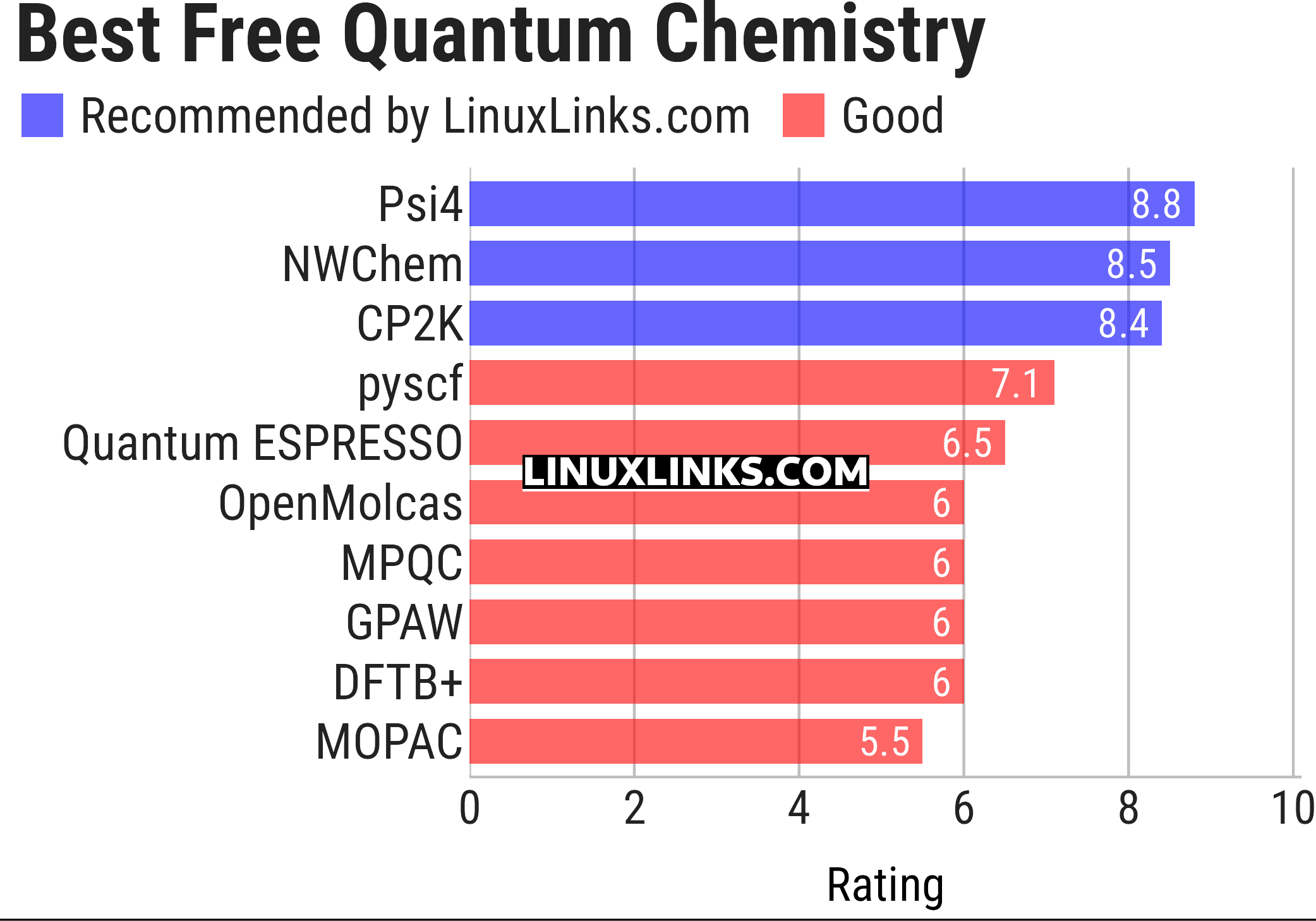
| Quantum Chemistry & Electronic Structure | |
|---|---|
| Psi4 | High-accuracy quantum chemistry calculations for molecules |
| NWChem | Scalable computational chemistry for molecules and materials |
| CP2K | Atomistic simulations of solids, liquids and molecules |
| pyscf | Python framework for electronic structure calculations |
| Quantum ESPRESSO | Plane-wave DFT calculations for electronic structure and materials |
| OpenMolcas | Advanced multiconfigurational methods for molecular chemistry |
| MPQC | Massively parallel electronic structure calculations for research |
| GPAW | Density functional theory calculations using the PAW method |
| DFTB+ | Fast atomistic modelling using density-functional tight binding |
| MOPAC | Semiempirical quantum chemistry for molecules and materials |
 Explore our carefully curated directory of recommended free and open source software, covering every major software category. The directory forms part of our extensive collection of articles for Linux enthusiasts. It includes hundreds of detailed reviews, together with free and open source alternatives to proprietary software from companies such as Google, Microsoft, Apple, Adobe, IBM, Cisco, Oracle, and Autodesk. LinuxLinks also covers interesting projects worth exploring, Linux-compatible hardware, free programming books and tutorials, and much more. Know a useful free and open source Linux application that we haven’t covered? Tell us about it using our submission form. |
Please read our Comment Policy before commenting.