
Python is a high-level, general-purpose, structured, powerful, open source programming language that is used for a wide variety of programming tasks. It features a fully dynamic type system and automatic memory management, similar to that of Scheme, Ruby, Perl, and Tcl, avoiding many of the complexities and overheads of compiled languages. The language was created by Guido van Rossum in 1991, and continues to grow in popularity.
Python is a very useful and popular computer language. One of the benefits of using an interpreted language such as Python is exploratory programming with its interactive shell. You can try out code without having to write a script. But there are limitations with the Python shell.
Fortunately, there are some excellent alternative Python shells that extend on the basic shell. They each offer a good interactive Python experience. Here’s our verdict captured in the chart below.
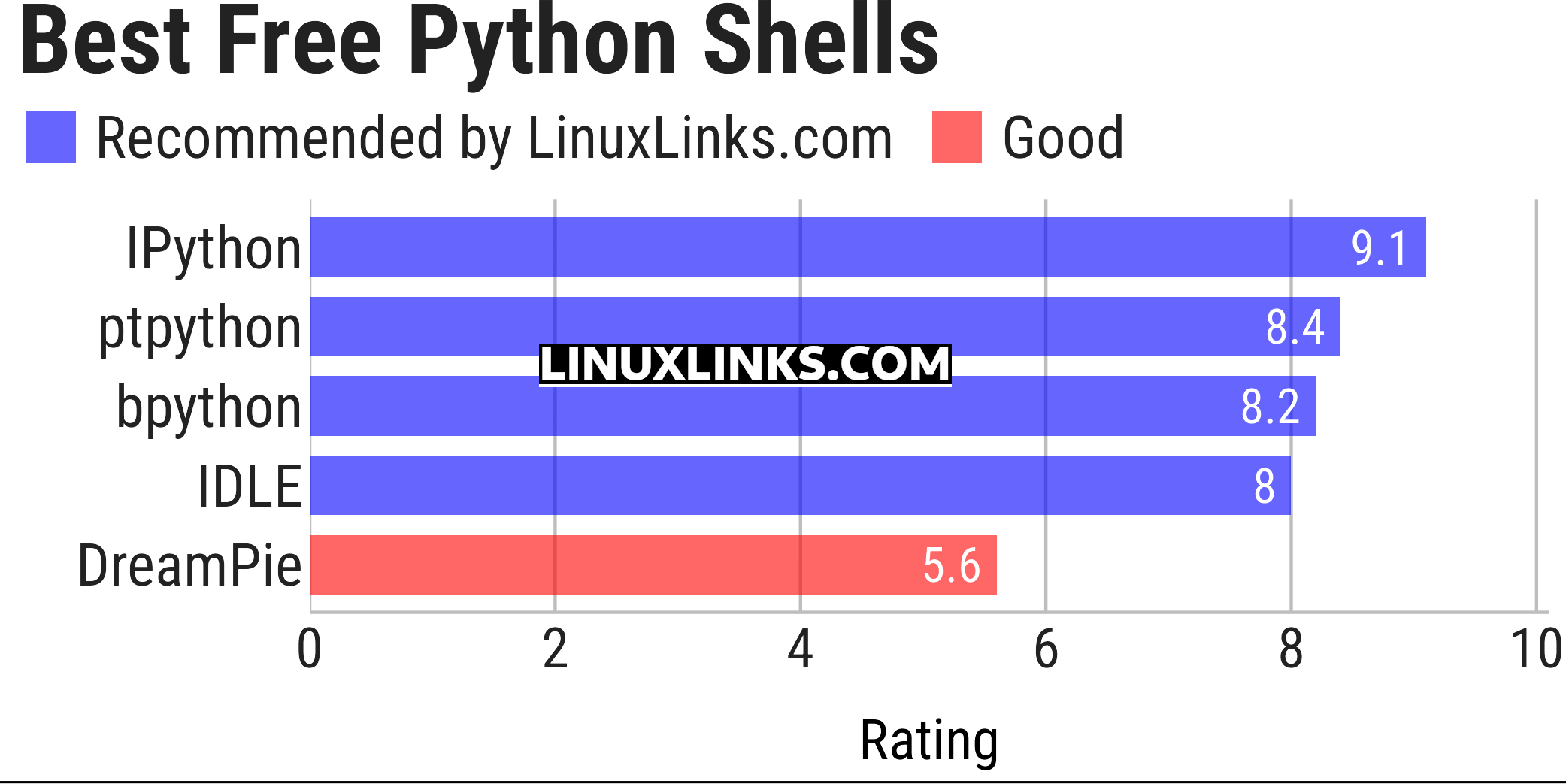
Click the links in the table below to learn more about each shell.
| Open Source Python Shells | |
|---|---|
| IPython | Enhanced interactive Python shell |
| ptpython | Advanced Python Read-Eval-Print Loop |
| bpython | Fancy interface to the Python interpreter for Linux, BSD, OS X and Windows |
| IDLE | Integrated development environment for Python |
| DreamPie | Python shell which is designed to be reliable and fun |
This article has been updated to reflect the changes outlined in our recent announcement.
 Explore our comprehensive directory of recommended free and open source software. Our carefully curated collection spans every major software category. Explore our comprehensive directory of recommended free and open source software. Our carefully curated collection spans every major software category.This directory is part of our ongoing series of informative articles for Linux enthusiasts. It features hundreds of detailed reviews, along with open source alternatives to proprietary solutions from major corporations such as Google, Microsoft, Apple, Adobe, IBM, Cisco, Oracle, and Autodesk. You’ll also find interesting projects to try, hardware coverage, free programming books and tutorials, and much more. Know a useful open source Linux program that we haven’t covered yet? Let us know by completing this form. |
Python is a general-purpose high-level programming language. Its design philosophy emphasizes programmer productivity and code readability. It has a minimalist core syntax with very few basic commands and simple semantics, but it also has a large and comprehensive standard library, including an Application Programming Interface (API).
It features a fully dynamic type system and automatic memory management, similar to that of Scheme, Ruby, Perl, and Tcl, avoiding many of the complexities and overheads of compiled languages. The language was created by Guido van Rossum in 1991, and continues to grow in popularity, in part because it is easy to learn with a readable syntax. The name Python derives from the sketch comedy group Monty Python, not from the snake.
Python is an increasingly popular programming language. It ranks very highly on sites listing the popularity of programming languages, such as the TIOBE Index, IEEE Spectrum ranking, and the PYPL PopularitY of Programming Language.
The prominence of Python is, in part, due to its flexibility, with the language frequently used by web and desktop developers, system administrators, data scientists, and machine learning engineers. It’s easy to learn and powerful to develop any kind of system with the language. Python’s large user base offers a virtuous circle. There’s more support available from the open source community for budding programmers seeking assistance.