
A database is a collection of records or data that is stored in a computer system. Database tools and applications are designed to help you store and manage data in a controlled and structured manner. A database is a vital system for any organisation that stores mission critical information. The continual failure of a company’s database system will inevitably lead to the demise of the organisation; companies cannot function without a fully working database system.
There are a number of different types of database. The most popular choice in storing data such as personal information, financial records, and medical records is the relational database management system. This type of system makes use of common ‘keys’ to tie related information together with data being manipulated with the SQL data definition and query language. SQL has many strengths for querying data. However, there are some disadvantages inherent in SQL. For example, SQL does not scale horizontally particularly well.
A graph database stores nodes and relationships instead of tables, or documents. Data is stored just like you might sketch ideas on a whiteboard. Your data is stored without restricting it to a pre-defined model, allowing a very flexible way of thinking about and using it.
Here’s our verdict on the finest graph databases that run under Linux. We only include free and open source software.
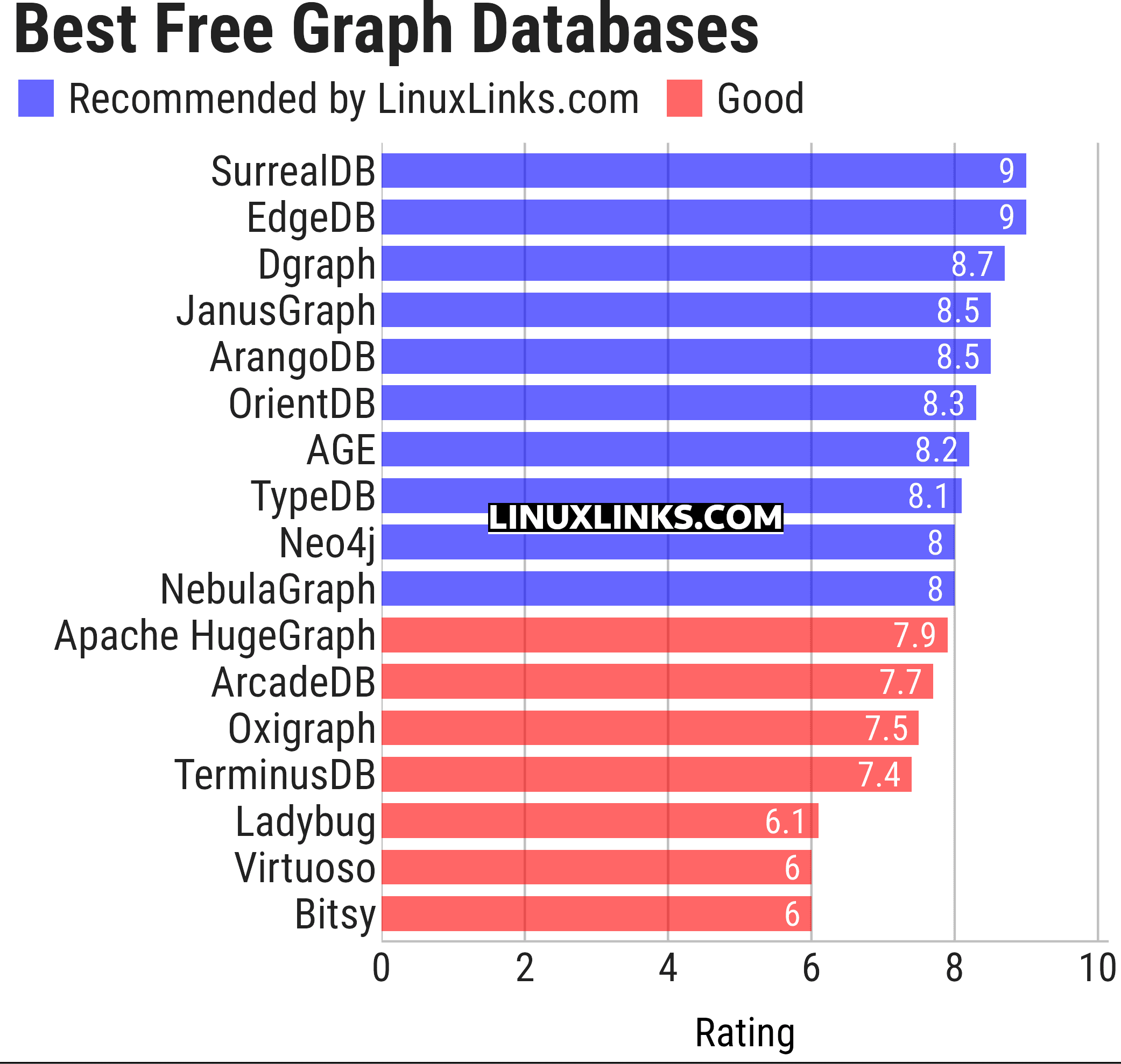
Click the links in the table below to learn more about each database.
| Graph Databases | |
|---|---|
| SurrealDB | Scalable, distributed, collaborative, document-graph database |
| EdgeDB | Graph-relational database with declarative schema |
| Dgraph | Distributed GraphQL database built for high-performance graph workloads |
| JanusGraph | Distributed graph database |
| ArangoDB | Scalable graph database system to drive value from connected data, faster |
| OrientDB | Document-graph database |
| AGE | PostgreSQL extension bringing graph database capabilities to SQL |
| TypeDB | Polymorphic database with a conceptual data model |
| Neo4j | Native graph database that is built to store and retrieve connected data |
| NebulaGraph | Graph database that can handle large volumes of data |
| HugeGraph | Highly scalable graph database designed for massive connected datasets |
| ArcadeDB | Multi-model database blending graph, document, and key-value data |
| Oxigraph | Lightweight RDF graph database implementing SPARQL and RDF standards |
| TerminusDB | Document-oriented graph database for building collaborative applications |
| Ladybug | Embedded graph database |
| Virtuoso | Middleware and database engine hybrid |
| Bitsy | Small, fast, embeddable, durable in-memory graph database |
This article has been updated to reflect the changes outlined in our recent announcement.
 Explore our comprehensive directory of recommended free and open source software. Our carefully curated collection spans every major software category. Explore our comprehensive directory of recommended free and open source software. Our carefully curated collection spans every major software category.This directory is part of our ongoing series of informative articles for Linux enthusiasts. It features hundreds of detailed reviews, along with open source alternatives to proprietary solutions from major corporations such as Google, Microsoft, Apple, Adobe, IBM, Cisco, Oracle, and Autodesk. You’ll also find interesting projects to try, hardware coverage, free programming books and tutorials, and much more. Know a useful open source Linux program that we haven’t covered yet? Let us know by completing this form. |
Please read our Comment Policy before commenting.
Why no mention of neo4j
Yes, it looks like neo4j should have been included. We’ll rectify.