

Secret scanning tools are designed to identify credentials and other sensitive information that have accidentally been stored in source code, configuration files, repositories or commit history. They are widely used by software developers, DevOps teams, security engineers and organisations that want to reduce the risk of passwords, API keys, access tokens, private keys and similar data being exposed.
These tools typically search files and Git repositories for patterns that resemble known types of secrets. Some can scan current working trees, previous commits and staged changes, while others integrate with development workflows to catch sensitive data before it is committed. More advanced tools can validate discovered credentials, reduce false positives, apply custom detection rules and scan large collections of source code or other textual data.
Used as part of a secure development process, secret scanning provides an additional safeguard against accidental disclosure. It does not replace good credential management, but it can catch mistakes early and help teams find exposed secrets before attackers, automated crawlers or unauthorised users discover and exploit them during routine development, audits, code review and incident response.
Here’s our verdict on the best Linux-based secret scanning tools, captured in our legendary LinuxLinks-style ratings chart. Only free and open source software is eligible for inclusion.
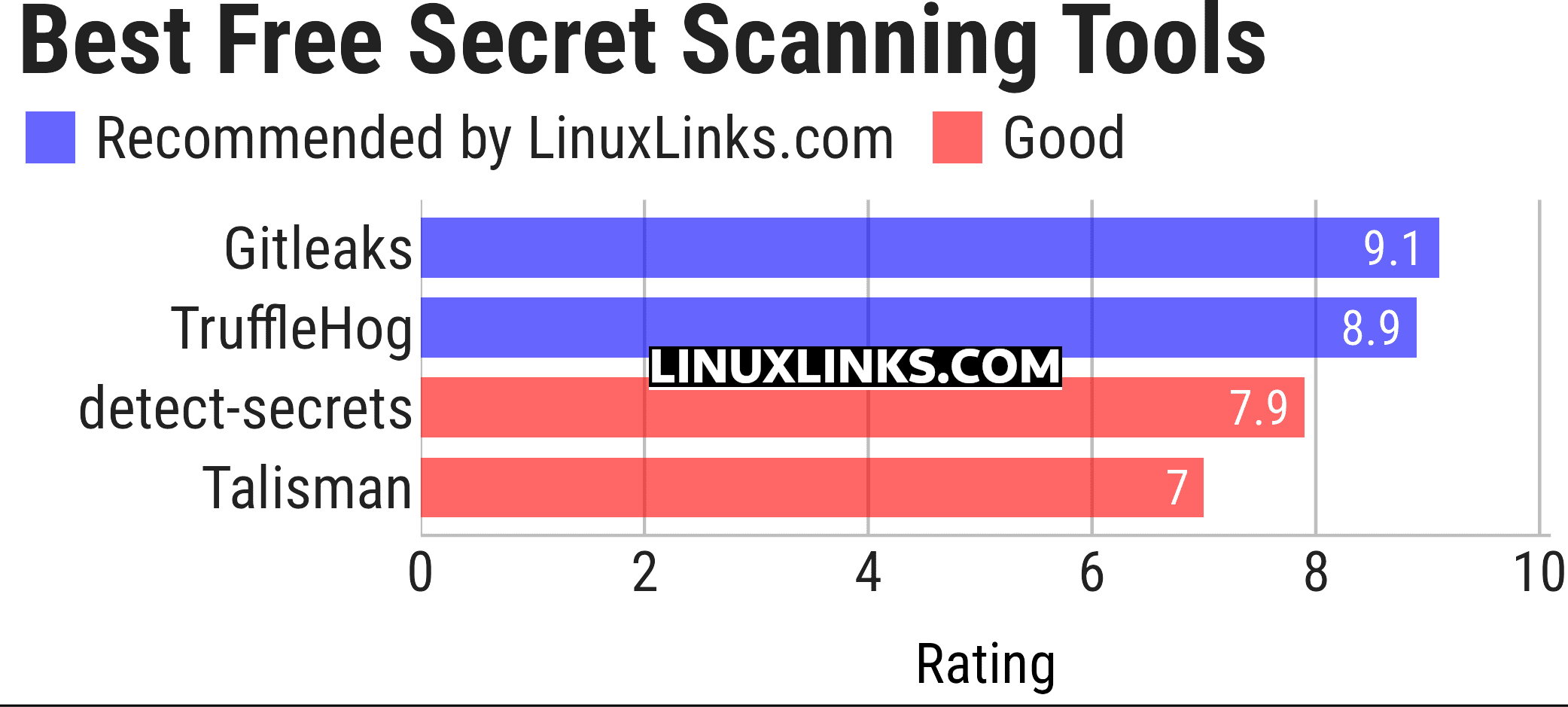
Click the links below to learn more about each tool.
| Secret Scanning Tools | |
|---|---|
| Gitleaks | Detects secrets and credentials in Git repositories |
| TruffleHog | Finds, classifies and verifies exposed secrets across many sources |
| detect-secrets | Helps detect and prevent secrets from being committed to source code |
| Talisman | Checks Git changes for secrets and sensitive data before they are committed |
 Explore our carefully curated directory of recommended free and open source software, covering every major software category. Explore our carefully curated directory of recommended free and open source software, covering every major software category.The directory forms part of our extensive collection of articles for Linux enthusiasts. It includes hundreds of detailed reviews, together with free and open source alternatives to proprietary software from companies such as Google, Microsoft, Apple, Adobe, IBM, Cisco, Oracle, and Autodesk. LinuxLinks also covers interesting projects worth exploring, Linux-compatible hardware, free programming books and tutorials, and much more. Know a useful free and open source Linux application that we haven’t covered? Tell us about it using our submission form. |
Please read our Comment Policy before commenting.