

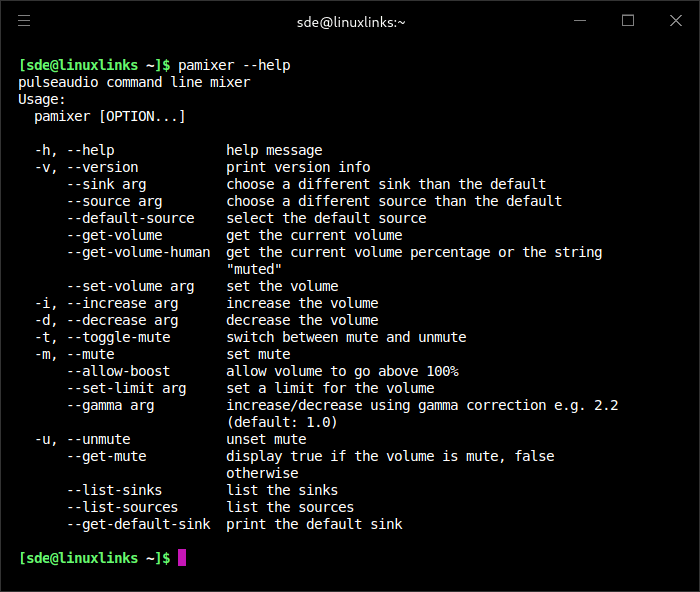
pamixer is like amixer but for PulseAudio. It can control the volume levels of the sinks.
This project also provides a small C++ library to control PulseAudio.
PulseAudio is a sound server for POSIX operating systems, primarily used on Linux, that acts as middleware between applications and audio hardware. It provides features like software mixing, individual volume control per application, and network audio streaming, making it easier to manage sound on a computer. PulseAudio typically runs on top of other systems like Advanced Linux Sound Architecture (ALSA) to provide more advanced functionality.
Key Features
- Get the current volume of the default sink, the default source or a selected one by its id.
- Set the volume for the default sink, the default source or any other device.
- List the sinks.
- List the sources.
- Increase / Decrease the volume for a device (using gamma correction optionally).
- Mute or unmute a device.
Website: github.com/cdemoulins/pamixer
Support:
Developer: Clément Démoulins
License: GNU General Public License v3.0
pamixer is written in C++. Learn C++ with our recommended free books and free tutorials.
Related Software
| Terminal-Based Audio Mixers | |
|---|---|
| wiremix | Simple TUI audio mixer fort Pipewire |
| pamixer | PulseAudio command line mixer |
| pulsemixer | CLI and curses mixer for PulseAudio |
| ncpamixer | ncurses mixer for PulseAudio inspired by pavucontrol |
| PAmix | ncurses/curses PulseAudio mixer written in C |
| pacmixer | PulseAudio tool similar to alsamixer |
| RsMixer | PulseAudio volume mixer |
| alsamixer | Terminal-based mixer for the ALSA sound system |
| pipemixer | TUI volume control software for pipewire |
| JackMiniMix | Simple mixer for the Jack Audio Connection Kit |
Read our verdict in the software roundup.
 Explore our carefully curated directory of recommended free and open source software, covering every major software category. Explore our carefully curated directory of recommended free and open source software, covering every major software category.The directory forms part of our extensive collection of articles for Linux enthusiasts. It includes hundreds of detailed reviews, together with free and open source alternatives to proprietary software from companies such as Google, Microsoft, Apple, Adobe, IBM, Cisco, Oracle, and Autodesk. LinuxLinks also covers interesting projects worth exploring, Linux-compatible hardware, free programming books and tutorials, and much more. Know a useful free and open source Linux application that we haven’t covered? Tell us about it using our submission form. |
Please read our Comment Policy before commenting.