

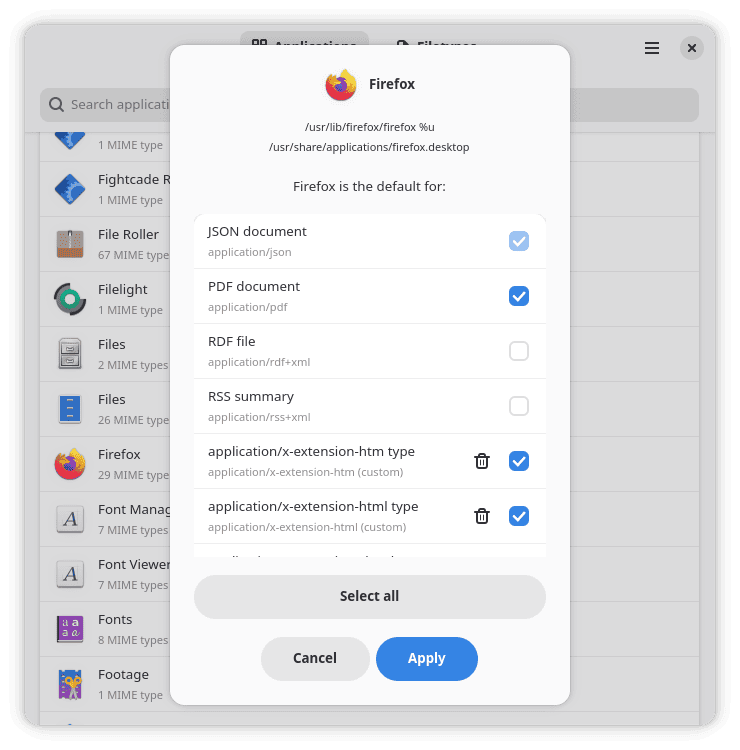
Mimic is a graphical utility for managing default applications and MIME type associations. It provides an easier way to inspect and modify the associations normally stored in mimeapps.list files, avoiding the need to edit these configuration files manually.
The application offers two main views. You can browse installed applications to see the file types associated with each program, or approach the task from the opposite direction by browsing MIME types and selecting which application should handle them. Mimic uses GTK4 and Libadwaita for its interface.
This is free and open source software.
Key Features
- Browse installed applications and their associated MIME types.
- Browse file types grouped into categories such as audio, images, text, video, fonts and models.
- Set the default application used to handle a MIME type.
- Add new MIME type associations to installed applications.
- Remove custom associations that are no longer required.
- Distinguishes between application-provided, custom-added and default associations.
- Recognises system-wide, local, desktop-specific and implicit defaults.
- Can load defaults supplied by the selected desktop environment.
- Search applications by name or executable.
- Search MIME types by identifier or human-readable description.
- Can display applications which do not currently advertise any MIME associations.
- Handles applications represented by multiple desktop files.
- Accounts for multiple applications configured as defaults and duplicate entries.
- Writes changes through temporary files before replacing existing configuration.
- Offers keyboard shortcuts for searching and switching between application and file-type views.
Website: github.com/ArijanJ/Mimic
Support:
Developer: Arijan J
License: GNU General Public License v2.0
Mimic is written in Python. Learn Python with our recommended free books and free tutorials.
 Explore our comprehensive directory of recommended free and open source software. Our carefully curated collection spans every major software category. Explore our comprehensive directory of recommended free and open source software. Our carefully curated collection spans every major software category.This directory is part of our ongoing series of informative articles for Linux enthusiasts. It features hundreds of detailed reviews, along with open source alternatives to proprietary solutions from major corporations such as Google, Microsoft, Apple, Adobe, IBM, Cisco, Oracle, and Autodesk. You’ll also find interesting projects to try, hardware coverage, free programming books and tutorials, and much more. Discovered a useful open source Linux program that we haven’t covered yet? Let us know by completing this form. |
Please read our Comment Policy before commenting.