

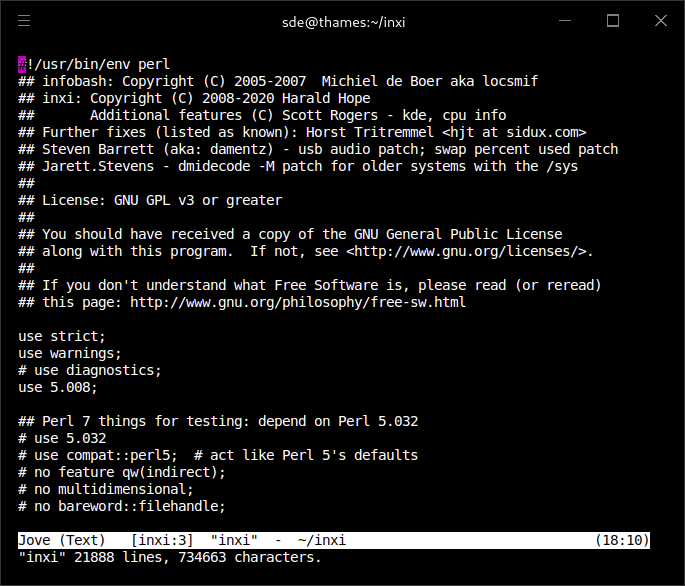
JOVE (Jonathan’s Own Version of Emacs) is an open-source, Emacs-like text editor, primarily intended for Unix-like operating systems. Although JOVE is meant to be compatible with Emacs, there are some major differences between the two editors.
It provides the common Emacs keyboard bindings, together with a reasonable assortment of the most popular advanced features (e.g., interactive shell windows, compile-it, language specific modes) while weighing in with CPU, memory, and disk requirements comparable to vi.
The part of the Emacs experience that Jove leaves out is Lisp. For hardcore users of Emacs, this makes Jove a non-starter as an Emacs replacement, but as a replacement for Vim, the absence of Lisp simply means you get a lightweight non-extensible editor with the same look-and-feel as GNU Emacs.
JOVE is intended to be highly portable. It supports many ancient systems.
JOVE tries to be small and simple, but not too simple. Historically, it could run on a PDP-11 with only 64K of memory for code and 64K for data.
Website: ftp.cs.toronto.edu/cs/ftp/pub/moraes/jove
Support:
Developer: Jonathan Payne, Hugh Redelmeier
License: GNU General Public License
JOVE is written in C. Learn C with our recommended free books and free tutorials.
Related Software
| Emacs-like Text Editors | |
|---|---|
| TeXmacs | High quality scientific word processor and typesetting program |
| Lem | General-purpose editor/IDE |
| vile | Combines aspects of the Emacs and vi editors |
| Zile | Customizable, self-documenting real-time display editor |
| Remacs | Community-driven port of Emacs to Rust |
| JOE | Joe's Own Editor with no code used from Emacs |
| Textbringer | Emacs-like text editor written in Ruby |
| QEmacs | Small but powerful UNIX editor |
| mg | Small, fast, and portable Emacs-like editor |
| ce | Small, fast, Emacs-like text editor |
| JOVE | Jonathan's Own Version of Emacs. Supports many ancient systems |
| Ymacs | Emacs-like code and text editor that runs in a web browser |
| MicroEmacs | Compact Emacs-like text editor |
Read our verdict in the software roundup.
 LinuxLinks helps you discover the best free and open source software for Linux. Explore our extensive collection of recommended applications, including alternatives to popular proprietary software. LinuxLinks helps you discover the best free and open source software for Linux. Explore our extensive collection of recommended applications, including alternatives to popular proprietary software.We also publish software reviews, Linux tutorials, hardware reviews, free programming books and articles covering the wider open source community. Browse our Linux resources to discover more. Know a useful free and open source Linux application we haven't covered? Suggest a program for inclusion. Has your software been featured on LinuxLinks? Display one of our Featured on LinuxLinks badges on your website or GitHub README. |
Please read our Comment Policy before commenting.