

LDAP (Lightweight Directory Access Protocol) is an application protocol for accessing directory services. It runs on a layer above the TCP/IP stack incorporating simplified encoding methods, and offers a convenient way to connect to, search, and modify Internet directories, specifically X.500-based directory services. It is an open, vendor-neutral, industry standard application protocol. LDAP utilizes a client-server model.
This protocol is specifically targeted at management applications and browser applications that provide read/write interactive access to directories.
The main benefit of using an LDAP server is that information for an entire organization can be consolidated into a central repository. LDAP supports Secure Sockets Layer (SSL) and Transport Layer Security (TLS), so that sensitive data can be protected. LDAP servers are used for a variety of tasks including, but not limited to, user authentication, machine authentication, user/system groups, asset tracking, organization representation, and application configuration stores.
The chart below offers our recommendations. Only free and open source software is eligible for inclusion.
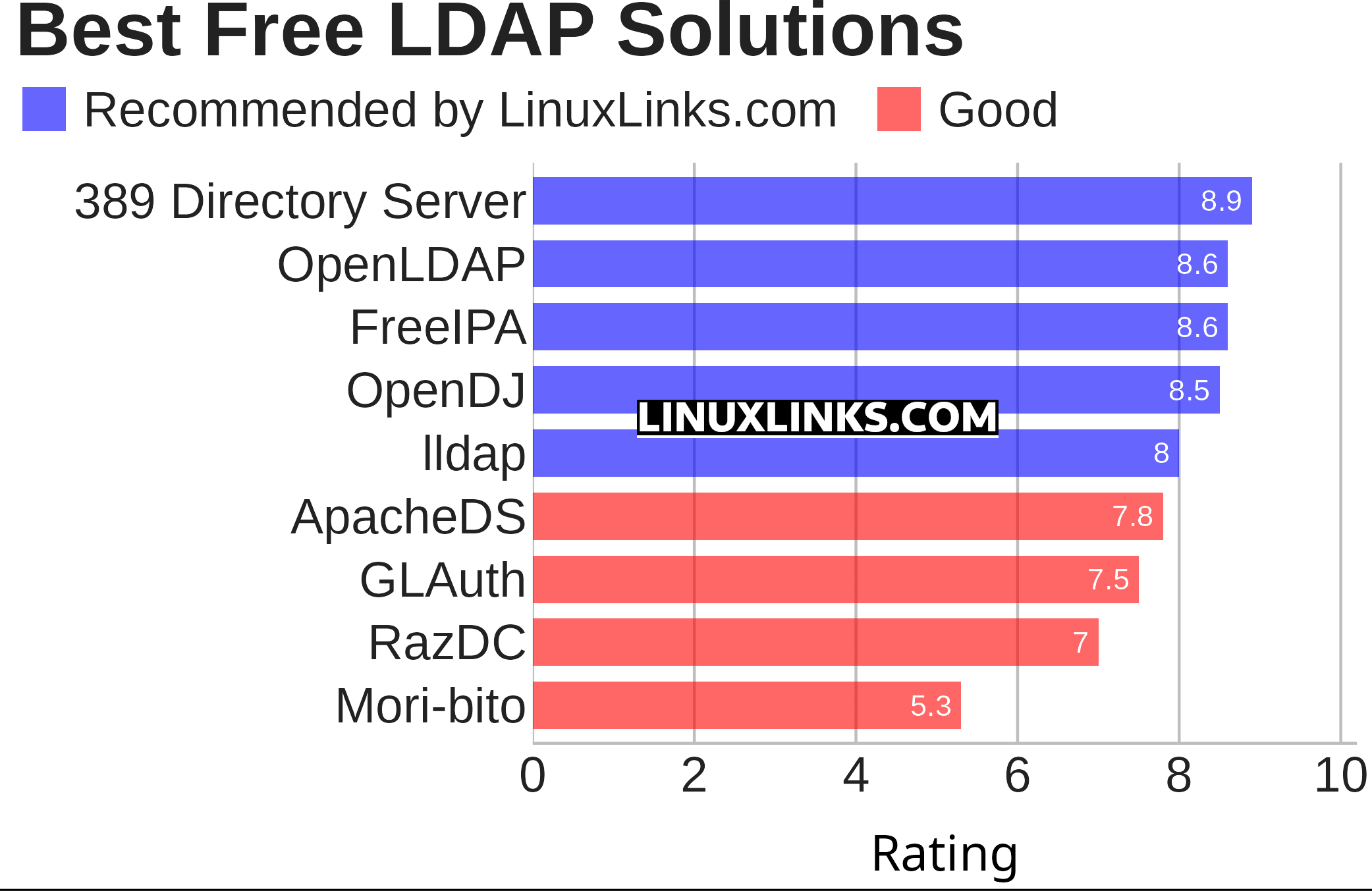
Let’s explore the 8 LDAP solutions at hand. The table below has links to each LDAP offering a full description with detailed feature lists, together with links to relevant resources.
| LDAP Solutions | |
|---|---|
| 389 Directory Server | Enterprise-class Open Source LDAP server |
| OpenLDAP | LDAP suite of applications and development tools |
| FreeIPA | Integrated security information management solution |
| OpenDJ | Cloud Directory for the API Economy |
| lldap | Light LDAP implementation |
| ApacheDS | LDAP and Kerberos server written in Java |
| GLAuth | Easy-to-use, LDAP server with configurable backends |
| RazDC | Active Directory domain controller built on Rocky Linux and Samba4 |
| Mori-bito | Terminal-based LDAP server |
This article has been updated to reflect the changes outlined in our recent announcement.
 Explore our comprehensive directory of recommended free and open source software. Our carefully curated collection spans every major software category. Explore our comprehensive directory of recommended free and open source software. Our carefully curated collection spans every major software category.This directory is part of our ongoing series of informative articles for Linux enthusiasts. It features hundreds of detailed reviews, along with open source alternatives to proprietary solutions from major corporations such as Google, Microsoft, Apple, Adobe, IBM, Cisco, Oracle, and Autodesk. You’ll also find interesting projects to try, hardware coverage, free programming books and tutorials, and much more. Know a useful open source Linux program that we haven’t covered yet? Let us know by completing this form. |