

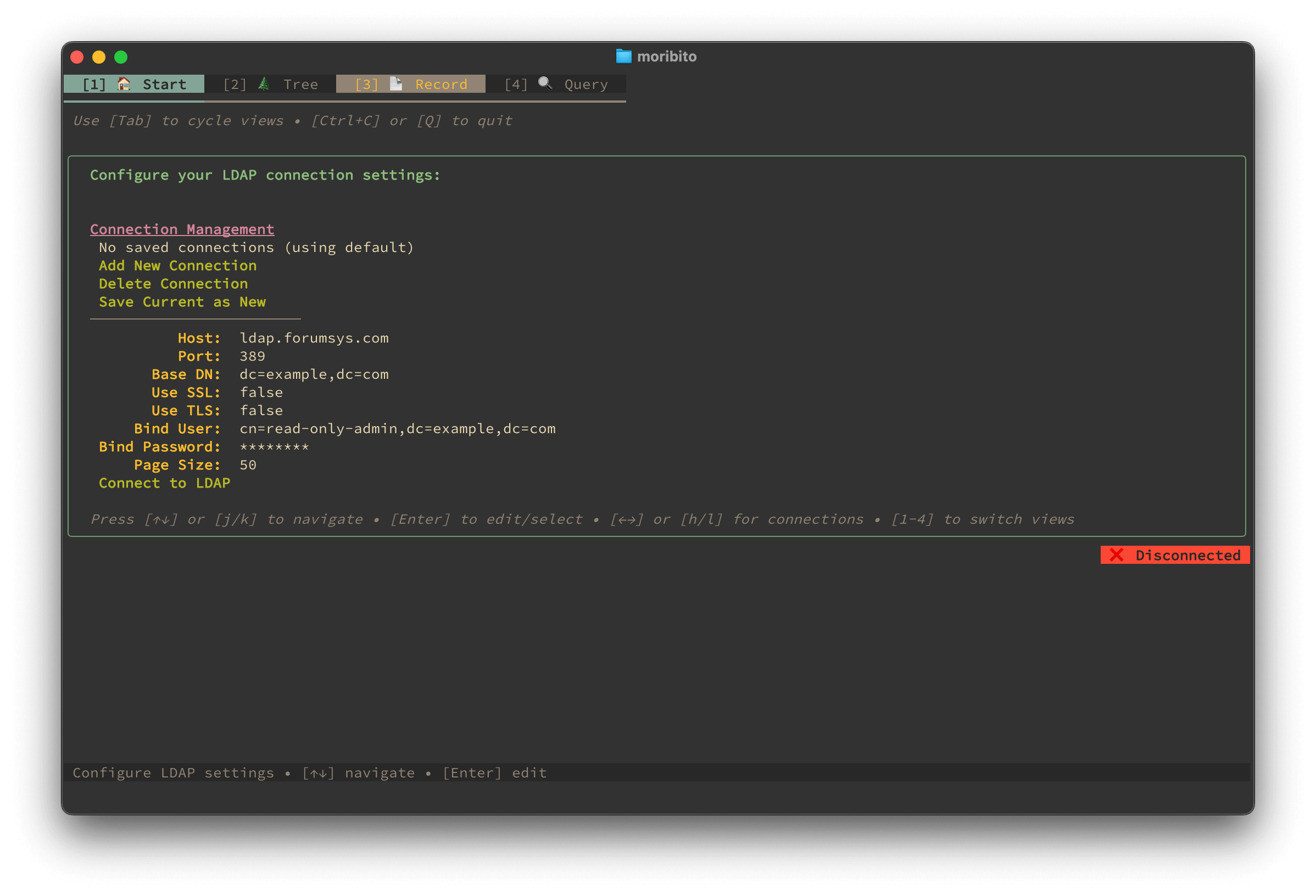
Mori-bito is a terminal-based LDAP server explorer built with Go and BubbleTea, providing an interactive interface for browsing LDAP directory trees, viewing records, and executing custom queries.
This is free and open source software.
Key Features
- Interactive Tree Navigation: Browse LDAP directory structure with keyboard/mouse.
- Record Viewer: View detailed LDAP entry attributes.
- Clipboard Integration: Copy attribute values to system clipboard.
- Custom Query Interface: Execute custom LDAP queries with real-time results.
- Paginated Results: Efficient pagination for large result sets with automatic loading.
- Flexible Configuration: Support for config files and command-line options.
- Secure Authentication: Support for SSL/TLS and various authentication methods.
- Auto-Update Notifications: Optional checking for newer releases from GitHub.
- Modern TUI: Clean, intuitive interface built with BubbleTea.
- Multiple Connections: Save and switch between multiple LDAP server configurations.
- Cross-platform support – runs under Linux, macOS, and Windows.
Website: github.com/ericschmar/moribito
Support:
Developer: Eric Schmar
License: MIT License
Mori-bito is written in Go. Learn Go with our recommended free books and free tutorials.
Related Software
| LDAP Solutions | |
|---|---|
| 389 Directory Server | Enterprise-class Open Source LDAP server |
| OpenLDAP | LDAP suite of applications and development tools |
| FreeIPA | Integrated security information management solution |
| OpenDJ | Cloud Directory for the API Economy |
| lldap | Light LDAP implementation |
| ApacheDS | LDAP and Kerberos server written in Java |
| GLAuth | Easy-to-use, LDAP server with configurable backends |
| RazDC | Active Directory domain controller built on Rocky Linux and Samba4 |
| Mori-bito | Terminal-based LDAP server |
Read our verdict in the software roundup.
 Explore our comprehensive directory of recommended free and open source software. Our carefully curated collection spans every major software category. Explore our comprehensive directory of recommended free and open source software. Our carefully curated collection spans every major software category.This directory is part of our ongoing series of informative articles for Linux enthusiasts. It features hundreds of detailed reviews, along with open source alternatives to proprietary solutions from major corporations such as Google, Microsoft, Apple, Adobe, IBM, Cisco, Oracle, and Autodesk. You’ll also find interesting projects to try, hardware coverage, free programming books and tutorials, and much more. Discovered a useful open source Linux program that we haven’t covered yet? Let us know by completing this form. |
Please read our Comment Policy before commenting.