

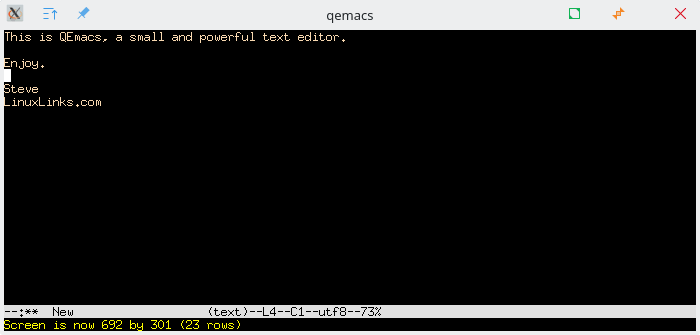
QEmacs is a small but powerful text editor with an Emacs-like interface.
Designed for tasks such as embedded development and debugging, it combines a lightweight footprint with features often associated with much larger editors. It supports editing huge files efficiently, offers full Unicode handling, and includes both terminal and X11 interfaces.
This is free and open source software.
Key Features
- Emacs-like editor with multi-buffer, multi-window, keyboard macros, minibuffer completion, and command mode.
- Edits very large files efficiently using an optimized internal representation and memory mapping.
- Provides full Unicode support, including multiple character sets and bidirectional text editing.
- Includes shell and compile modes with VT100 terminal emulation and colorized error parsing.
- Offers binary and hexadecimal editing modes for patching files in place.
- Works on VT100 terminals and also supports X11 with proportional fonts and anti-aliased font display.
Website: github.com/qemacs/qemacs
Support:
Developer: qemacs
License: MIT License
QEmacs is written in C. Learn C with our recommended free books and free tutorials.
Related Software
| Emacs-like Text Editors | |
|---|---|
| TeXmacs | High quality scientific word processor and typesetting program |
| vile | Combines aspects of the Emacs and vi editors |
| Zile | Customizable, self-documenting real-time display editor |
| Remacs | Community-driven port of Emacs to Rust |
| JOE | Joe's Own Editor with no code used from Emacs |
| mg | Small, fast, and portable Emacs-like editor |
| ce | Small, fast, Emacs-like text editor |
| JOVE | Jonathan's Own Version of Emacs. Highly portable, supports many ancient systems |
Read our verdict in the software roundup.
 Explore our comprehensive directory of recommended free and open source software. Our carefully curated collection spans every major software category. Explore our comprehensive directory of recommended free and open source software. Our carefully curated collection spans every major software category.This directory is part of our ongoing series of informative articles for Linux enthusiasts. It features hundreds of detailed reviews, along with open source alternatives to proprietary solutions from major corporations such as Google, Microsoft, Apple, Adobe, IBM, Cisco, Oracle, and Autodesk. You’ll also find interesting projects to try, hardware coverage, free programming books and tutorials, and much more. Discovered a useful open source Linux program that we haven’t covered yet? Let us know by completing this form. |