
Plone is a free, user friendly, and open source content management system running on top of Python, Zope and the CMF.
The software is suited for an internal website or may be used as a server on the Internet, playing such roles as a document publishing system and groupware collaboration tool. It offers a good, low maintenance intranet/portal system.
Plone’s Web-based administrative interface is optimized for standards, allowing it to work with most common web browsers, and uses additional accessibility standards to help users who have disabilities. All of Plone’s features are customizable, and free add-ons are available from the Plone website.
It benefits from all features of Zope/CMF such as: RDBMS integration, Python/Perl extensions, Object Oriented Database, Web configurable workflow, pluggable membership and authentication, Undos, Form validation, amongst many many other features. Available protocols: FTP, XMLRPC, HTTP, WEBDAV and you can hack it to enable SOAP. Turn it into a distributed application system by installing ZEO.
Plone shares some of the qualities of Livelink, Interwoven and Documentum. It aims to be *the* open source out-of-the-box publishing system.
The software ships with some basic tools and functionality, but a lot of its strength comes from the specialized applications that run inside it.
Key Features
- Inline Ajax-powered editing.
- Working Copy support.
- Link and reference integrity checking.
- Automatic locking and unlocking which prevents people from overwriting each others changes, but makes it easy to unlock accidentally locked content.
- Collaboration and sharing. Control who can:
- View content.
- Edit content.
- Approve content for publishing.
- Add new content.
- Versioning, history and reverting content:
- Get a full version history of edits.
- Compare certain revisions of the document with others.
- Revert to an earlier version of the document.
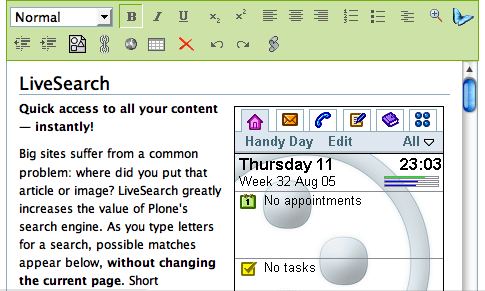
- Upgraded visual HTML editor, Kupu 1.4, a powerful, easy-to-use graphical HTML editor.
- Workflow capabilities to model organizational processes and keep track of approval chains.
- Authentication back-end to centralize logins and passwords, and to integrate with an organization’s existing systems.
- Full-text indexing of Word and PDF documents.
- Collections to construct dynamic searches, reports and queries — without writing any code.
- Presentation mode for content to create slides that are both printable and projectable.
- Support for the search engine Sitemap protocol which ensures that publicly visible content is indexed properly.
- Support for multiple mark-up formats: Markdown, Textile, Structured Text, Restructured Text, and Plain Text.
- Wiki support.
- Automatic previous/next navigation.
- Rules engine for content; perform operations on content with event triggers.
- Auto-generated tables of contents – to navigate large documents.
- Portlets engine.
- Support, development, hosting & training.
- LiveSearch.
- Multilingual content management with native support for the LinguaPlone component.
- Time-based publishing.
- Human-readable URLs to increase search engine visibility and make URLs easier to understand and remember.
- Powerful graphical page editor; to produce consistent layouts.
- Navigation and updated site maps.
- Resource compression; automatically combines and compresses CSS and JavaScript.
- Caching proxy integration with the CacheFu add-on.
- Drag and drop reordering of content.
- XML exports of site configurations to make it easier to backup and replicate site setups.
- Localized workflow configuration.
- Adjustable templates on content.
- Standard content types.
- Content is automatically formatted for printing – automatically removes the header, navigation and any other irrelevant information using CSS.
- Standards-compliant XHTML and CSS.
- Accessibility compliant.
- RSS feed support.
- Automatic image scaling and thumbnail generation.
- Free add-on products.
- Cross-platform.
- Comment capabilities on any content.
- Microformat support (hCalendar, rel-tag formats).
- Installer packages for multiple platforms.
- WebDAV and FTP support.
- In-context editing.
- “Hot Backup” support.
- Cut/copy/paste operations on content.
Website: plone.org
Support: Documentation
Developer: Alan Runyan, Alexander Limi, Vidar Andersen and the Plone Team
License: GNU General Public License v2.0
Plone is written in Python. Learn Python with our recommended free books and free tutorials.
Related Software
| Python-Based Web Content Management Systems | |
|---|---|
| Wagtail | Powerful content management system |
| django CMS | Content management system platform written in Django |
| Plone | Running on top of Python, Zope and the CMF |
| Mezzanine | Powerful, consistent, and flexible content management platform |
| Superdesk | Scaleable to suit news organizations of any size |
| Tendenci | Association management system and content management platform |
Read our verdict in the software roundup.
 Explore our carefully curated directory of recommended free and open source software, covering every major software category. Explore our carefully curated directory of recommended free and open source software, covering every major software category.The directory forms part of our extensive collection of articles for Linux enthusiasts. It includes hundreds of detailed reviews, together with free and open source alternatives to proprietary software from companies such as Google, Microsoft, Apple, Adobe, IBM, Cisco, Oracle, and Autodesk. LinuxLinks also covers interesting projects worth exploring, Linux-compatible hardware, free programming books and tutorials, and much more. Know a useful free and open source Linux application that we haven’t covered? Tell us about it using our submission form. |
Please read our Comment Policy before commenting.