

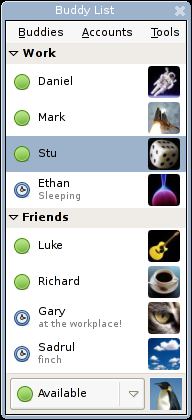
Pidgin is an open source graphical Instant Messenger (IM) program that lets you sign on to many chat services including Google Talk, IRC, and other IM networks. It used to be known as Gaim but changed its name to avoid confusion with AOL’s instant messenger (AIM).
Pidgin integrates well with popular desktop environments such as GNOME and KDE. This allows you to work with Pidgin without requiring the buddy list window to be open at all times.
There are a large number of plugins available, adding functionality to the software. Examples include Album (archives buddy icons), Plonkers (announces your ignore list to a chat room), Talk Filters, and XMMS Remote.
There is also a console based version of Pidgin supporting the same IM networks available. This software is known as Finch.
Pidgin supports the following IM services:
- Bonjour.
- Gadu-Gadu.
- Google Talk.
- Groupwise.
- ICQ.
- IRC.
- SILC.
- SIMPLE.
- Sametime.
- XMPP.
- Zephyr.
Key Features
- Multiple account access support.
- On-action automated scripts for contact status changes (known as Buddy Pounces).
- Tabbed message windows for conversation management.
- Grouping multiple buddies into a single “contact”.
- Conversation and chat logging.
- Notification pop-ups.
- Built-in NSS support, offering client-to-server message encryption for protocols that support it.
- File transfers.
- Away messages.
- Buddy icons.
- Custom smilies.
- Plugins “Off-the-Record Messaging” and Pidgin encryption, offering end-to-end message encryption.
- Contact aliasing.
- Spell checking.
- Notification area integration.
- Internationalization support – Afrikaans, Albanian, Amharic, Arabic, Armenian, Azerbaijani, Basque, Belarusian Latin, Bengali, Bokmal Norwegian, Bosnian, Bulgarian, Burmese, Catalan, Chinese (Traditional), Chinese (Simplified), Czech, Danish, Dutch, Dzongkha, Esperanto, Estonian, Finnish, Flemish, French, Galician, Georgian, German, Greek, Gujarati, Hebrew, Hindi, Hong Kong Chinese, Hungarian, Indonesian, Irish, Italian, Japanese, Kannada, Khmer, Korean, Kurdish, Lao, Lithuanian, Macedonian, Malay, Marathi, Mongolian, Nepali, Norwegian Nynorsk, Occitan, Oriya, Pashto, Persian, Polish, Portuguese, Portuguese (Brazilian), Punjabi, Romanian, Russian, Serbian, Sinhala, Slovakian, Slovenian, Spanish, Swahili, Swedish, Tamil, Telugu, Thai, Turkish, Ukrainian, Urdu, Valencian-Catalan, Vietnamese, and Xhosa.
- Cross-platform support – runs under Linux, other UNIX operating systems, and Windows.
Website: pidgin.im
Support: Planet Pidgin, Using Pidgin, FAQ
Developer: Sean Egan (lead developer), and 18+ other developers
License: GNU GPL v2
Pidgin is written in C. Learn C with our recommended free books and free tutorials.
Related Software
| IRC Clients | |
|---|---|
| Konversation | User friendly client for KDE Plasma |
| Smuxi | Smart MUltipleXed Irc - the IRC client for sophisticated users |
| Pidgin | Easy to use and free chat client supporting lots of protocols |
| KVIrc | KDE based next generation IRC client with module support |
| Quassel IRC | Distributed, KDE4/Qt based |
| Halloy | IRC client written in Rust |
| Polari | Simple to use IRC Client |
| Srain | Modern IRC client written in GTK |
| HexChat | Multi-network IRC client based on XChat |
| dxirc | Simple yet capable cross-platform IRC client |
| Grumpy | Advanced IRC client |
| Tithon | Modern, cross-platform IRC client |
| Communi | Simple and elegant cross-platform IRC client |
Read our verdict in the software roundup.
| Graphical XMPP Clients | |
|---|---|
| Gajim | Full featured and easy to use XMPP client |
| Pidgin | Multi-protocol instant messaging client |
| Dino | Jabber/XMPP experience while having your privacy in mind |
| Kaidan | Simple, user-friendly and modern chat client |
| Psi | Cross-platform XMPP instant messaging client |
| Fluux Messenger | Modern, cross-platform XMPP client |
| Swift | Clean design and comprehensive feature set |
Read our verdict in the software roundup.
 Explore our comprehensive directory of recommended free and open source software. Our carefully curated collection spans every major software category. Explore our comprehensive directory of recommended free and open source software. Our carefully curated collection spans every major software category.This directory is part of our ongoing series of informative articles for Linux enthusiasts. It features hundreds of detailed reviews, along with open source alternatives to proprietary solutions from major corporations such as Google, Microsoft, Apple, Adobe, IBM, Cisco, Oracle, and Autodesk. You’ll also find interesting projects to try, hardware coverage, free programming books and tutorials, and much more. Discovered a useful open source Linux program that we haven’t covered yet? Let us know by completing this form. |
Please read our Comment Policy before commenting.
I’m glad to see this blast from the past being developed again.