

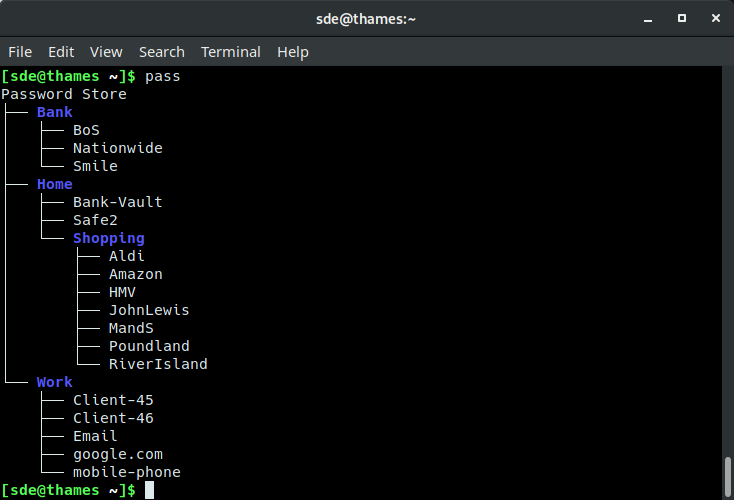
pass is a very simple open source password store that keeps passwords inside gpg21 encrypted files inside a simple directory tree stored at ~/.password-store.
The pass utility provides a series of commands for manipulating the password store, allowing the user to add, remove, edit, synchronize, generate, and manipulate passwords.
The utility is trivial to use if you are already familiar with regular unix shell commands.
Besides GnuPG, the software also uses Git and tree.
Key Features
- No schema imposed for the data, so the software can be used for passwords, PINs, websites, metadata — anything.
- Multi-line functionality allowing users to put a password on the first line, and additional information on subsequent lines.
- dmenu wrapper to enable easy searching/copying.
- Generate random passwords.
- Temporarily put passwords on your clipboard. This feature lets you paste the password into web forms.
- Create a git repository, and then manipulate and sync passwords.
- Bash completion allowing you to press tab to fill in names and commands.
- Scripts to import 1Password txt or 1pif data, KeepassX XML, Keepass2 CSV, Keepass2 XML, Figaro’s Password Manager XML, Lastpass CSV, Ked Password Manager data, Revelation Password Manager data, Password Gorilla data, PWSafe data, KWallet data, Roboform data, password-exporter data, pwsafe data, and Firefox password interface.
- Supports extensions. The community has produced the following extensions:
- pass-tomb: manage the whole tree of your password store encrypted inside a tomb.
- pass-update: an easy flow for updating passwords.
- pass-import: a generic importer tool from other password managers.
- pass-extension-tail: a way of printing only the tail of a file.
- pass-extension-wclip: a plugin to use wclip on Windows.
- pass-otp: support for one-time-password (OTP) tokens.
- Cross-platform support – packages available for a wide range of Linux distributions. FreeBSD and macOS are supported too.
Website: www.passwordstore.org
Support: Git, Tutorial
Developer: Jason A. Donenfeld
License: GNU General Public License v 2 or later
1gpg2 is the OpenPGP part of the GNU Privacy Guard (GnuPG). It is a tool to provide digital encryption and signing services using the OpenPGP standard. GnuPG implements many of the optional parts of the standard, such as the SHA-512 hash, and the ZLIB and BZIP2 compression algorithms.
Related Software
| Terminal-Based Password Managers | |
|---|---|
| gopass | Simple but powerful password manager for your terminal |
| pass | Simple password manager using gpg and ordinary unix directories |
| prs | Secure, fast and convenient password manager for the terminal |
| Teller | Multi provider secret management tool |
| Bitwarden CLI | Password management for individuals, teams, and business organizations |
| Rooster | Simple password manager for geeks |
| passage | age-backed password manager |
| seniorpw | Password manager using age |
| pa | Simple password manager. Encryption support is provided via age |
| SpicyPass | Lightweight password manager |
| rbw | Unofficial Bitwarden CLI |
| MUTN | Self-hosted, SSH-synchronized password and note manager |
| Pass-CLI | Password and API key manager |
| pago | Go-based command-line password manager |
| kyp | Stores credentials in an encrypted SQLite database |
| Steelsafe | TUI password manager written in Rust |
| keydex | Password manager for KeePass databases |
| kpxhs | Keepass database interactive TUI viewer |
| kpcli | Command line interface to KeePass database files |
| cruxpass | Minimal command-line password manager written in C |
| Puny Manager | Minimal, local, CLI password manager |
| privage | Password manager and general file encryption tool that uses age |
| passfzf | Simple fzf wrapper for pass |
| pasejo | Command line password manager written in Rust |
| cpass | Console UI for pass |
Read our verdict in the software roundup.
 Explore our comprehensive directory of recommended free and open source software. Our carefully curated collection spans every major software category. Explore our comprehensive directory of recommended free and open source software. Our carefully curated collection spans every major software category.This directory is part of our ongoing series of informative articles for Linux enthusiasts. It features hundreds of detailed reviews, along with open source alternatives to proprietary solutions from major corporations such as Google, Microsoft, Apple, Adobe, IBM, Cisco, Oracle, and Autodesk. You’ll also find interesting projects to try, hardware coverage, free programming books and tutorials, and much more. Discovered a useful open source Linux program that we haven’t covered yet? Let us know by completing this form. |
Please read our Comment Policy before commenting.