

pandas is an open source, BSD-licensed library providing high-performance, easy-to-use data structures and data analysis tools for the Python programming language. It aims to be the fundamental high-level building block for doing practical, real world data analysis in Python.
pandas needs NumPy, python-dateutil, and pytz.
pandas is well suited for many different kinds of data:
- Tabular data with heterogeneously-typed columns, as in an SQL table or Excel spreadsheet.
- Ordered and unordered (not necessarily fixed-frequency) time series data.
- Arbitrary matrix data (homogeneously typed or heterogeneous) with row and column labels.
- Any other form of observational / statistical data sets. The data actually need not be labeled at all to be placed into a pandas data structure.
Key Features
- Provides a DataFrame object – a 2-dimensional labelled data structure with columns of potentially different types. DataFrame accepts many different kinds of input:
- Dict of 1D ndarrays, lists, dicts, or Series;
- 2-D numpy.ndarray;
- Structured or record ndarray;
- A Series;
- Another DataFrame.
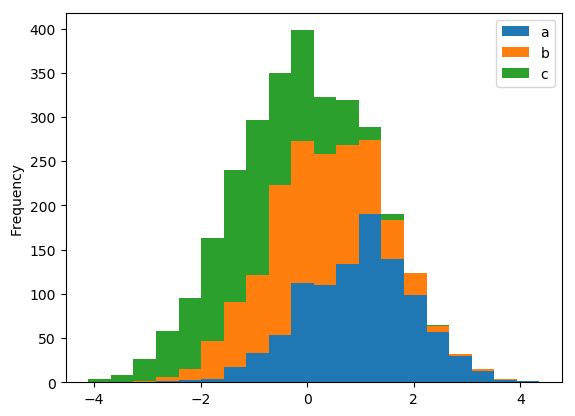
- Simple API for plotting DataFrames.
- Intelligent data alignment and integrated handling of missing data: gain automatic label-based alignment in computations and easily manipulate messy data into an orderly form.
- Easy handling of missing data (represented as NaN) in floating point as well as non-floating point data.
- Size mutability: columns can be inserted and deleted from DataFrame and higher dimensional objects.
- Automatic and explicit data alignment: objects can be explicitly aligned to a set of labels, or the user can simply ignore the labels and let Series, DataFrame, etc. automatically align the data for you in computations.
- Powerful, flexible group by functionality to perform split-apply-combine operations on data sets, for both aggregating and transforming data.
- Makes it easy to convert ragged, differently-indexed data in other Python and NumPy data structures into DataFrame objects.
- Intelligent label-based slicing, fancy indexing, and subsetting of large data sets.
- Intuitive merging and joining data sets.
- Flexible reshaping and pivoting of data sets.
- Hierarchical labeling of axes (with the option of multiple labels per tick).
- Tools for reading and writing data between in-memory data structures and different formats for loading data from flat files (CSV and delimited), Excel files, databases, and saving/loading data from the ultra-fast HDF5 format.
- Offers sophisticated statistical visualization tools.
- Time series-specific functionality: date range generation and frequency conversion, moving window statistics, moving window linear regressions, date shifting and lagging, etc.
- Keeps matplotlib as its backend but provides a new API.
- Highly optimized for performance, with critical code paths written in Cython or C.
Python with pandas is used in a wide variety of academic and commercial domains, including Finance, Neuroscience, Economics, Statistics, Advertising, Web Analytics, and more.
Website: pandas.pydata.org
Support: Documentation, GitHub Code Repository
Developer: PyData Development Team
License: 3-clause (“Simplified” or “New”) BSD license
pandas is written in Python. Learn Python with our recommended free books and free tutorials.
Related Software
| Python Data Analysis | |
|---|---|
| pandas | High-level building block for doing practical, real world data analysis |
| NumPy | Core package for scientific computing with Python |
| SciPy | Ecosystem for mathematics, science, and engineering |
| Polars | DataFrame interface on top of an OLAP Query Engine |
| statsmodels | Statistical modeling and econometrics in Python |
| Dask | Advanced parallelism for analytics |
| Orange | Component-based framework for machine learning and data mining |
| Modin | Drop-in replacement for pandas |
| Vaex | Fast visualization of big data |
| AWS DW | Extends the power of pandas library |
| yt | Multi-code Toolkit for Analyzing and Visualizing Volumetric Data |
| HoloViews | Make Data Analysis and Visualization Seamless |
| datatable | Manipulate 2-dimensional tabular data structures |
| xarray | Work with labelled multi-dimensional arrays and datasets |
| pyjanitor | Extend pandas with readable data-cleaning functions |
| Optimus | Agile Data Preparation Workflows |
Read our verdict in the software roundup.
 Explore our carefully curated directory of recommended free and open source software, covering every major software category. Explore our carefully curated directory of recommended free and open source software, covering every major software category.The directory forms part of our extensive collection of articles for Linux enthusiasts. It includes hundreds of detailed reviews, together with free and open source alternatives to proprietary software from companies such as Google, Microsoft, Apple, Adobe, IBM, Cisco, Oracle, and Autodesk. LinuxLinks also covers interesting projects worth exploring, Linux-compatible hardware, free programming books and tutorials, and much more. Know a useful free and open source Linux application that we haven’t covered? Tell us about it using our submission form. |
Please read our Comment Policy before commenting.