

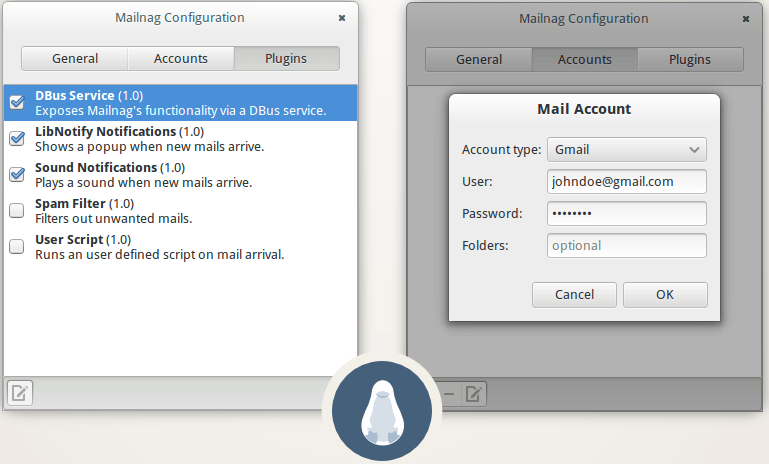
Mailnag is a daemon program that checks POP3 and IMAP servers for new mail.
On mail arrival it performs various actions provided by plugins.
By default, Mailnag issues libnotify notifications, which work fine on most desktop environments.
Mailnag comes with a set of desktop-independent default plugins for visual/sound notifications, script execution etc. and can be extended with additional plugins.
Key Features
- Support for mbox and maildir backend.
- Support for IMAP-Push notifications.
- Support for CRAM-MD5 auth
- STARTTLS support for pop3 accounts.
- Support for UTF-7 folder decoding.
- GNOME-Software integration with support for notification settings in GNOME-Control-Center.
- GNOME Online Accounts integration
- libnotify plugin.
- Support for platform-specific credential (login password) backends.
- Account assistants for popular email providers like Gmail.
- DBUS service (for remote control/integration in other apps).
- Plugin system offering simple extensibility.
- Logging.
- Enable SSL by default.
- Explicit SSL encryption.
- Internationalization support.
Website: github.com/pulb/mailnag
Support:
Developer: Patrick Ulbrich
License: GNU General Public License v2.0
Mailnag is written in Python. Learn Python with our recommended free books and free tutorials.
Related Software
| Mail Notification | |
|---|---|
| Bubblemail | Extensible mail notification service. Fork of Mailnag |
| Mailutils | Swiss army knife of electronic mail handling |
| Ayatana Webmail | Webmail notifications and actions for any desktop. Quicklist support |
| Birdtray | System tray new mail notification for Thunderbird |
| gnubiff | Mail notification program |
| CheckMails | System tray unread mail checker using the IMAP protocol |
| Go IMAP notify | Monitors IMAP mailboxes and executes scripts |
| Mailnag | Extensible mail notification daemon |
Read our verdict in the software roundup.
 Explore our comprehensive directory of recommended free and open source software. Our carefully curated collection spans every major software category. Explore our comprehensive directory of recommended free and open source software. Our carefully curated collection spans every major software category.This directory is part of our ongoing series of informative articles for Linux enthusiasts. It features hundreds of detailed reviews, along with open source alternatives to proprietary solutions from major corporations such as Google, Microsoft, Apple, Adobe, IBM, Cisco, Oracle, and Autodesk. You’ll also find interesting projects to try, hardware coverage, free programming books and tutorials, and much more. Discovered a useful open source Linux program that we haven’t covered yet? Let us know by completing this form. |
Please read our Comment Policy before commenting.