

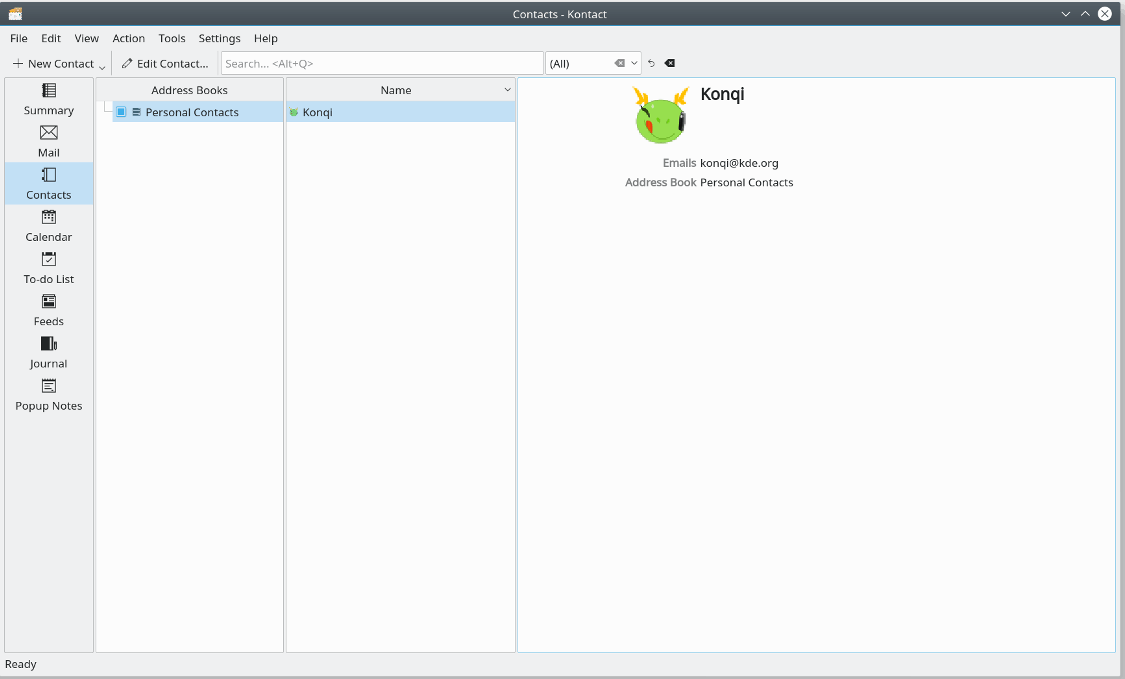
KAddressBook is an address book manager. It stores all the personal details of your family, friends and other contacts.
This tool supports a wide variety of services, including NextCloud, Kolab, Google Contacts, Microsoft Exchange (EWS) or any standard CalDAV server.
This is free and open source software.
Key Features
- Powerful search – KAddressBook has configurable filters and powerful search capabilities.
- Duplicate detection and merging – KAddressBook can find duplicated contacts from multiple sources and can merge them into a single contact.
- Good standard support – KAddressBook can import and export from and to nearly every address book standard.
- LDAP integration – Can connect to multiple LDAP servers, which can then be used for contact autocompletion when composing emails in KMail.
- Integration – Integrates with other Kontact components, e.g. exporting birthday reminders to KOrganizer.
- QR codes – KAddressBook can display a QR code for each contact to quickly scan it into your phone or send to someone.
Website: apps.kde.org/kaddressbook
Support: Code Repository
Developer: Laurent Montel
License: GNU General Public License v2.0 or later
KAddressBook is written in C++. Learn C++ with our recommended free books and free tutorials.
Related Software
| Address Book Managers | |
|---|---|
| KAddressBook | Supports a wide range of services including NextCloud, Google Contacts |
| Contacts | GNOME's integrated address book. It is written in Vala and uses libfolks |
| qcard | CLI addressbook application for CardDAV servers |
| khard | Console vcard client |
| CardBook | Thunderbird address book based on CardDAV and vCard standards |
| aercbook | Minimalist address book for the aerc e-mail client |
| addrb | Lightweight, read-only command-line address book |
Read our verdict in the software roundup.
 Explore our carefully curated directory of recommended free and open source software, covering every major software category. Explore our carefully curated directory of recommended free and open source software, covering every major software category.The directory forms part of our extensive collection of articles for Linux enthusiasts. It includes hundreds of detailed reviews, together with free and open source alternatives to proprietary software from companies such as Google, Microsoft, Apple, Adobe, IBM, Cisco, Oracle, and Autodesk. LinuxLinks also covers interesting projects worth exploring, Linux-compatible hardware, free programming books and tutorials, and much more. Know a useful free and open source Linux application that we haven’t covered? Tell us about it using our submission form. |
Please read our Comment Policy before commenting.
Check out at home on Linux