

hist-rs is a Rust command-line utility built for high-throughput line-oriented text processing.
It provides a fast standalone alternative to traditional shell pipelines for building histograms of repeated lines, and it also includes extra controls for deduplication, filtering, substitutions, and output shaping that make it useful for logs, datasets, and other text streams.
This is free and open source software.
Key Features
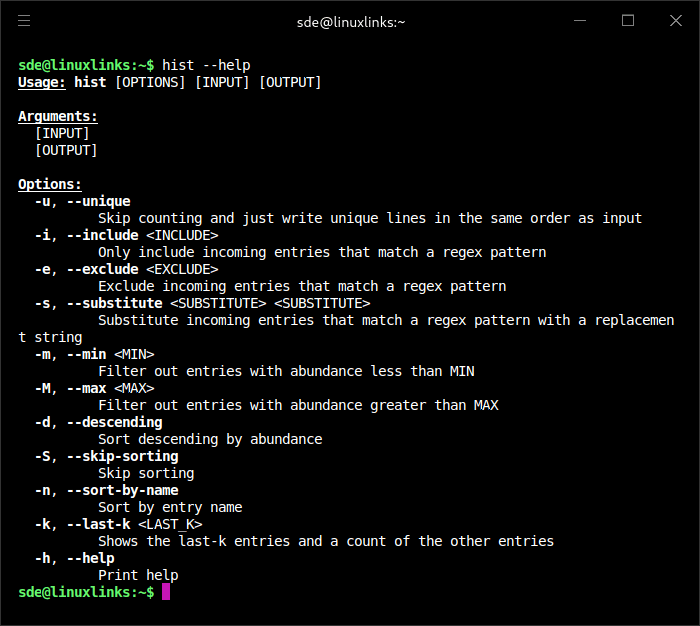
- Counts the abundance of unique lines from files or standard input.
- Can output only unique lines to deduplicate an input stream.
- Supports include and exclude pattern matching while processing input.
- Filters results using minimum or maximum abundance thresholds.
- Can sort output by key or abundance in ascending or descending order.
- Supports regex-based pattern substitution on incoming lines.
- Can show the last k entries together with a summary count of the remaining data.
- Includes an option to generate a histogram without sorting by value.
Website: github.com/noamteyssier/hist-rs
Support:
Developer: Noam Teyssier
License: MIT License
hist-rs is written in Rust. Learn Rust with our recommended free books and free tutorials.
Related Software
| Alternatives to uniq | |
|---|---|
| runiq | An efficient way to filter duplicate lines from input, à la uniq |
| huniq | Removes duplicates from stdin using a hash table |
| nauniq | Non-adjacent uniq |
| semiuniq | Removes nearby repeated lines in a file |
| uq | Removes duplicate lines from the output, regardless of the order |
| zet | Perform set operations on files considered as sets of lines |
| anew | Adds new lines to files, skipping duplicates |
| anewer | Appends lines from stdin to a file if they don't already exist in the file |
 Explore our carefully curated directory of recommended free and open source software, covering every major software category. Explore our carefully curated directory of recommended free and open source software, covering every major software category.The directory forms part of our extensive collection of articles for Linux enthusiasts. It includes hundreds of detailed reviews, together with free and open source alternatives to proprietary software from companies such as Google, Microsoft, Apple, Adobe, IBM, Cisco, Oracle, and Autodesk. LinuxLinks also covers interesting projects worth exploring, Linux-compatible hardware, free programming books and tutorials, and much more. Know a useful free and open source Linux application that we haven’t covered? Tell us about it using our submission form. |
Please read our Comment Policy before commenting.