

cuniq is a command-line utility written in Rust for counting unique lines in text input.
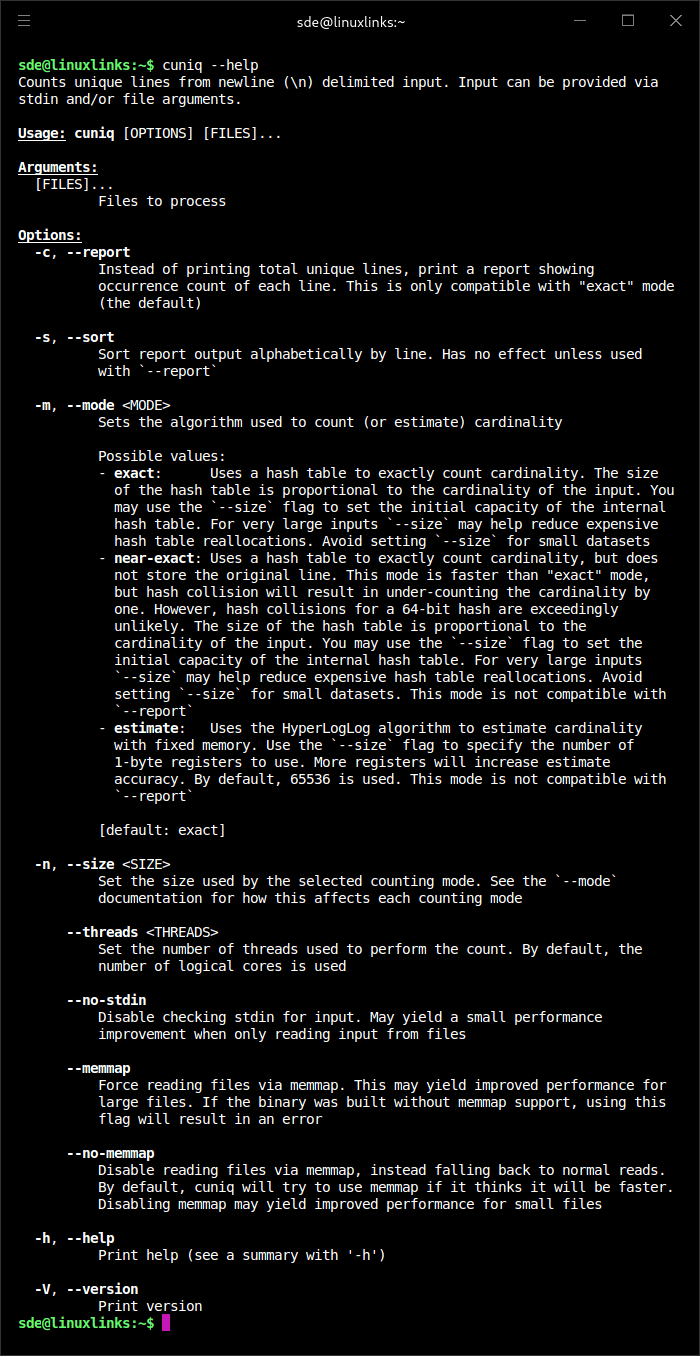
It’s designed as a faster alternative to common shell pipelines used for line cardinality and duplicate counting, and it can work with stdin or one or more files. Alongside exact counting, the project also provides faster near-exact and estimated modes for large datasets, plus optional reporting features when you need occurrence counts for each distinct line.
This is free and open source software.
Key Features
- Counts unique lines from standard input or one or more files.
- Supports multithreaded processing.
- Can generate occurrence reports for each distinct line with the report option.
- Includes exact, near-exact, and estimated counting modes for different speed and accuracy trade-offs.
- Can sort report output alphabetically when required.
- Offers optional tuning such as hash-table sizing, thread control, and memory-mapped file reading.
Website: https://github.com/zkxs/cuniq
Support:
Developer: zkxs
License: GNU General Public License v3.0
cuniq is written in Rust. Learn Rust with our recommended free books and free tutorials.
Related Software
| Alternatives to uniq | |
|---|---|
| runiq | An efficient way to filter duplicate lines from input, à la uniq |
| huniq | Removes duplicates from stdin using a hash table |
| nauniq | Non-adjacent uniq |
| semiuniq | Removes nearby repeated lines in a file |
| uq | Removes duplicate lines from the output, regardless of the order |
| zet | Perform set operations on files considered as sets of lines |
| anew | Adds new lines to files, skipping duplicates |
| anewer | Appends lines from stdin to a file if they don't already exist in the file |
 Explore our carefully curated directory of recommended free and open source software, covering every major software category. Explore our carefully curated directory of recommended free and open source software, covering every major software category.The directory forms part of our extensive collection of articles for Linux enthusiasts. It includes hundreds of detailed reviews, together with free and open source alternatives to proprietary software from companies such as Google, Microsoft, Apple, Adobe, IBM, Cisco, Oracle, and Autodesk. LinuxLinks also covers interesting projects worth exploring, Linux-compatible hardware, free programming books and tutorials, and much more. Know a useful free and open source Linux application that we haven’t covered? Tell us about it using our submission form. |
Please read our Comment Policy before commenting.