

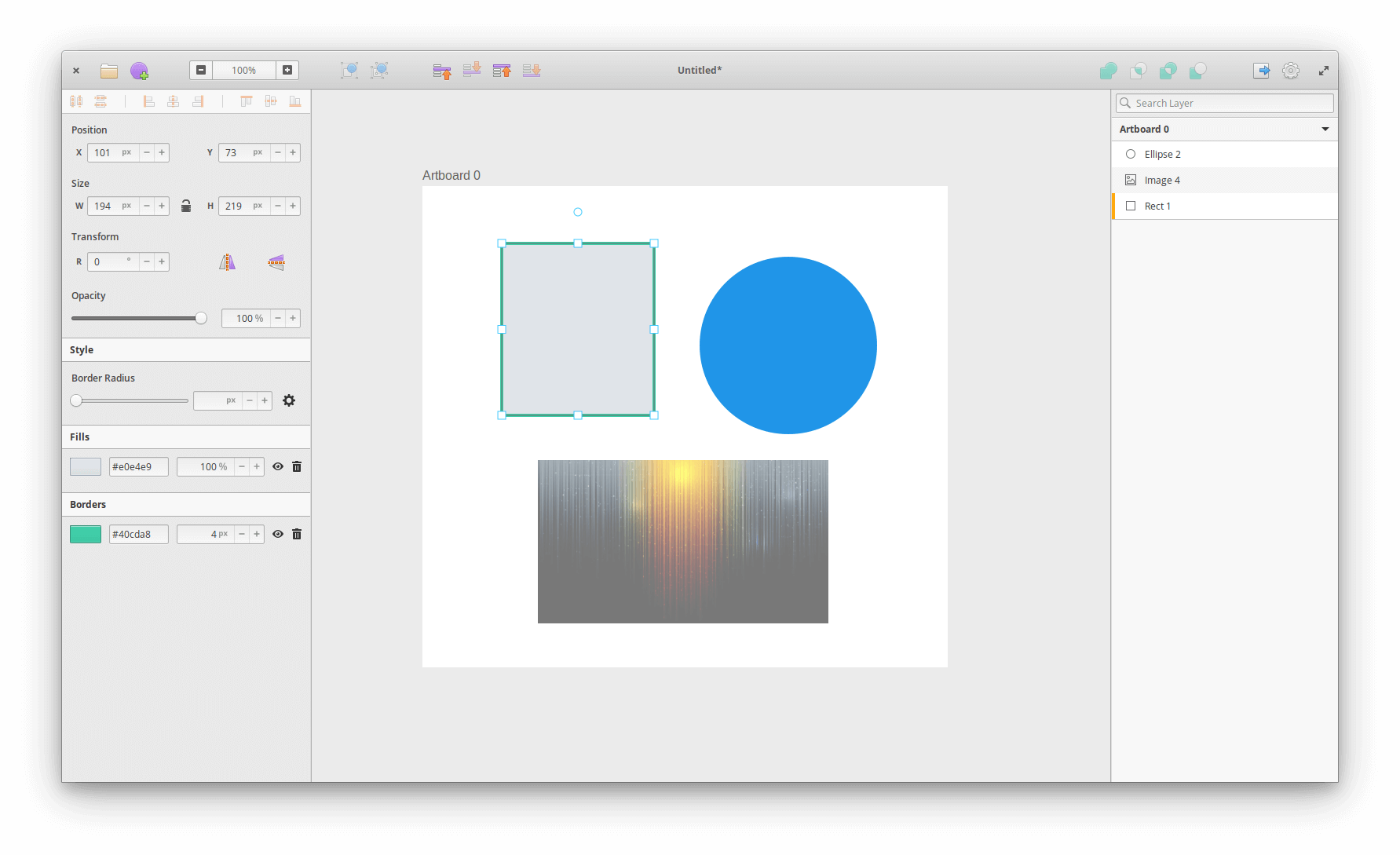
Akira is a native Linux design application built in Vala and GTK.
Akira focuses on offering a modern and fast approach to UI and UX Design, mainly targeting web designers and graphic designers. The main goal is to offer a valid and professional solution for designers who want to use Linux as their main OS.
Akira is in an early stage of development and is not currently ready for production use.
The software is free and open source software.
Key Features
- Fully native – no JavaScript is used to handle core functionalities of the application. Core functionality is written in Vala.
- Adaptable interface – light mode, dark mode, symbolic and non-symbolic icons, with labels or no labels.
- Vector SVG based Canvas.
- Shapes that are handled like a standalone path with 2 levels of editing. The first level (shape edit), activated on select, will allow standard transformation options like rotate, resize, flip, etc. The second level (path edit) will allow to handle the shape like a standalone path, with the ability to move, add, and remove vertices, use bezier curves, and break or close paths.
- Zoom.
- Presentation mode
- Pixel grid.
- Used for creating mock-ups, visualizations and vector graphics.
Website: github.com/akiraux/Akira
Support:
Developer: Alessandro “Alecaddd” Castellani
License: GNU General Public License v3.0
Akira is written in Vala. Learn Vala with our recommended free books and free tutorials.
Related Software
| GUI Prototyping Tools | |
|---|---|
| Penpot | Design tool that’s web based. Penpot requires a browser, that’s it. |
| Inkscape | Powerful design software with flexible drawing tools |
| Akira | Design application for prototyping |
| Pencil | Easy GUI Prototyping with a good range of built-in shape collections |
| Workbench | Prototype with GNOME technologies |
| mydraft | Wireframing tool |
Read our verdict in the software roundup.
 Explore our carefully curated directory of recommended free and open source software, covering every major software category. Explore our carefully curated directory of recommended free and open source software, covering every major software category.The directory forms part of our extensive collection of articles for Linux enthusiasts. It includes hundreds of detailed reviews, together with free and open source alternatives to proprietary software from companies such as Google, Microsoft, Apple, Adobe, IBM, Cisco, Oracle, and Autodesk. LinuxLinks also covers interesting projects worth exploring, Linux-compatible hardware, free programming books and tutorials, and much more. Know a useful free and open source Linux application that we haven’t covered? Tell us about it using our submission form. |
Please read our Comment Policy before commenting.