
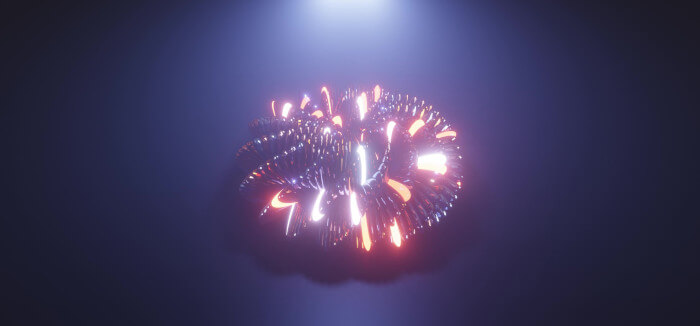
POV-Ray is a full-featured ray tracer.
Ray tracers simulate objects and light sources of the real world to calculate photorealistic, computer generated images. Because of the nature of ray tracing, this process is quite CPU-intensive, at the benefit of more realistic images compared to real time rendering techniques. For example, in POV-Ray, you can model a glass prism, and you will see a spectrum in the resulting image.
POV-Ray by itself is a command-line utility that will take scene descriptions, written in a special easy-to-understand language, to produce ray-traced images (or even a sequence of images, for animations). You can either write those scene-descriptions by hand, or use external tools to generate (parts of) the scene.
Key Features
- Easy to use scene description language.
- Large library of stunning example scene files.
- Standard include files that pre-define many shapes, colors and textures.
- Very high quality output image files (up to 48-bit color).
- 16 and 24 bit color display on many computer platforms using appropriate hardware.
- Create landscapes using smoothed height fields.
- Many camera types, including perspective, orthographic, fisheye, etc.
- Spotlights, cylindrical lights and area lights for sophisticated lighting
- Photons for realistic, reflected and refracted, caustics. Photons also intera.ct with media.
- Phong and specular highlighting for more realistic-looking surfaces.
- Inter-diffuse reflection (radiosity) for more realistic lighting.
- Atmospheric effects like atmosphere, ground-fog and rainbow.
- Particle media to model effects like clouds, dust, fire and steam.
- Several image file output formats including Targa, PNG and PPM.
- Basic shape primitives such as spheres, boxes, quadrics, cylinders, cones, triangle and planes.
- Advanced shape primitives such as Tori (donuts), bezier patches, height fields (mountains), blobs, quartics, smooth triangles, text, superquadrics, surfaces of revolution, prisms, polygons, lathes, fractals, isosurfaces and the parametric object.
- Shapes can easily be combined to create new complex shapes using Constructive Solid Geometry (CSG). POV-Ray supports unions, merges, intersections and differences.
- Objects are assigned materials called textures (a texture describes the coloring and surface properties of a shape) and interior properties such as index of refraction and particle media (formerly known as “halos”).
- Built-in color and normal patterns: Agate, Bozo, Bumps, Checker, Crackle, Dents, Granite, Gradient, Hexagon, Leopard, Mandel, Marble, Onion, Quilted, Ripples, Spotted, Spiral, Radial, Waves, Wood, Wrinkles and image file mapping. Or build your own pattern using functions.
- Users can create their own textures or use pre-defined textures such as … Brass, Chrome, Copper, Gold, Silver, Stone, Wood.
- Combine textures using layering of semi-transparent textures or tiles of textures or material map files.
- Display preview of image while rendering.
- Halt and save a render part way through, and continue rendering the halted partial render later.
- SMP (symmetric multiprocessing) support.
Website: www.povray.org
Support: Wiki
Developer: The POV-Team
License: POV-RAY license
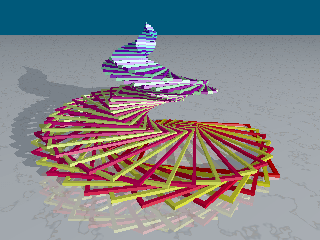
POV-Ray is written in C++. Learn C++ with our recommended free books and free tutorials.
Related Software
| Ray Tracing Software | |
|---|---|
| POV-Ray | Full-featured ray tracer |
| Blender | 3D content creation suite with a huge range of uses |
| McXtrace | Monte Carlo Xray Tracing for simulation X-ray beamlines and experiments |
| McStas | Simulator for neutron scattering instruments and experiments |
| Embree | High-performance ray tracing library |
| LuxCoreRender | Rendering system for physically correct image synthesis |
| pbrt | Physically based ray tracing system |
| OSPRay | Scalable and portable ray tracing engine |
| BRL-CAD | Combinatorial Constructive Solid Geometry (CSG) solid modeling system |
| Visionaray | C++ ray tracing template library |
| MantaRay | Advanced renderer using modern rendering techniques |
| YafaRay | Montecarlo raytracing engine |
| Tachyon | Parallel / multiprocessor ray tracing system |
Read our verdict in the software roundup.
 Explore our comprehensive directory of recommended free and open source software. Our carefully curated collection spans every major software category. Explore our comprehensive directory of recommended free and open source software. Our carefully curated collection spans every major software category.This directory is part of our ongoing series of informative articles for Linux enthusiasts. It features hundreds of detailed reviews, along with open source alternatives to proprietary solutions from major corporations such as Google, Microsoft, Apple, Adobe, IBM, Cisco, Oracle, and Autodesk. You’ll also find interesting projects to try, hardware coverage, free programming books and tutorials, and much more. Discovered a useful open source Linux program that we haven’t covered yet? Let us know by completing this form. |
Please read our Comment Policy before commenting.