

Natural language processing (NLP) is a field of computer science, artificial intelligence, and computational linguistics concerned with the interactions between computers and human (natural) languages. It includes word and sentence tokenization, text classification and sentiment analysis, spelling correction, information extraction, parsing, meaning extraction, and question answering.
In our formative years, we master the basics of spoken and written language. However, the vast majority of us do not progress past some basic processing rules when we learn how to handle text in our applications. Yet unstructured software comprises the majority of the data we see. NLP is the technology for dealing with our all-pervasive product: human language, as it appears in social media, emails, web pages, tweets, product descriptions, newspaper stories, and scientific articles, in thousands of languages and variants.
Many challenges in NLP involve natural language understanding. In other words, computers learn how to determine meaning from human or natural language input, and others involve natural language generation.
There are some excellent open source software to solve common problems in text processing like sentiment analysis, topic identification, automatic labeling of content, and more.
To provide an insight into the quality of software that is available, we have compiled a list of 15 excellent open source NLP tools. This roundup amalgamates our NLP roundups focused on specific languages.
Hopefully, there will be something of interest here for anyone who wants to use these tools to solve practical problems. Our recommendations are captured in a legendary LinuxLinks-style ratings chart.
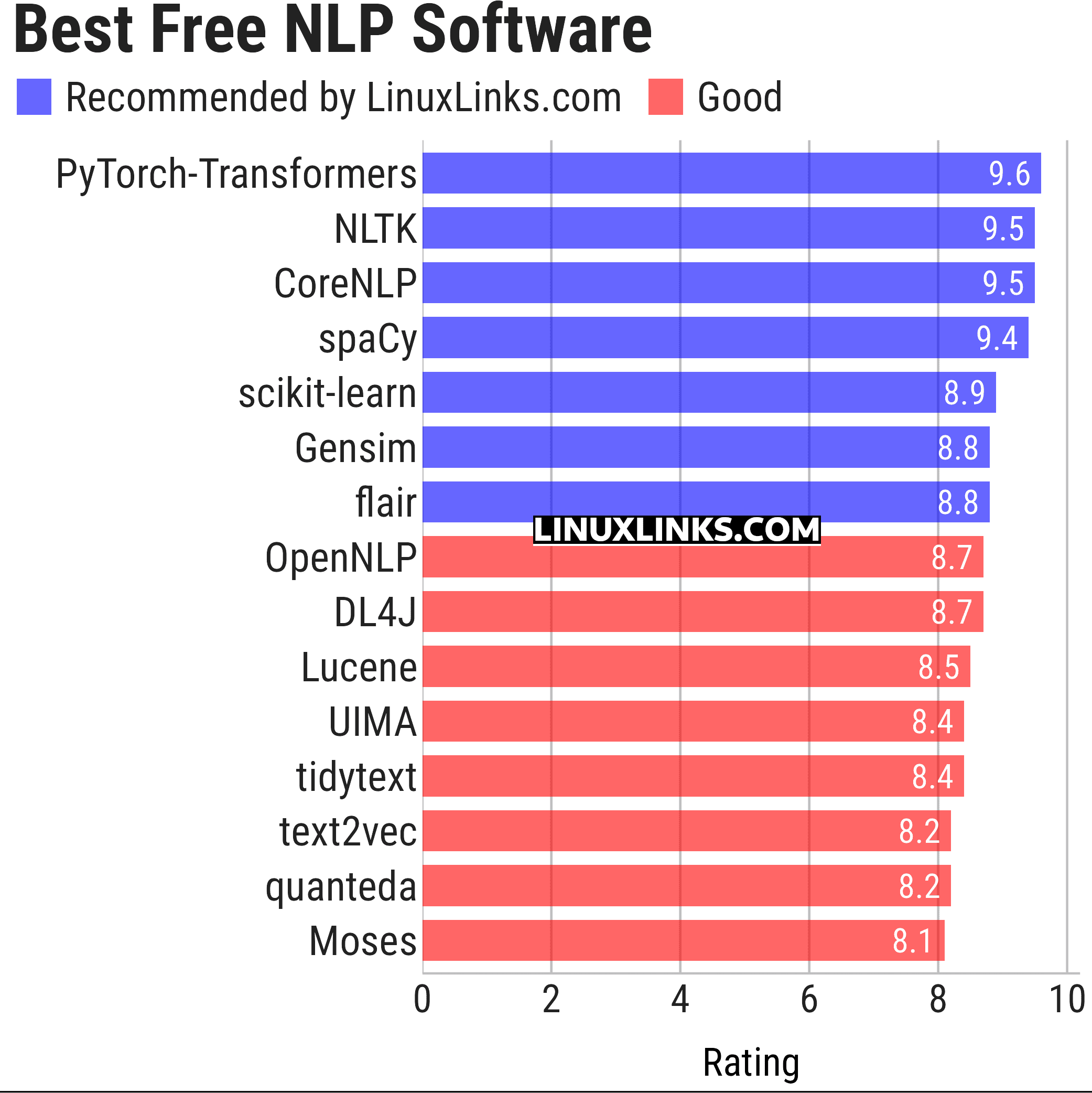
Click the links in the table below to learn all about each tool.
| Natural Language Processing | |
|---|---|
| PyTorch-Transformers | Library of state-of-the-art pre-trained models |
| Natural Language Toolkit | Suite of open source Python modules, data sets and tutorials |
| Stanford CoreNLP | Extensible annotation-based NLP pipeline |
| spaCy | Industrial strength natural language processing |
| scikit-learn | Machine learning library for Python |
| Gensim | Python-based vector space modeling and topic modeling toolkit |
| flair | Simple framework for state-of-the-art NLP |
| Apache OpenNLP | Machine learning based toolkit |
| DL4J | Deploy and train deep learning models |
| Apache Lucene | Full-featured information retrieval software library |
| UIMA | Implementation of the UIMA specification |
| tidytext | Text mining using dplyr, ggplot2, and other tidy tools |
| text2vec | Framework with API for text analysis and NLP |
| quanteda | R package for Quantitative Analysis of Textual Data |
| Moses | Statistical machine translation system |
This article has been updated to reflect the changes outlined in our recent announcement.
 LinuxLinks helps you discover the best free and open source software for Linux. Explore our extensive collection of recommended applications, including alternatives to popular proprietary software. We also publish software reviews, Linux tutorials, hardware reviews, free programming books and articles covering the wider open source community. Browse our Linux resources to discover more. Know a useful free and open source Linux application we haven't covered? Suggest a program for inclusion. Has your software been featured on LinuxLinks? Display one of our Featured on LinuxLinks badges on your website or GitHub README. |
Please read our Comment Policy before commenting.
Hi, where is weka?
It features in our Data Mining Group Test
https://www.linuxlinks.com/DataMining/
I have read some excellent stuff here. Definitely value bookmarking for revisiting. I wonder how much effort you put to make the sort of excellent informative website.