

A Type 1 hypervisor is known as native or bare-metal. With this type, the hypervisor runs directly on the host’s hardware to control the hardware resources and to manage guest operating systems. In other words, the software hypervisor does not require an additional underlying operating system.
A Type 2 hypervisor, or hosted hypervisor, interacts with the underlying host machine hardware through the host machine’s operating system. You install it on the machine, where it runs as an application. The Type 2 hypervisor negotiates with the operating system to obtain underlying system resources. The hypervisor lets the host hardware operate multiple virtual machines independent of each other and share abstracted resources among those virtual machines.
This roundup focuses on Type 2 hypervisors. We also include GUI frontends and wrappers to view, access, and manage remote and virtual systems.
QEMU is included because it’s primarily a Type 2 hypervisor. It runs on top of a host operating system and provides virtualization capabilities for various guest operating systems and architectures.
Here’s our verdict captured in a legendary LinuxLinks-style ratings chart. Only free and open source software is eligible for inclusion.
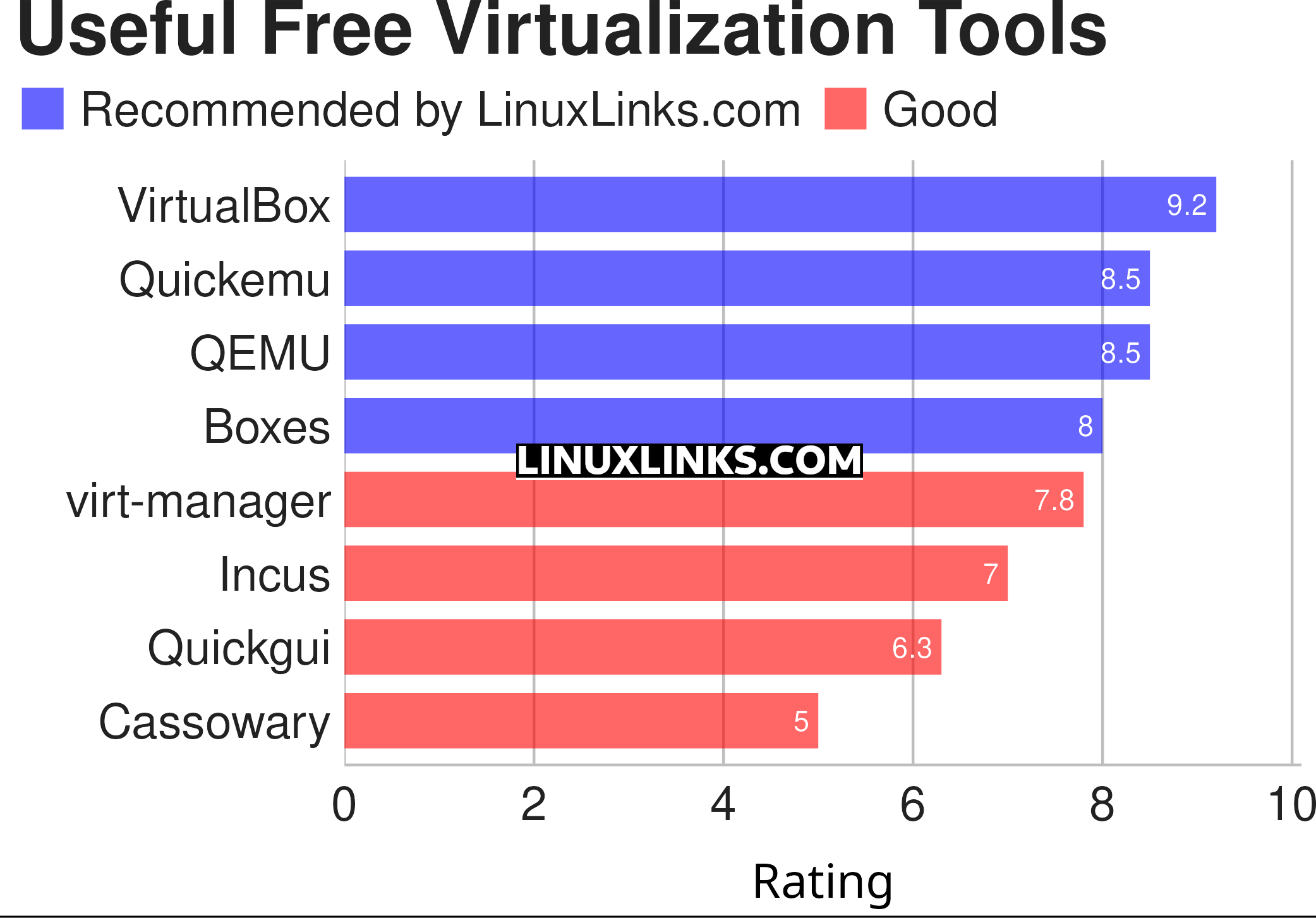
Let’s examine the programs in more detail.
| Virtualization Tools | |
|---|---|
| VirtualBox | Powerful x86 and AMD64/Intel64 virtualization software |
| Quickemu | Wrapper for QEMU that automatically “does the right thing” |
| QEMU | Machine emulator and virtualizer |
| Boxes | View, access, and manage remote and virtual systems |
| virt-manager | Desktop tool for managing virtual machines via libvirt |
| Incus | Modern, secure and powerful system container and virtual machine manager |
| Quickgui | Gaphical user interface for the Quickemu virtual machine manager. |
| Cassowary | Run Windows virtual machine on Linux |
We explore Type 1 hypervisors in this separate roundup.
 Explore our comprehensive directory of recommended free and open source software. Our carefully curated collection spans every major software category. Explore our comprehensive directory of recommended free and open source software. Our carefully curated collection spans every major software category.This directory is part of our ongoing series of informative articles for Linux enthusiasts. It features hundreds of detailed reviews, along with open source alternatives to proprietary solutions from major corporations such as Google, Microsoft, Apple, Adobe, IBM, Cisco, Oracle, and Autodesk. You’ll also find interesting projects to try, hardware coverage, free programming books and tutorials, and much more. Know a useful open source Linux program that we haven’t covered yet? Let us know by completing this form. |