

ToaruOS is a from-scratch Unix-like operating system that provides a representative desktop OS environment for learning and experimentation.
It targets x86-64 PCs and ARMv8 VM environments, and includes its own kernel, bootloader, C standard library, dynamic linker, graphical environment, applications, and supporting tools rather than using the Linux kernel.
This is free and open source software.
Key Features
- Includes Misaka, a hybrid modular kernel forming the core of the operating system.
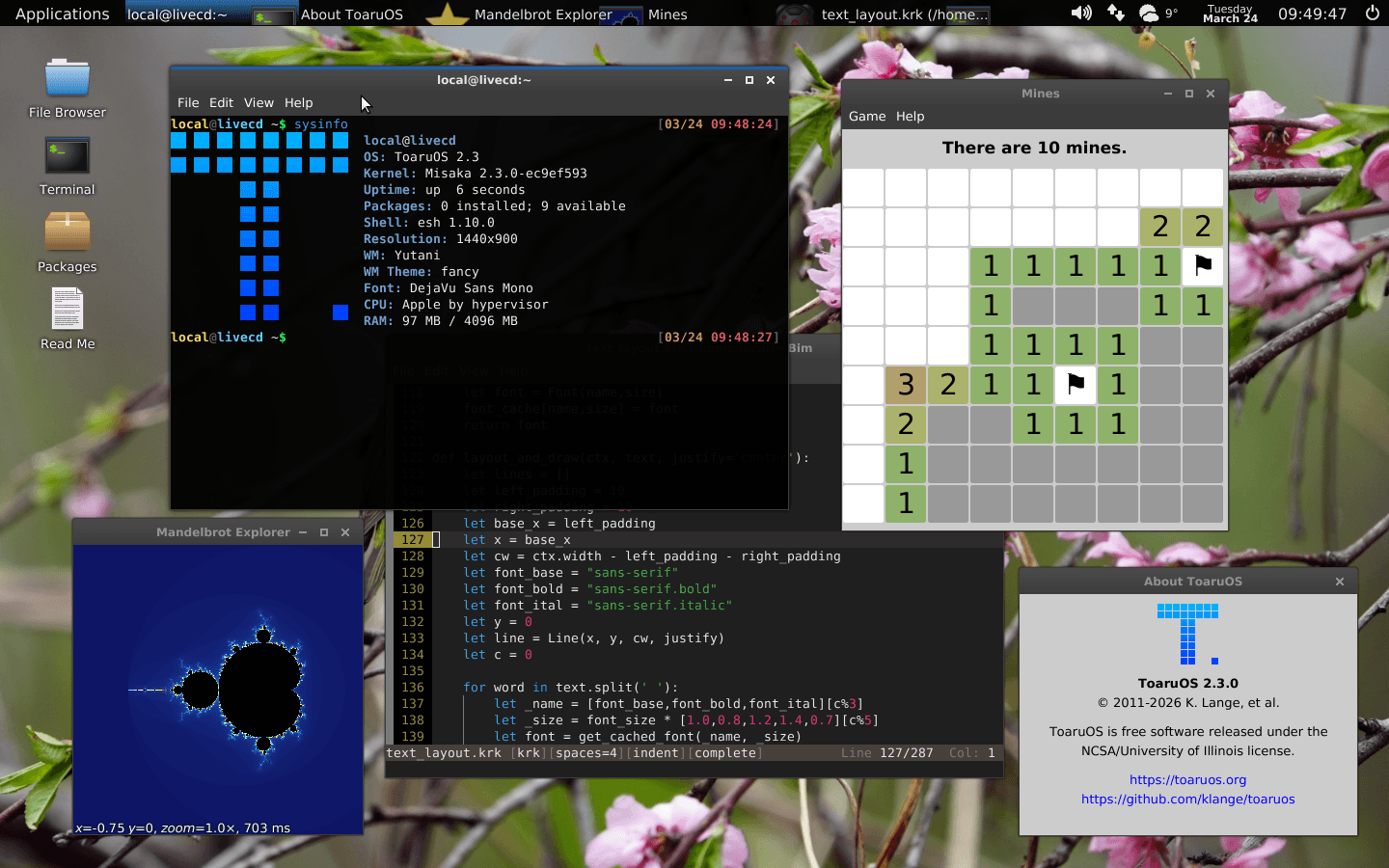
- Provides a composited graphical user interface with its own window compositor.
- Ships with a dynamically linked userspace, shared libraries, and dlopen support.
- Includes a Unix-like terminal environment with a terminal emulator, shell, and familiar utilities.
- Bundles Bim, a Vim-inspired text editor with syntax highlighting.
- Includes Kuroko, a dynamic bytecode-compiled programming language.
- Offers VM integration features for VirtualBox and VMware Workstation, including absolute mouse support and automatic display sizing.
- Can be run in QEMU, VirtualBox, VMware Workstation, and on some real hardware.
| Working state: | Active |
| Desktop: | Yutani |
| Init Software: | ToaruOS init |
| Package Management: | msk |
| Release Model: | Fixed |
| Platforms: | x86-64, AArch64 |
| Home Page: | toaruos.org |
| Developer: | K. Lange |
| This article is part of our Big List of Active Linux Distributions and Open Source Operating Systems. |
What's a Linux distribution ("distro")? |
| A distro provides the user with a desktop environment, preloaded applications, and ways to update and maintain the system. Each distro makes different choices, deciding which open source projects to install and provides custom written programs. They can have different philosophies. Some distros are intended for desktop computers, some for servers without a graphical interface, and others for special uses. Because Linux is an open source operating system, combinations of software vary between Linux distros. |
Please read our Comment Policy before commenting.