

pawk is a command-line text processing utility that brings Python expressions and statements to AWK-style workflows.
It reads from standard input and lets you filter, transform, and summarize line-oriented data using Python syntax, making it useful for shell pipelines, ad hoc analysis, and quick text manipulation tasks where Python’s data structures and modules are more expressive than traditional AWK.
This is free and open source software.
Key Features
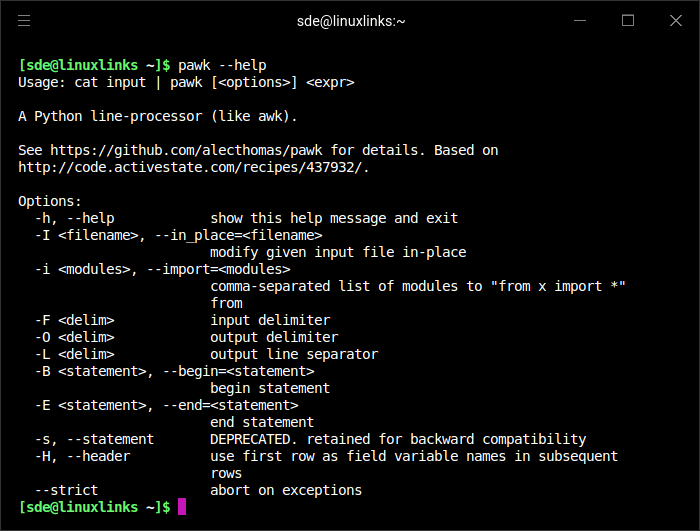
- Processes input line by line using Python expressions or statements.
- Supports AWK-like pattern matching and field-based text processing.
- Provides begin and end blocks for initialization and final output.
- Can use the first row as named header fields for subsequent rows.
- Automatically imports referenced Python modules, with optional explicit imports.
- Supports whole-file processing through end-block access to accumulated input.
- Offers configurable input, output, and line delimiters.
- Includes an option to modify files in place.
- Requires Python 3.7 or later.
Website: github.com/alecthomas/pawk
Support:
Developer: Alec Thomas
License: MIT License
pawk is written in Python. Learn Python with our recommended free books and free tutorials.
Related Software
| Alternatives to awk | |
|---|---|
| gawk | Implementation of the awk programming language |
| GoAWK | POSIX-compliant awk interpreter written in Go |
| Miller | Small and powerful CLI tool to do all your data processing |
| frawk | Small programming language for writing short programs processing textual data |
| choose | Human-friendly and fast alternative to cut and (sometimes) awk |
| gema | General purpose text processing utility based on the concept of pattern matching |
| mawk | Interpreter for the awk programming language |
| ruplacer | Find and replace text in source files |
 Explore our comprehensive directory of recommended free and open source software. Our carefully curated collection spans every major software category. Explore our comprehensive directory of recommended free and open source software. Our carefully curated collection spans every major software category.This directory is part of our ongoing series of informative articles for Linux enthusiasts. It features hundreds of detailed reviews, along with open source alternatives to proprietary solutions from major corporations such as Google, Microsoft, Apple, Adobe, IBM, Cisco, Oracle, and Autodesk. You’ll also find interesting projects to try, hardware coverage, free programming books and tutorials, and much more. Discovered a useful open source Linux program that we haven’t covered yet? Let us know by completing this form. |