

Last Updated on January 26, 2024
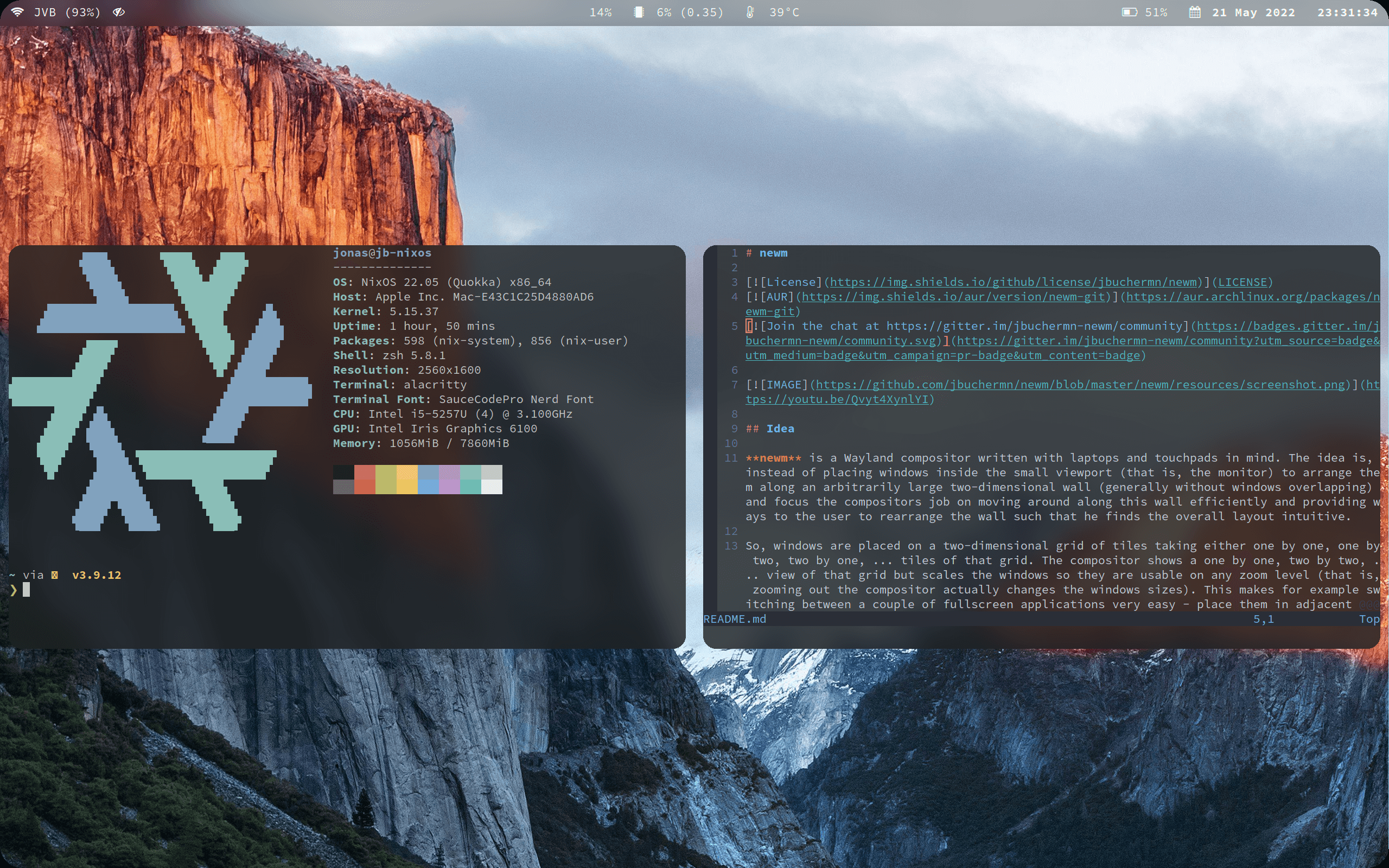
newm is a Wayland compositor written with laptops and touchpads in mind.
The idea is, instead of placing windows inside the small viewport (that is, the monitor) to arrange them along an arbitrarily large two-dimensional wall (generally without windows overlapping) and focus the compositors job on moving around along this wall efficiently and providing ways to the user to rearrange the wall such that they find the overall layout intuitive.
This is free and open source software. It is not currently maintained.
Website: github.com/jbuchermn/newm
Support:
Developer: Iliya Bozhinov
License: MIT License
newm is written in Python. Learn Python with our recommended free books and free tutorials.
Related Software
| Tiling Wayland Compositors | |
|---|---|
| Sway | i3-compatible tiling Wayland compositor and a replacement for i3 |
| niri | Scrollable-tiling Wayland compositor |
| Hyprland | Dynamic tiling Wayland compositor based on wlroots |
| Qtile | Full-featured, hackable tiling window manager |
| Swayfx | Sway with eye candy |
| river | Compositor with flexible runtime configuration. |
| MangoWC | Lightweight yet a good set of features |
| dwl | dwm for Wayland |
| fht-compositor | Dynamic tiling Wayland compositor |
| IonWL | Manual window management software focused on precise placement |
| scroll | i3-compatible window management software with scrolling workspaces |
| newm-atha | Wayland compositor written with laptops and touchpads in mind |
| Pinnacle | Scriptable window management software built for custom workflows |
| miracle-wm | Hackable desktop environment with flexible layouts and smooth control |
| Cagebreak | Seeks inspiration from Ratpoison |
| CwC | Extensible window management software offering deep customisation |
| Mahogany | Modeled after StumpWM |
| Jay | Wayland compositor written in Rust |
| Vivarium | Dynamic tiling Wayland compositor using wlroots |
| polonium | Tiling window manager for KWin |
| Volare | Tabbed, tiling Wayland compositor |
| japokwm | wlroots and dwl based tiling wayland compositor |
| doors | Lightweight window management software with a clean, focused design |
| velox | Simple window manager based on swc |
| stagen | wlroots-based Wayland compositor |
| newm | Written with laptops and touchpads in mind |
Read our verdict in the software roundup.
 Explore our carefully curated directory of recommended free and open source software, covering every major software category. Explore our carefully curated directory of recommended free and open source software, covering every major software category.The directory forms part of our extensive collection of articles for Linux enthusiasts. It includes hundreds of detailed reviews, together with free and open source alternatives to proprietary software from companies such as Google, Microsoft, Apple, Adobe, IBM, Cisco, Oracle, and Autodesk. LinuxLinks also covers interesting projects worth exploring, Linux-compatible hardware, free programming books and tutorials, and much more. Know a useful free and open source Linux application that we haven’t covered? Tell us about it using our submission form. |
Please read our Comment Policy before commenting.