

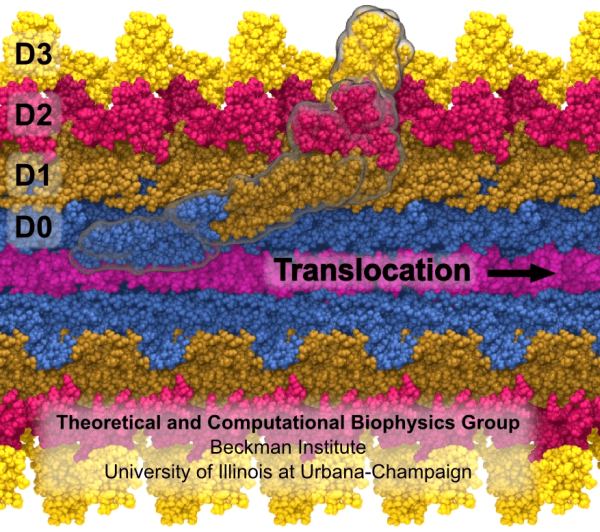
NAMD is a parallel, object-oriented molecular dynamics code designed for high-performance simulation of large biomolecular systems.
NAMD is written using the Charm++ parallel programming model, noted for its parallel efficiency and often used to simulate large systems (millions of atoms). NAMD is implemented using the Converse runtime system.
Converse provides machine-independent interface to all popular parallel computers as well as workstation clusters.
Key Features
- VMD used to prepare molecular structure for simulation.
- Also reads X-PLOR, CHARMM, AMBER, and GROMACS input files.
- Psfgen tool generates structure and coordinate files for CHARMM force field.
- Efficient conjugate gradient minimization.
- Fixed atoms and harmonic restraints.
- Thermal equilibration via periodic rescaling, reinitialization, or Langevin dynamics.
- Force Field Compatibility.
- Efficient Full Electrostatics Algorithms.
- Multiple Time Stepping.
- Input and Output Compatibility.
- Dynamics Simulation Options – MD simulations using options such as:
- Constant energy dynamics.
- Constant temperature dynamics via:
- Velocity rescaling.
- Velocity reassignment.
- Langevin dynamics.
- Periodic boundary conditions.
- Constant pressure dynamics via:
- Berendsen pressure coupling.
- Nosé-Hoover Langevin piston.
- Energy minimization.
- Fixed atoms.
- Rigid waters.
- Rigid bonds to hydrogen.
- Harmonic restraints.
- Spherical or cylindrical boundary restraints.
- Interactive molecular dynamics simulations.
- Accelerated molecular dynamics provides a robust biasing potential that increases the escape rates from potential wells, while still converging to the correct canonical distribution.
- Load balancing.
- Shared-Memory Multicore and SMP Builds.
- Replica-based umbrella sampling via collective variables module.
- Optimized shared-memory single-node and multiple-node CUDA builds.
- CUDA GPU-accelerated generalized Born implicit solvent (GBIS) model.
- CUDA GPU-accelerated energy evaluation and minimization.
- Native CRAY XE/XK uGNI network layer implementation.
- Faster grid forces and lower-accuracy “lite” implementation.
- Hybrid MD with knowledge-based Go forces to drive folding.
- Linear combination of pairwise overlaps (LCPO) SASA for GBIS model.
- Weeks-Chandler-Anderson decomposition for alchemical FEP simulations.
- Native replica-exchange implementation for CRAY XE/XK and BlueGene/Q.
Website: www.ks.uiuc.edu/Research/namd
Support:
Developer: Theoretical and Computational Biophysics Group (TCB) and the Parallel Programming Laboratory (PPL)
License: Non-Exclusive, Non-Commercial Use License
NAMD is written in C++. Learn C++ with our recommended free books and free tutorials.
Related Software
| Biology Tools | |
|---|---|
| EMBOSS | The European Molecular Biology Open Software Suite |
| NAMD | Parallel, object-oriented molecular dynamics |
| GROMACS | Molecular dynamics simulator, with building and analysis tools |
| VMD | Displays, animates, and analyzes large biomolecular systems 3-D graphics |
| simuPOP | Forward-time population genetics simulation environment |
| MUSCLE | MUltiple Sequence Comparison by Log-Expectation |
| SeaView | Graphical user interface for molecular phyologeny |
| SeqViz | DNA, RNA, and protein sequence viewer |
| TREE-PUZZLE | Reconstruction of phylogenetic trees by maximum likelihood |
| TreeView X | Displays and prints phylogenetic trees |
| CellProfiler | Image analysis application for researchers |
| napari | Python-based image viewer |
| COPASI | Biochemical systems simulator |
| VCell | Modeling and simulation framework |
| NEURON | Build and run biophysically detailed models |
| NEST | Simulator for spiking neural network models |
Read our verdict in the software roundup.
 Explore our comprehensive directory of recommended free and open source software. Our carefully curated collection spans every major software category. Explore our comprehensive directory of recommended free and open source software. Our carefully curated collection spans every major software category.This directory is part of our ongoing series of informative articles for Linux enthusiasts. It features hundreds of detailed reviews, along with open source alternatives to proprietary solutions from major corporations such as Google, Microsoft, Apple, Adobe, IBM, Cisco, Oracle, and Autodesk. You’ll also find interesting projects to try, hardware coverage, free programming books and tutorials, and much more. Discovered a useful open source Linux program that we haven’t covered yet? Let us know by completing this form. |
Please read our Comment Policy before commenting.