

m23 is a software distribution and management system for Debian, Ubuntu and Kubuntu. It can install hundreds of clients over an existing network infrastructure. It can manage (format, install, remove and update) software packages.
m23 is controlled via the web browser. The installation of a new m23 client is performed in three simple steps and the integration of existing clients is possible, too. Group functions and mass tools make managing a vast number of clients simple.
m23 is composed of a large number of open source components such as Etherboot, Apache, PHP, BusyBox, MySQL, DHCP, ATFTP and many more.
Key Features
- Web-based administration.
- Three steps to your complete client.
- Integration of existing clients into m23: Existing Debian systems can be assimilated into the m23 system easily and administered like a normal client (installed with m23).
- Group functions: Convenient group functions if you have a large number of clients that need to install new software or if other routine jobs need to be done. For example, a new software package can be installed on all clients or be removed from all clients of a group. In addition, an update or client recovery can be accomplished on all group members.
- Mass installation: The mass installation tools are handy, if you need to install a big amount of clients with similar requirements.
- Free partitioning and formatting.
- Installation of Linux OS on any number of clients (Debian, Ubuntu, Kubuntu, Xubuntu, Linux Mint and Fedora).
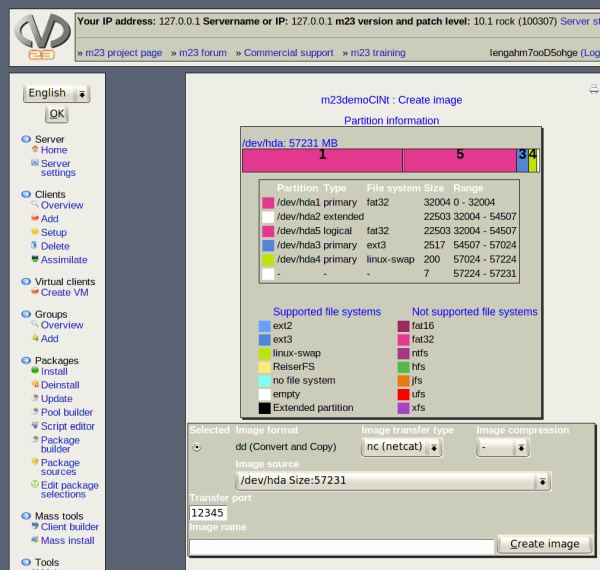
- Imaging: Installation using image files: An image file of a partition or entire harddisk can be used to install other clients. These image files are taken from installed clients with all their software packages and settings.
- Support for software RAIDs: Partitions or entire harddrives can be combined into software RAIDs. m23 supports the RAID levels 0, 1, 4, 5, 6 and 10. RAIDs can be used like normal partitions to install operating systems to or to use them as swap or storage space.
- NFS for storing home directories.
- User management with LDAP: User accounts can be stored on a central LDAP server. This increases the ease of use in environments with many clients and a lot of users. The OpenLDAP server is shipped with the m23 server and can be administrated via the highly integrated phpLDAPadmin.
- Pool builder: The pool builder makes it possible to combine software packages from different media (CD, DVD, internet) on the m23 server and convert them to a package source. These package sources can be used to install clients. This can be done without an internet connection or if the internet connection is rather slow. It is also possible to add self-made packages to the pool.
- VirtualBox included, virtual clients can be installed on m23 server and/or clients.
- HalfSister extension makes it easy to add new Linux distributions to the list of systems that can be managed.
- Client and server backup.
- Client recovery.
- Rescue system.
- Graphical desktops: KDE, Gnome, XFce or pure X11.
- Plugins.
Website: m23.sourceforge.io
Support: Manual
Developer: Hauke Goos-Habermann and contributors
License: GNU General Public License v2.0
Related Software
| Server Provisioning | |
|---|---|
| FAI | High quality tool for fully automatic installation of Linux systems |
| Foreman | Life cycle systems management tool |
| Cobbler | OS provisioning and profile management |
| m23 | Software distribution and management system |
| MAAS | Data centre automation platform |
| Confluent | Handle essential bootstrap and operation of scale-out server configurations |
| xCAT | Extreme Cluster Administration Toolkit |
| OpenQRM | Systems management platform |
| Uyuni | Configuration and infrastructure management solution |
| Warewulf | Stateless, network-boot cluster provisioning system |
| Tinkerbell | Bare metal provisioning engine |
| Ironic | OpenStack service for managing and provisioning bare metal servers |
Read our verdict in the software roundup.
 Explore our comprehensive directory of recommended free and open source software. Our carefully curated collection spans every major software category. Explore our comprehensive directory of recommended free and open source software. Our carefully curated collection spans every major software category.This directory is part of our ongoing series of informative articles for Linux enthusiasts. It features hundreds of detailed reviews, along with open source alternatives to proprietary solutions from major corporations such as Google, Microsoft, Apple, Adobe, IBM, Cisco, Oracle, and Autodesk. You’ll also find interesting projects to try, hardware coverage, free programming books and tutorials, and much more. Discovered a useful open source Linux program that we haven’t covered yet? Let us know by completing this form. |
Please read our Comment Policy before commenting.