

Email is arguably one of the most popular and useful functions of a Linux system. Fortunately, there is a wide selection of free email software available on the Linux platform which is stable, feature laden, and ideal for personal and business environments.
A mail notification tool lets you know when new emails are received. A prominent feature of these tools is the non-obtrusive passive notification about important emails which will let you concentrate on your work and avoid unnecessary interruptions.
When all you want to do is be notified when you have a new e-mail message the last thing you want is software chugging along in the background using up valuable system memory. Fortunately, the programs are lightweight in nature.
We make the following recommendations captured in a legendary LinuxLinks-style chart. All of the programs are free and open source goodness.
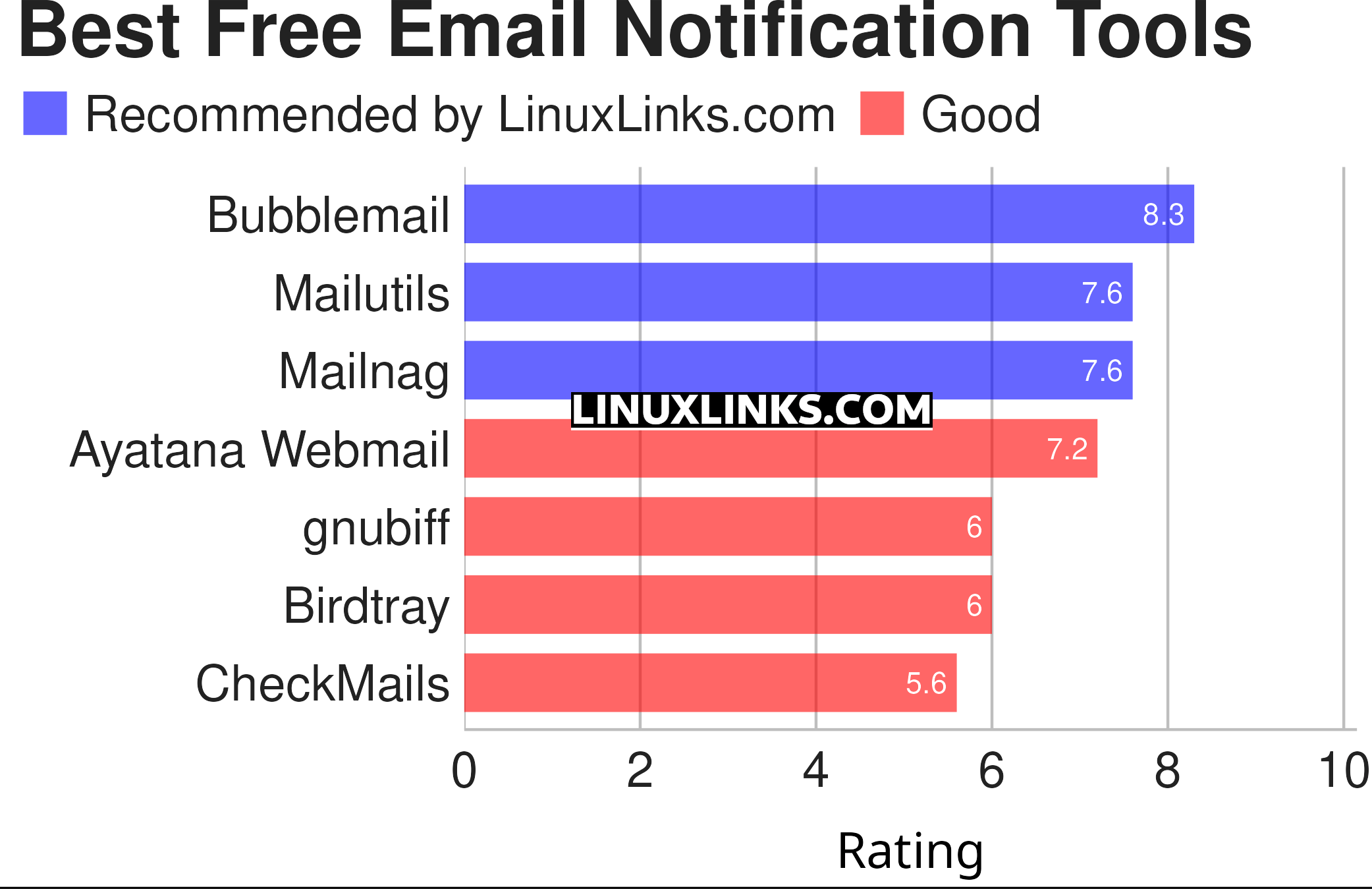
Hopefully, there will be something of interest for anyone that doesn’t want to miss an important email.
Even if you happy using your mobile phone to receive mail notifications, it’s handy to have notifications go to your desktop too.
Let’s explore the 7 mail notification tools at hand. Click the links in the table below to learn about each tool.
| Mail Notification | |
|---|---|
| Bubblemail | Extensible mail notification service. Fork of Mailnag |
| Mailutils | Swiss army knife of electronic mail handling |
| Mailnag | Extensible mail notification daemon |
| Ayatana Webmail | Webmail notifications and actions for any desktop. Quicklist support |
| gnubiff | Mail notification program |
| Birdtray | System tray new mail notification for Thunderbird |
| CheckMails | System tray unread mail checker using the IMAP protocol |
This article has been revamped in line with our recent announcement.
 Explore our comprehensive directory of recommended free and open source software. Our carefully curated collection spans every major software category. Explore our comprehensive directory of recommended free and open source software. Our carefully curated collection spans every major software category.This directory is part of our ongoing series of informative articles for Linux enthusiasts. It features hundreds of detailed reviews, along with open source alternatives to proprietary solutions from major corporations such as Google, Microsoft, Apple, Adobe, IBM, Cisco, Oracle, and Autodesk. You’ll also find interesting projects to try, hardware coverage, free programming books and tutorials, and much more. Know a useful open source Linux program that we haven’t covered yet? Let us know by completing this form. |