

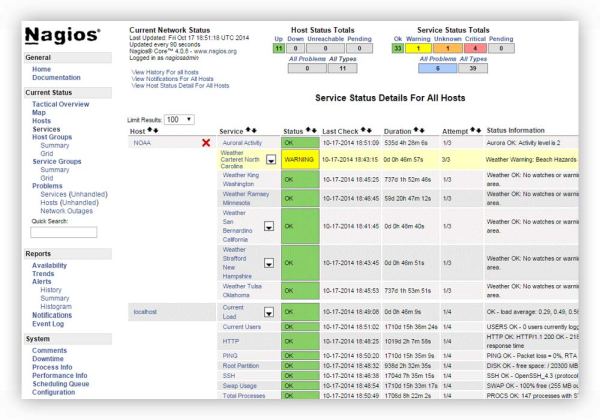
Nagios is a host and service monitor designed to inform you of network problems.
The monitoring daemon runs periodic checks on hosts and services specified using external “plugins” which return status information to Nagios. When problems are encountered, the daemon can send notifications out to administrative contacts in a variety of different ways (email, instant message, SMS, etc.). Current status information, historical logs, and reports can all be accessed via a web browser.
Although Nagios is powerful and flexible, it does require some time for it to be installed and configured correctly.
Key Features
- Monitoring of network services (SMTP, POP3, HTTP, NNTP, PING, etc).
- Monitoring of host resources (processor load, disk and memory usage, running processes, log files, etc).
- Monitoring of environmental factors such as temperature.
- Simple plugin design that allows users to easily develop their own host and service checks.
- Ability to define network host hierarchy, allowing detection of and distinction between hosts that are down and those that are unreachable.
- Contact notifications when service or host problems occur and get resolved (via email, pager, or other user-defined method).
- Optional escalation of host and service notifications to different contact groups.
- Ability to define event handlers to be run during service or host events for proactive problem resolution.
- Support for implementing redundant and distributed monitoring servers.
- External command interface that allows on-the-fly modifications to be made to the monitoring and notification behavior through the use of event handlers, the web interface, and third-party applications.
- Retention of host and service status across program restarts.
- Scheduled downtime for suppressing host and service notifications during periods of planned outages.
- Ability to acknowledge problems via the web interface.
- Web interface for viewing current network status, notification and problem history, log file, etc.
- Simple authorization scheme that allows you restrict what users can see and do from the web interface.
- Automatic log file rotation/archiving.
Website: www.nagios.org
Support: Nagios Exchange
Developer: Ethan Galstad
License: GNU General Public License v2.0
Nagios is written in C. Learn C with our recommended free books and free tutorials.
Related Software
| System Monitoring Tools | |
|---|---|
| Prometheus | Systems and service monitoring system |
| Nagios | Host and service monitor designed to inform you of network problems |
| OpenNMS | Enterprise grade network monitoring platform |
| LibreNMS | Fully featured network monitoring system |
| SigNoz | Monitor your applications and troubleshoot problems |
| ZABBIX | All-in-one 24x7 free monitoring solution |
| Jaeger | Distributed tracing system |
| Beszel | Lightweight server monitoring platform |
| Loki | Horizontally-scalable, highly-available, multi-tenant log aggregation system |
| Cockpit | Sysadmin login session in a web browser |
| Coroot | Observability platform for monitoring cloud-native apps |
| Monit | Utility for monitoring processes, files, directories and filesystems |
| HyperDX | Cloud-based production monitoring and debugging tool |
| NetXMS | Network and infrastructure monitoring and management system |
| FreeNATS | Automatic network status testing, alerting and reporting package |
| Cacti | Web-based frontend to RRDtool |
| Monitorix | Lightweight system monitoring tool |
| Icinga | Monitoring platform with a powerful configuration language |
| Checkmk | IT monitoring platform |
| Munin | Networked resource monitoring tool designed to be plug and play |
| Shinken | Flexible and scalable monitoring framework |
| openITCOCKPIT | Comprehensive infrastructure monitoring and management platform |
| Pandora FMS | Flexible monitoring system |
| Xymon | System for monitoring of hosts and networks |
| Mon | General-purpose problem alerting system |
Read our verdict in the software roundup.
 Explore our carefully curated directory of recommended free and open source software, covering every major software category. Explore our carefully curated directory of recommended free and open source software, covering every major software category.The directory forms part of our extensive collection of articles for Linux enthusiasts. It includes hundreds of detailed reviews, together with free and open source alternatives to proprietary software from companies such as Google, Microsoft, Apple, Adobe, IBM, Cisco, Oracle, and Autodesk. LinuxLinks also covers interesting projects worth exploring, Linux-compatible hardware, free programming books and tutorials, and much more. Know a useful free and open source Linux application that we haven’t covered? Tell us about it using our submission form. |
Please read our Comment Policy before commenting.