

Magic is an open source, interactive, very-large-scale integration (VLSI) layout tool, written in the 1980’s at Berkeley by John Ousterhout, the creator of the popular scripting interpreter language Tcl. VLSI design and simulation is the process of capturing circuits on a computer workstation with the intention of having them placed into an Integrated Circuit (IC).
Magic is a popular application with some universities and smaller companies. The open source license has allowed VLSI engineers to implement clever ideas and help magic stay abreast of fabrication technology. However, it is the well thought-out core algorithms which lend to magic the greatest part of its popularity.
Magic is widely cited as being the easiest tool to use for circuit layout, even for people who ultimately rely on commercial tools for their product design flow. It contains knowledge about geometrical design rules, transistors, connectivity, and routing.
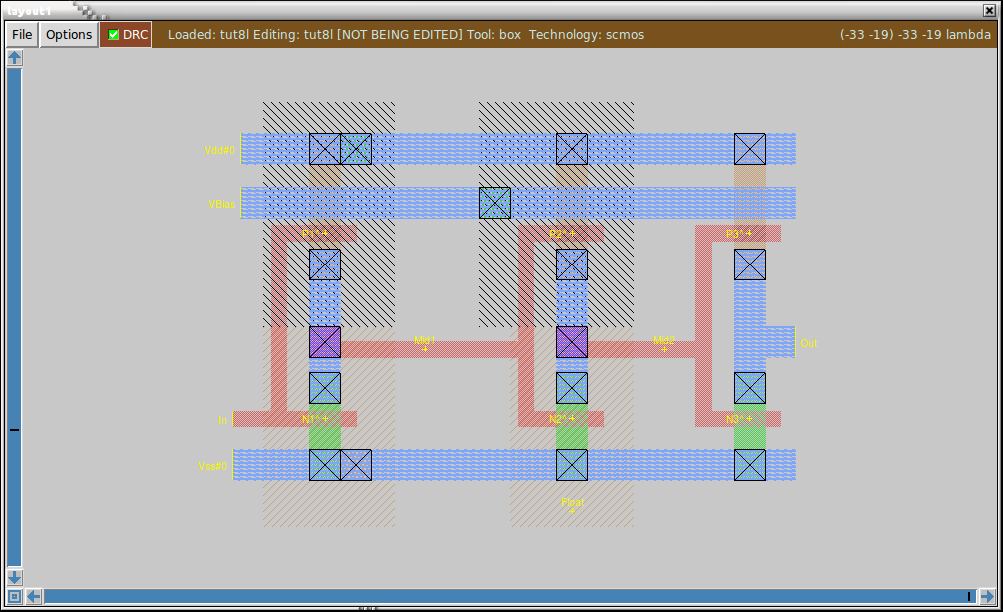
Magic uses two windows: one for text and a separate window for displaying layouts.
Key Features
- Uses simplified design rules and circuit structures.
- “Corner-stitched” geometry, in which all layout is represented as a stack of planes, and each plane consists entirely of “tiles” (rectangles). This provides an efficient implementation of these operations.
- Split tile which allows true representation of non-Manhattan geometry.
- Real-time design rule checking to maintain an up-to-date picture of violations.
- Plowing – permits interactive stretching and compaction.
- Routing tools.
- Cell manager.
- Tech manager.
- Read: CIF, GDS.
- Write: CIF, GDS.
Website: opencircuitdesign.com/magic
Support: Documentation, User Guide
Developer: Gordon Hamachi, Robert Mayo, John Ousterhout, Walter Scott, George Taylor (original authors)
License: BSD license
Magic is written in C. Learn C with our recommended free books and free tutorials.
Related Software
| Electronic Design Automation | |
|---|---|
| gEDA | Full suite and toolkit of Electronic Design Automation tools |
| Qucs-S | Graphical interface for SPICE circuit simulation engines |
| Digital | Digital logic designer and circuit simulator |
| LibrePCB | Software to develop printed circuit boards |
| Fritzing | Suited to the needs of designers and artists |
| Magic | VLSI layout editor, extraction, and DRC tool |
| KiCad | Software suite for the creation of electronic schematics |
| QElectroTech | Design electric diagrams |
| PyOPUS | Library for simulation-based optimization of arbitrary systems |
| KTechLab | IDE for electronic and PIC microcontroller circuit design and simulation |
| KLayout | GDS and OASIS file viewer and editor |
| DIYLC | Circuit layout and schematic drawing tool |
| Horizon EDA | Supports an integrated end-to-end workflow for printed circuit board design |
| xschem | Schematic editor for VLSI/Asic/Analog custom designs |
| Ringdove | EDA suite of multiple software components |
| Electric | The Electric VLSI Design System |
| FidoCadJ | Offers a large library of electronics and electronic engineering symbols |
| Lepton | Suite of software tools for designing electronics |
| Kactus2 | IP-XACT based SoC design and IP integration tool |
Read our verdict in the software roundup.
 Explore our carefully curated directory of recommended free and open source software, covering every major software category. Explore our carefully curated directory of recommended free and open source software, covering every major software category.The directory forms part of our extensive collection of articles for Linux enthusiasts. It includes hundreds of detailed reviews, together with free and open source alternatives to proprietary software from companies such as Google, Microsoft, Apple, Adobe, IBM, Cisco, Oracle, and Autodesk. LinuxLinks also covers interesting projects worth exploring, Linux-compatible hardware, free programming books and tutorials, and much more. Know a useful free and open source Linux application that we haven’t covered? Tell us about it using our submission form. |
Please read our Comment Policy before commenting.