

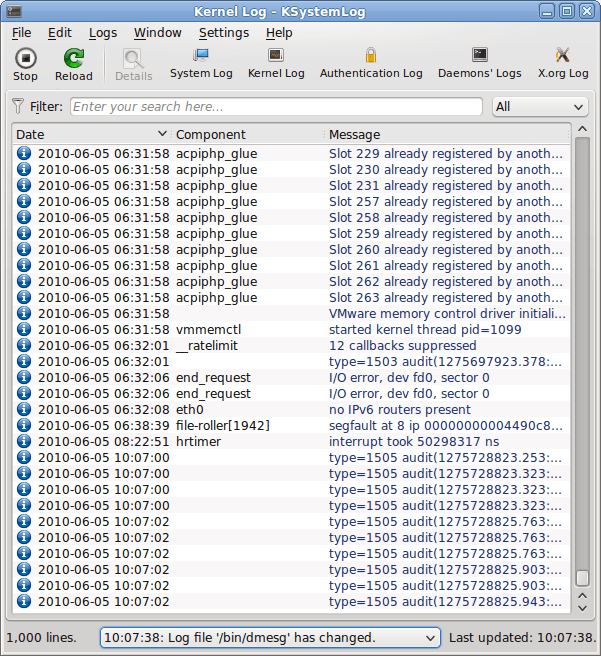
KSystemLog is a system log viewer tool for KDE.
KSystemLog helps users understand what their machine does in the background. This package aims to simplify the reading of system log files, and is developed for beginners who do not know how to find information about their system or where the log files are located in their computer. KSystemLog also provides features to easily sort and filter log lines.
However, the software is useful for advanced users who want to quickly see problems occurring on their server. KSystemLog tries to provide some advanced features to allow sorting and reading logs from specific programs.
This package is part of the KDE 4 administration module.
Key Features
- Show all logs of your system, grouped by General (Default system log, Authentication, Kernel, X.org…), and optional Services (Apache, Cups,…).
- Shows up to 30,000 entries.
- Colorize log lines depending on their severity.
- Tabbed view to display several logs at the same time.
- Auto-display of newly logged lines in bold.
- Fast parsing and reading (more than 10000 lines each 5 seconds).
- Detailed information for each log lines.
- Quick filter.
- Able to send a log message manually to the system.
- Save, copy to clipboard and printing.
- Adding a log entry manually.
- Support for multiple date formats.
- Parse the following log files:
- System logs.
- X.org logs.
- Kernel logs.
- Authentication logs.
- Acpid logs.
- Cups logs.
- Postfix logs.
- Apache logs.
- Samba logs.
- Daemons logs.
- Cron logs.
- XSessions logs.
Website: apps.kde.org/ksystemlog
Support:
Developer: Nicolas Ternisien
License: GNU General Public License v2.0
KSystemLog is written in C++. Learn C++ with our recommended free books and free tutorials.
Related Software
| LogFile Viewers | |
|---|---|
| lnav | Curses-based utility for viewing and analyzing log files. |
| tailspin | Terminal log file highlighter designed for inspecting log output in the shell |
| journalctl | Query and display messages from the journal |
| hl | Inspect structured logs from the terminal |
| Nerdlog | Remote-first terminal log viewer |
| lazyjournal | Inspect logs from multiple sources |
| KSystemLog | System log viewer for KDE |
| Logdy | Lightweight log viewer that works just like grep, awk, sed, or jq |
| humanlog | Reads logs from stdin and prints them back to stdout, but prettier. |
| toolong | View, tail, merge, and search log files |
| Xlogmaster | GTK+ based program to keep track of logfiles and devices |
| QJournalctl | Graphical User Interface for systemd’s journalctl |
| logrifle | Designed to "rifle through" large logfiles |
| Gnome-logs | View and search logs with this graphical utility |
| frontail | Stream logs to your web browser |
| nless | Pager for exploring structured and semi-structured data |
| glogg | Qt graphical log explorer |
| Chipmunk | Fast logfile viewer that can deal with huge logfiles (>10 GB) |
| SEE | Inspect logs from systemd services |
| MultiTail | View multiple logfiles windowed on the console |
| Logria | Log aggregation tool |
| logana | Work efficiently with very large log files, including multi-GB logs |
| QLogExplorer | Qt-based tool for exploring log files |
| Grafito | Simple, self-contained web-based log viewer for journalctl |
| swatch | Logfile viewer with regexp matching, highlighting & hooks |
| logmaster-gtk-d | Log viewer for Linux built with GTK and D |
| LogLens | Linux equivalent to Windows Event Viewer |
Read our verdict in the software roundup.
 Explore our comprehensive directory of recommended free and open source software. Our carefully curated collection spans every major software category. Explore our comprehensive directory of recommended free and open source software. Our carefully curated collection spans every major software category.This directory is part of our ongoing series of informative articles for Linux enthusiasts. It features hundreds of detailed reviews, along with open source alternatives to proprietary solutions from major corporations such as Google, Microsoft, Apple, Adobe, IBM, Cisco, Oracle, and Autodesk. You’ll also find interesting projects to try, hardware coverage, free programming books and tutorials, and much more. Discovered a useful open source Linux program that we haven’t covered yet? Let us know by completing this form. |
Please read our Comment Policy before commenting.