
A Text-based User Interface (TUI) provides a structured way to engage with a computer through text characters. Unlike a basic Command-Line Interface (CLI), a TUI utilizes the entire screen, incorporating menus, panels, and colors for better visual organization. While it still relies on keyboard input and text, it enhances the user experience by creating a more advanced terminal setting that connects the simplicity of commands with the richness of graphical interfaces (GUIs).
The software featured in this roundup helps developers create TUI programs. There is a diverse range of programs included, mostly best described as frameworks. All of the software is written in the Go language. Go is a versatile, high-level programming language that combines the benefits of being statically-typed and compiled. Its syntax is notably simple, which allows for efficient development. Additionally, Go comes with an extensive standard library that caters to many common project needs, making it a great choice for a wide range of applications.
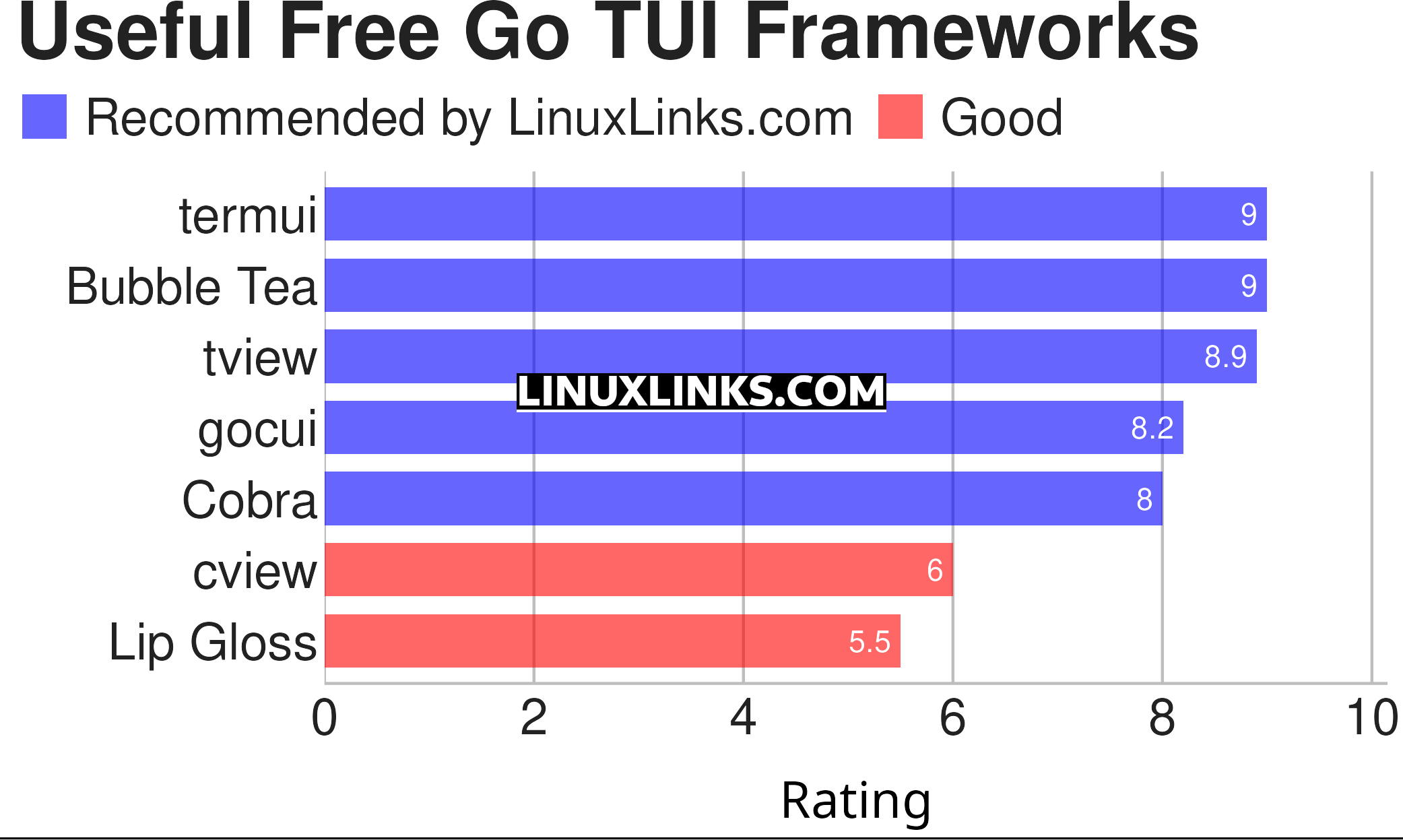
Here’s our verdict captured in a legendary LinuxLinks-style ratings chart. Only free and open source software is eligible for inclusion.
Click the links in the table below to learn more about each tool.
| Go TUI Frameworks | |
|---|---|
| termui | Golang terminal dashboard |
| Bubble Tea | Fun, functional and stateful way to build terminal apps |
| tview | Terminal UI library with rich, interactive widgets |
| gocui | Minimalist Go package aimed at creating Console User Interfaces. |
| Cobra | Library for creating powerful modern CLI applications |
| cview | Terminal-based user interface toolkit (fork of tview) |
| Lip Gloss | Style definitions for nice terminal layouts |
 Explore our comprehensive directory of recommended free and open source software. Our carefully curated collection spans every major software category. Explore our comprehensive directory of recommended free and open source software. Our carefully curated collection spans every major software category.This directory is part of our ongoing series of informative articles for Linux enthusiasts. It features hundreds of detailed reviews, along with open source alternatives to proprietary solutions from major corporations such as Google, Microsoft, Apple, Adobe, IBM, Cisco, Oracle, and Autodesk. You’ll also find interesting projects to try, hardware coverage, free programming books and tutorials, and much more. Know a useful open source Linux program that we haven’t covered yet? Let us know by completing this form. |